Thursday, March 31, 2011

Glass Buildings

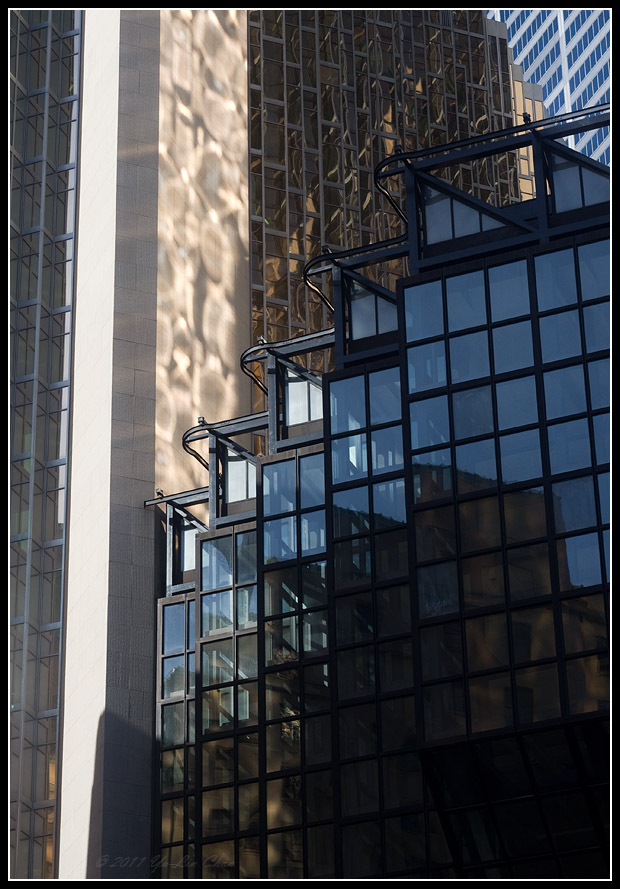
Glass Buildings -- NEX-5 & Carl Zeiss Jena Biotar 5.8cm f2.0

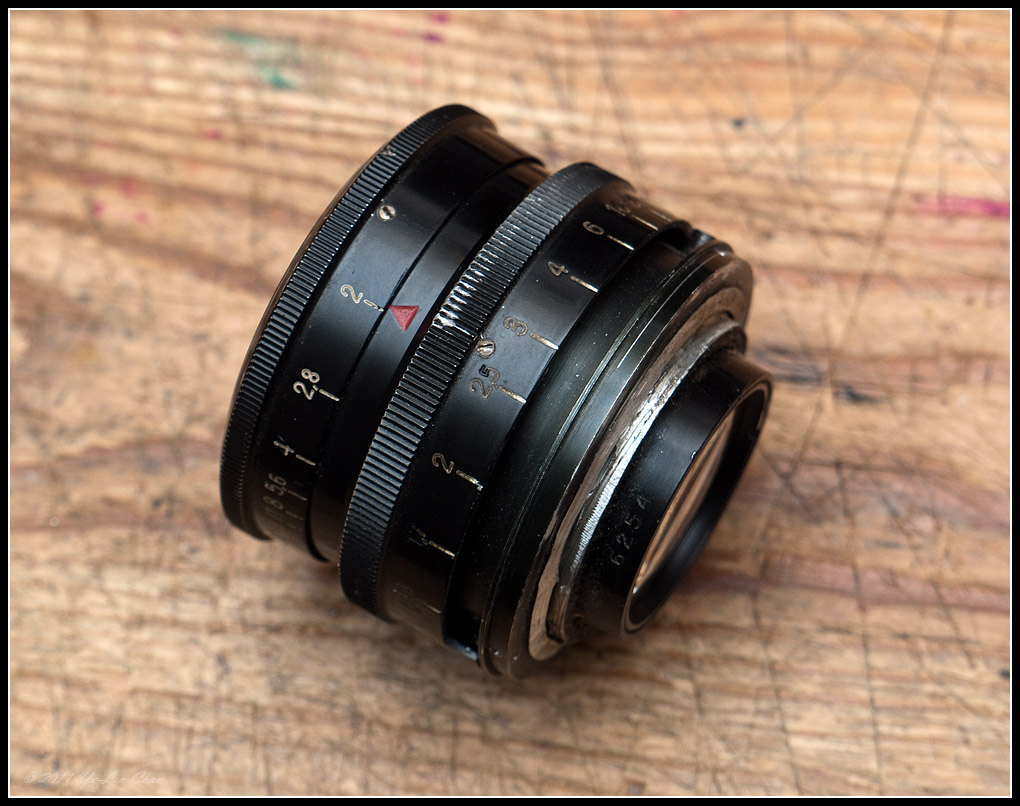
I have two working Biotars.  This particular one is small with a red T. Not really sure what it signifies, but it's significantly smaller than the other export version which simply says Aus Jena B 58mm f2.0.  I like the Aus Jena too.  Very sweet bokeh and both are very sharp when stopped down a little.  It just boggles my mind that these 30-40 year old lenses still performs so wonderfully today.

Wednesday, March 30, 2011

The Saga Continues

News flash -- Shop owners at the south east corner of Spadina & Dundas reported that a suspicious man was seen taking pictures outside of a gift shop, three days in a row around noon. They were quoted as saying this man used a weird looking picture taking device, oblivious to strange stares from passersby and took pictures of nicknacks from different angles.  The giftshop owner said that "this weird fellow used some kind of strange contraption to photograph my stuff.  That thing looks revolting!"  No arrest has been made, but shop owners are debating whether or not to call the authorities before something worse happens.

OK, jokes aside, I did another test today at the same place.  I was a little apprehensive going to the same place again, but you got to do what you got to do!  Today it's the Carl Zeiss Planar 50mm f1.4 QBM vs. EL-Nikkor 50mm f2.8.

Colour differences aside, it's tough to see much difference in sharpness, although the EL-Nikkor still wins wide open, against the Planar two stops down, in terms of absolute sharpness.  It's a very close call though.  Unless you look at them at 100%, you won't find differences in sharpness.  I do prefer the Planar's way of rendering the picture more.

EL-Nikkor 50mm f2.8 @ f2.8. Click to see larger.

Rollei QBM Carl Zeiss Planar 50mm f1.4 @ f2.8. Click to see larger.


Pixel Peeping at 100%.  click to see 100% crop.

Tuesday, March 29, 2011

Victim of Desperate Measures

Carl Zeiss Jena Biotar 58mm f2 on NEX

Few years ago, when EVIL cameras were still in the labs, I was having a hard time trying to get some of the lenses to be used on the Canon DSLRs.  Many of them were destroyed in the process, and some of the them were half dead, and this particular one, the Carl Zeiss Jena Biotar 5.8cm f2 had it's mounted cut away, in an attempt to mount it on the Canon and have infinity focus.  Needless to say, I never succeeded.  But, the NEX with the focus helicoid saves the day, again.

Butt gone -- Operation went bad

I went out at lunch time again today with the newly mounted Biotar, to the same place where I took the picture in my last blog entry, in an attempt to photograph the same thing.  It didn't turn out the way I wanted, although I did take some similar pictures.  The few I took at f2.8 did not have the focus point where it should, therefore can't really be compared.  Below is one taken at f2 wide open.  With a bit of sharpening, and resized, it's actually quite nice.  There is no surprise that the Biotar has a nicer bokeh.  This picture was taken closer than the EL-Nikkor.  The original lens' focusing ring, plus the focusing helicoid which makes the lens able to focus much closer than other 50mm lenses, but it does seem to have a smaller magnification ratio than the EL-Nikkor.

Double Happiness -- NEX-5 & Carl Zeiss Biotar 5.8cm f2 @ f2. Click to see larger.

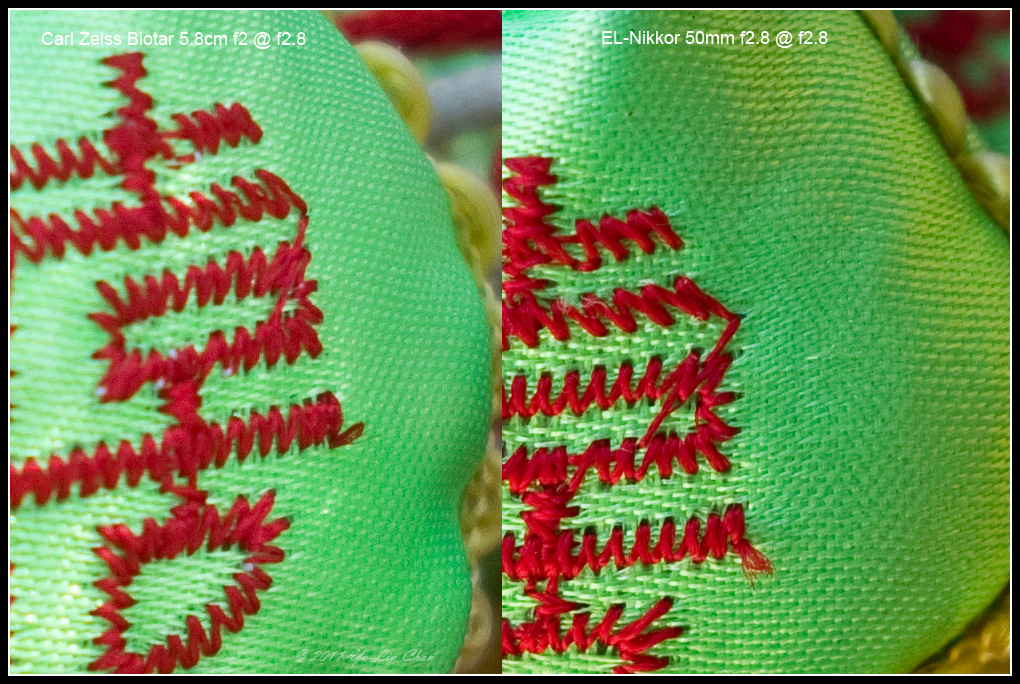
Finally, I took a 100% crop of a pictures taken at f2.8 from the Biotar, to the pictures taken yesterday by the EL-Nikkor, also at f2.8.  Note that these two pictures were taken at different dates, and under different conditions and both hand held.  So it's not scientific in anyway, but I think you can see the difference.  The Biotar is one stop down from maximum, while the EL-Nikkor is wide open.  I will put both lenses on tripod and try again later on.

Sharpness compared.  Click to see the original 100% crop.

 The slightly less sharp Biotar does not make it any less a lens, though.  Sharpness is not everything.  The EL-Nikkor is very contrasty, typical of Nikon lenses, just more so with this lens.  The two lenses produce pictures with very different emotions.  But, the Biotar can be very sharp from f4 on.

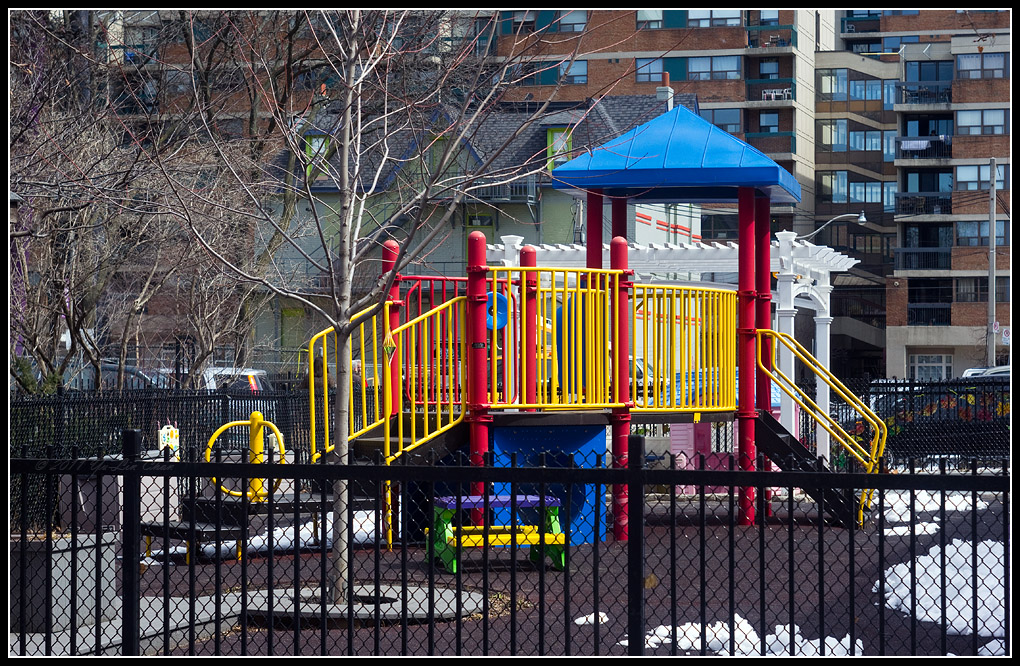
Playground -- NEX-5 & Biotar 5.8cm f2 @ f5.6 or f8. click to see larger.

Monday, March 28, 2011

EL-Nikkor Supremo 50mm f2.8 Enlarging Lens

EL-Nikkor 50mm f2.8 on focusing helicoid. Click to see larger.

Many people, including yours truly, have been trying to make this lens focus to infinity on DSLRs, but without much luck, until the NEX, of course.  After acquiring the focusing helicoid, I find so many uses for it.  All those lenses that could not be used before suddenly are given a new life!

I mounted the EL-Nikkor 50mm f2.8 enlarging lens on the 17-32mm helicoid, through a 52mm filter ring.  Works perfectly, and actually focuses past infinity.  In case you are not aware, the EL-50mm f2.8 is a very highly regarded lens.  Truly flat field with excellent sharpness from corner to corner.  The best feature, of course, is its very fast maximum aperture of f2.8.  Don't laugh, f2.8 is very bright for enlarging lenses.  Most of them have maximum apertures of f4 to f5.6 or even smaller.  You can actually use this lens as a normal 50mm lens, except it's sharper than most 50mm lenses, especially at close range.  If you have an NEX camera and like to tinker with enlarging lenses, grab one from eBay.  It's still El Cheapo in price, but what you get in return in optical quality is unequaled.

Double Happiness -- NEX-5 & EL-Nikkor 50mm f2.8 @ F2.8. Click to see larger.

Sunday, March 27, 2011

Last Camera Show at Thornhill Community Center

Today marked the last camera show at the Thornhill Community Center.  This show has been running for more than a decade.  For whatever reason, the community center no longer allows this show to continue, which really is too bad, as it's accessible and lots of parking spaces.

I picked up a few pieces of old stuff, as usual.  Struck a good deal for a Flectogon 35mm f2.8 in Exakta mount for $10.  I had this lens in M42 mount before and it's a good performer.  This lens has a quite a following.  One notable features of this lens is its extremely close focusing capability.  It can be used as a macro lens as it focuses as close as 0.18 meters, or 0.6 ft.  Lens is in excellent condition complete with original box.  I have a few lenses in Exakta mount, but don't have an adapter for the NEX.  The adapters I have for EOS are not very good. None of them allow the lenses to focus to infinity.

Another goodie I picked up is the Fuji 75mm f1.8 c-mount lens for a very good price of $30.  These days, anything that has a c-mount has become very expensive.  Very surprised to find that there is no vignetting on the NEX-5.  Even the corners are acceptable when stopped down to around f11.  Sharp as a knife, and beautifully built.  All metal barrel with large aperture and focusing rings, making it very easy to use.  Took a few shots with it, and already like it a lot. Only complain is its relatively long minimum focusing distance.

Other bits and pieces picked up at the show includes a Vivitar 24mm f2 in Canon FD mount.  Already has a Nikon mount of this lens, both are built by Komine (serial #22), as well as Kiron version in OM mount.  Only reason I bought it because it's cheap and in such great condition.  This reason is primarily responsible for so many lenses I have, and often with duplicates.  Buy them because I think they are cheap!  Other stuff I picked up are Takumar SMC 50mm f1.4, SMC-A 50mm f1.7 and an EL-Nikkor 50mm f2.8 enlarging lens -- all because they are cheap :)  Buying too much cheap stuff can really bankrupt you!

Bikes -- NEX-5 & Fuji 75mm f1.8 @ f2.8 or f4. Click to enlarge.

Saturday, March 26, 2011

Choosing a 50mm Manual Focus Lens

The sound gallery asked me if I were looking for my first 50mm manual focus lens, which one I would choose.  This seemingly easy question is actually tough to answer.

Back in the 70s and 80s, when an SRL was purchased, it invariably came with a 50mm lens.  Some will choose a 50mm f1.4, as an upgrade to the f1.7/1.8/1.9/2.0 lens that normally would come with the camera.  There is a good reason for this.  The 50mm lens has a field of view similar to that of the human eye vision.  It is much easier to compose and use than say, a 28mm wide angle, not to mention the usually fast aperture, which made it usable even in very dim lights.  In other words, the 50mm lens is a very versatile lens.  This hold true today.
But which 50mm lens would one get?  I don't think anyone can answer that question, because there are literally hundreds of different ones made by so many manufacturers, and they cost anywhere from five to thousands of dollars.  For NEX users, the choice is even broader, simply because you can mount more lenses on it than any other interchangeable lens cameras out there.  

Even though I can't recommend a specific 50mm lens, if this is the first time you are trying out a manual focus lens on digital camera, I would suggest starting with something cheap.  Cheap in price, but not in performance. This allows you to try it and see how you like focusing manually.  Really, manual focus lenses is not for everyone.

What manual focus lenses are still cheap in price?  My favourites are Canon FD and Minolta SR/MD mount lenses.  Often the Canon FD 50mm f1.8 can be had for around $10.  I tried a New FD version and it was optically excellent.  Optically equivalent to the EF 50mm f1.8 II, if not better.  The other good choice is the Minolta Rokkor 50mm f1.7.  This lens is often overlooked but optically it compares well with the modern equivalent.  Other low price but good chooses are lenses from Konica KR, Olympus OM, and of course the supremely well made Pentax Takumars. If you don't like stuff made in the east, there are low priced Pentacons, Meyer-Optiks, Carl Zeiss you can also try, mostly in M42 mount.

The danger here is that once you tried manual focus lenses, you may get hooked and even addicted.  Yours truly is a deeply addicted 50mm ( specifically 40-60mm) lens user.  No amount of auto focus lenses treatments has any effect on the condition.  Even extreme treatments with the L formulation did not help much.  Below is a snapshot of the a collection taken two years ago.

Fabulous Fifties. Click to see larger.

Thursday, March 24, 2011

Chinatown -- NEX-5 & Rollei Planar 50mm f1.8. Click to see larger.

Just when I thought winter was done and over, we had a mini snow storm yesterday.  Luckily, the temperature was warm enough to melt most of the snow already.  I normally do not mind snow, but this year we seem to have excessive amount of it.  Hopefully, this will be the last snow fall until winter again.

After using the Rollei Planar 50mm f1.8 a few times, I think it's a fabulous lens.  It's cheap enough that I don't worry much about taking care of it, but it's optically wonderful.  Some purple fringing at wide apertures, but then again my 85mm f1.2L is even worse wide open.  It really is a great value for the money.  Wish it works on full frame but it would hit the mirror at infinity, even on my 1D IIn.  It does work perfectly on 1.6x crop cameras at infinity.  

Wednesday, March 23, 2011

Hey Lucy


Hey Lucy -- NEX-5 & Rollei Planar 50mm f1.8 @ f1.8.

This lens reminds me of the Contax Carl Zeiss 50mm f1.7.  Both are very sharp wide open and extremely sharp stopped down just a tad.  The colours are nice too.  However, the price of the Rollei version is an order of a magnitude lower than the Contax version, mostly because the Contax 50mm f1.7 can be used on the Canon bodies without much trouble, but not so with the Rollei 50mm f1.8.

Monday, March 21, 2011

How to Adjust Infinity Focus on Rollei HFT 50mm f1.8 QBM

For some very strange reason, some lenses I have vary greatly in infinity focus.  My Leica lenses as well as the Rollei lenses are prime examples. I wasn't sure if the variation was from factory or from usage, but after I looked at the Rollei HFT 50mm f1.8 Planar, I think it's from usage.  Fortunately, it's easy to adjust infinity on this particular lens.

Rollie Planar 50mm f1.8, a nice and inexpensive lens.

Instructions to adjust infinity focus:

1.  Turn the lens to the minimum focusing distance.  This makes the front element extend.  Grab and turn the front of the extended part of the lens.  Keep turning counterclockwise until it comes off:

Name ring comes off by just turning it counterclockwise.

2. Before you go on, focus the lens to infinity.  Note that there are three screws that secures the focusing ring.  These screws are marked in yellow circles below.  Remove them using a small bladed screw driver:

Unscrew the marked screws.

3.  Once the screws come off, remove the circular metal plate, and the focusing ring.  Be sure not to lose the three screws:

Screws came off and focusing ring and metal plate removed.

4.  Mount the lens on a digital camera to calibrate infinity focus.  It's best to use an EVIL camera or a camera with liveview.  Set the aperture to maximum (f1.8).  Focus adjustment is done by turning the lens element a little bit at a time either clockwise or counterclockwise, depending on whether the lens is unable to obtain infinity focus, or it focuses past infinity.  Turn on the camera and pick an object you know is far enough to be considered at infinity, using a small screw driver and insert it on one of the holes on the lens (marked in yellow circle).  Be sure to turn just a little at a time:

Using a small screw driver, insert it into one of the holes and turn slowly until you obtain infinity focus.

5.  Once you get infinity focus, remove screw driver and do not move the focusing mechanism.  Remove lens from camera, and put the focusing ring back on.  Turn the focusing ring until infinity mark is lined up at the mark:

Make sure focusing ring is at infinity.

6.  Put the circular metal plate back on, and partially screw in the screws.  Do not tighten the screws until all of them are partially in. This allows you to adjust the metal plate to make sure it is centered.  Now tighten all the screws.

7.  Screw the name ring back on and you are done.

Now I need to figure out how to do this with the Distagon 35mm f2.8, which also could not focus to infinity.
Sunday, March 20, 2011

Graffiti on the Rail Bridge

Graffiti -- NEX-5 & Carl Zeiss 60mm f2.8 Makro S-Planar. Click for larger size.

Dillon and I rode the same path up Don River and went quite a bit further today.  We did about 20 KM on the bike path.  It was a little too much for Dillon, as he has not been riding his bike for a while, but we did enjoy it.

This picture is of the same rail bridge from the IR pictures in the last post.  It's a more close up version.  As you can see, kids will not miss any opportunity to "express" themselves.  I am not against graffiti and some of them are quite tasteful, as long as they are not in inappropriate places.