Showing posts with label Carl Zeiss Jena Biotar 5.8cm f2. Show all posts

Tuesday, February 18, 2014

Is Digital Full Frame the Holy Grail for the Masses?

I am no stranger to full frame, analog or digital. I shot 35mm film camera from early 1980s for almost 20 years, and have owned a few full frame digital, including the Canon 1Ds, Kodak SLR/c, Canon 5D, and currently 5D Mark II.  In the last few weeks I have been thinking about why, it seems, that digital full frame is the ultimate goal for a lot of people. Aside from a larger sensor that mates to the focal lengths of 35mm lenses 1:1, thinner shallow depth of field, and marginally better image quality, what makes people want to upgrade to full frame?

I have to ask myself that same question. Other than what's listed above, I can't think of any other reason. After using different (and concurrently most of the time) sensor formats, I am so used to adjusting myself to see and capture pictures through the viewfinder, regardless of what size the sensor is; Point & Shoots, Micro 4/3 (and 4/3), APS-C 1.5 (Sony), APS-C 1.6x (Canon), APS-C 1.7x (Sigma, yeah I had an SD-9, but it suffered from electrical problems so it was short lived), APS-H 1.3x (Canon 1D, 1D II, 1D III). I am as comfortable with a 50mm lens on a 1.5x crop camera as a 50mm lens on full frame. When I look through the viewfinder, my mind automatically compensates. I can't say I prefer shooting with full frame over APS-C or M4/3, although I have a preference to what lenses go with what camera.

Big Tree - Carl Zeiss Jena Biotar 58mm f2 & NEX-6

So, do people just want full frame camera because it's full frame, and they can say I shoot with a full frame camera?  In most shooting circumstances, the size of the sensor is all but irrelevant, given the right lenses. I can't deny there is a certain amount of influence of that, but the most important reason has been image quality. Full frame back then was the pinnacle of digital sensors, but how times have changed.

Even the M4/3 format sensors have achieved amazing image quality not possible just a few years ago. The Olympus E-M5/E-M1 sensor is as good as most APS-C sensors and may even be better than some 18MP sensors that's been around for more than five years from a certain manufacturer. But the most amazing low light sensor is in the Fujifilm X-E2/X-T1. If you compared the RAW output (on dpreview), it's on par, or even better than the Sony A7 full frame sensor. I am always attracted to weird and unique features and that's why I had a Kodak SLR/c and Sigma SD-9.

For the last few weeks, it has been a struggle for me deciding which camera to upgrade to. The Sony A7 is my top of my list with great image quality and using all the legacy lenses as they were designed is an alluring feature.  Then there is the Olympus E-M5/E-M1 and the Fujifilm XE-2/X-T1. These two cameras keep distracting me from firmly committing myself to the A7.

The E-M5/E-M1's In-Body-Stabilization is something I have always wanted, and I want to replace my dying Panasonic G1 so that I can start using those wonky c-mount lenses again. The Fujifilm X-E2/X-T1 for its amazing image quality, especially high ISO. Besides, the sexy look of the X-T1 gives me wet dreams; I can not shake its image off my mind! This is a camera with retro done right.

So, full frame digital is not the ultimate and the end all of camera quest. To some, unique features like in-body-stabilization is more important than full frame. If I get any camera other than the A7 in the near future, it also means full frame is not as important to me as other camera features.

Sunday, January 20, 2013

Carl Zeiss Jena Biotar 5.8cm f2 Sample

I wrote about this "castrated" Carl Zeiss Jena Biotar 5.8cm f2 lens some time ago, before mirrorless cameras were on the market.  I thought the lens was history, but it is rescued by the mirrorless cameras, especially the NEX-6. I have it remounted on the Yeenon helicoid and the focusing feels a lot better. There is a benefit for mounting the lens on the helicoid: the lens could be used almost like a macro lens.

Carl Zeiss Jena Biotar 5.8cm f2 on Yeenon Helicoid. Click for larger.

Winter in the city - NEX-6 & Carl Zeiss Jena Biotar 5.8cm f2 @ f8. Click for larger.
 

Thursday, March 31, 2011

Glass Buildings

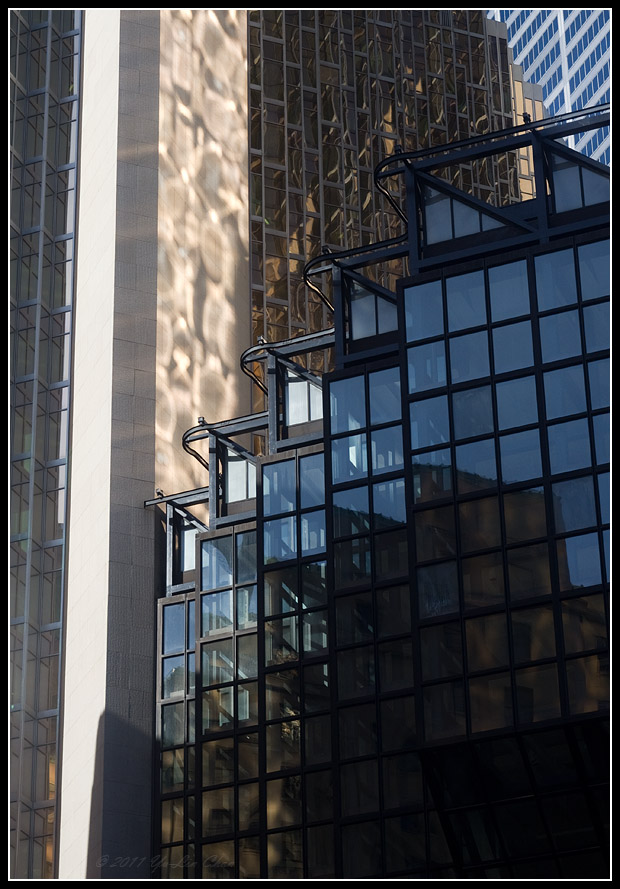
Glass Buildings -- NEX-5 & Carl Zeiss Jena Biotar 5.8cm f2.0

I have two working Biotars.  This particular one is small with a red T. Not really sure what it signifies, but it's significantly smaller than the other export version which simply says Aus Jena B 58mm f2.0.  I like the Aus Jena too.  Very sweet bokeh and both are very sharp when stopped down a little.  It just boggles my mind that these 30-40 year old lenses still performs so wonderfully today.

Tuesday, March 29, 2011

Victim of Desperate Measures

Carl Zeiss Jena Biotar 58mm f2 on NEX

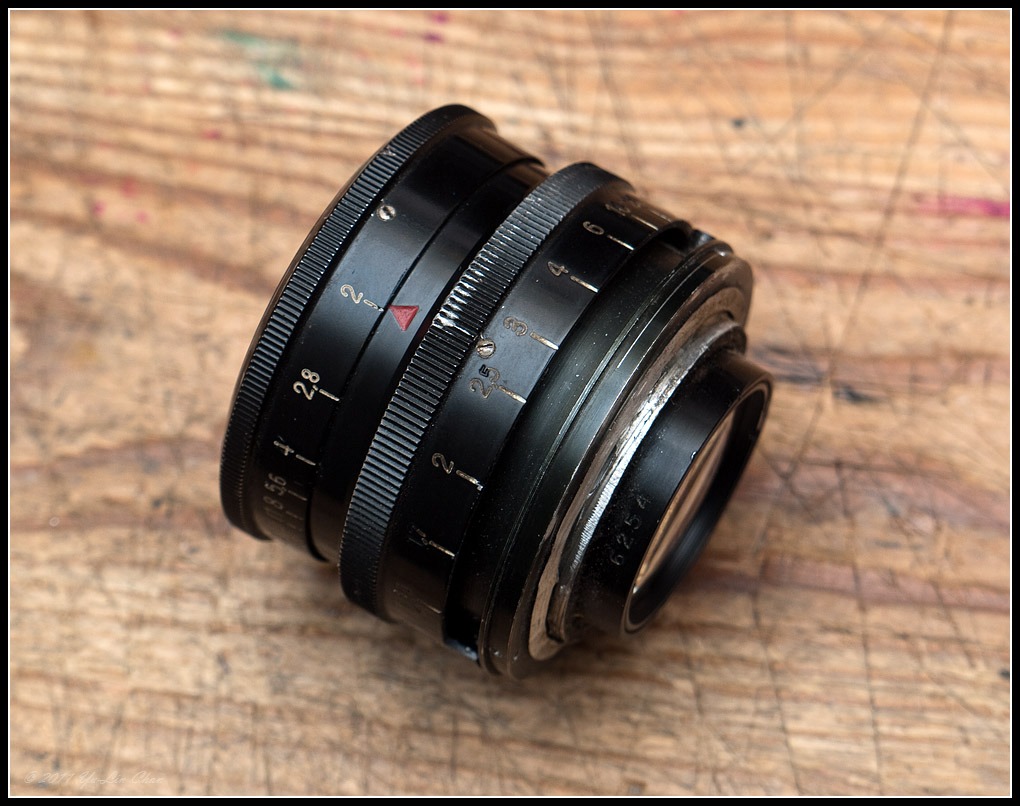
Few years ago, when EVIL cameras were still in the labs, I was having a hard time trying to get some of the lenses to be used on the Canon DSLRs.  Many of them were destroyed in the process, and some of the them were half dead, and this particular one, the Carl Zeiss Jena Biotar 5.8cm f2 had it's mounted cut away, in an attempt to mount it on the Canon and have infinity focus.  Needless to say, I never succeeded.  But, the NEX with the focus helicoid saves the day, again.

Butt gone -- Operation went bad

I went out at lunch time again today with the newly mounted Biotar, to the same place where I took the picture in my last blog entry, in an attempt to photograph the same thing.  It didn't turn out the way I wanted, although I did take some similar pictures.  The few I took at f2.8 did not have the focus point where it should, therefore can't really be compared.  Below is one taken at f2 wide open.  With a bit of sharpening, and resized, it's actually quite nice.  There is no surprise that the Biotar has a nicer bokeh.  This picture was taken closer than the EL-Nikkor.  The original lens' focusing ring, plus the focusing helicoid which makes the lens able to focus much closer than other 50mm lenses, but it does seem to have a smaller magnification ratio than the EL-Nikkor.

Double Happiness -- NEX-5 & Carl Zeiss Biotar 5.8cm f2 @ f2. Click to see larger.

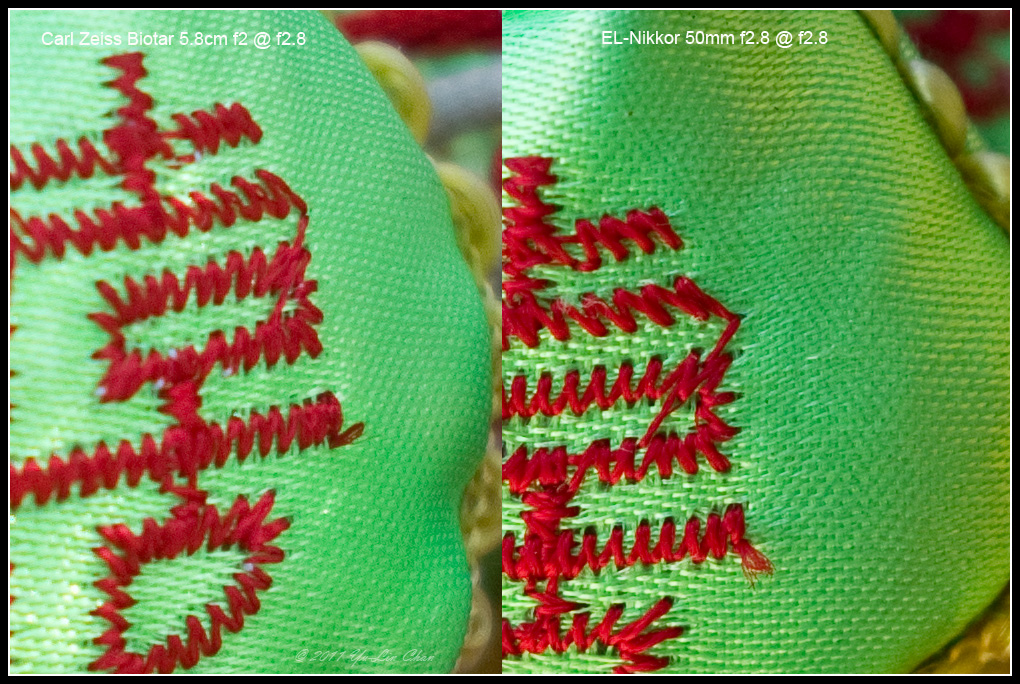
Finally, I took a 100% crop of a pictures taken at f2.8 from the Biotar, to the pictures taken yesterday by the EL-Nikkor, also at f2.8.  Note that these two pictures were taken at different dates, and under different conditions and both hand held.  So it's not scientific in anyway, but I think you can see the difference.  The Biotar is one stop down from maximum, while the EL-Nikkor is wide open.  I will put both lenses on tripod and try again later on.

Sharpness compared.  Click to see the original 100% crop.

 The slightly less sharp Biotar does not make it any less a lens, though.  Sharpness is not everything.  The EL-Nikkor is very contrasty, typical of Nikon lenses, just more so with this lens.  The two lenses produce pictures with very different emotions.  But, the Biotar can be very sharp from f4 on.

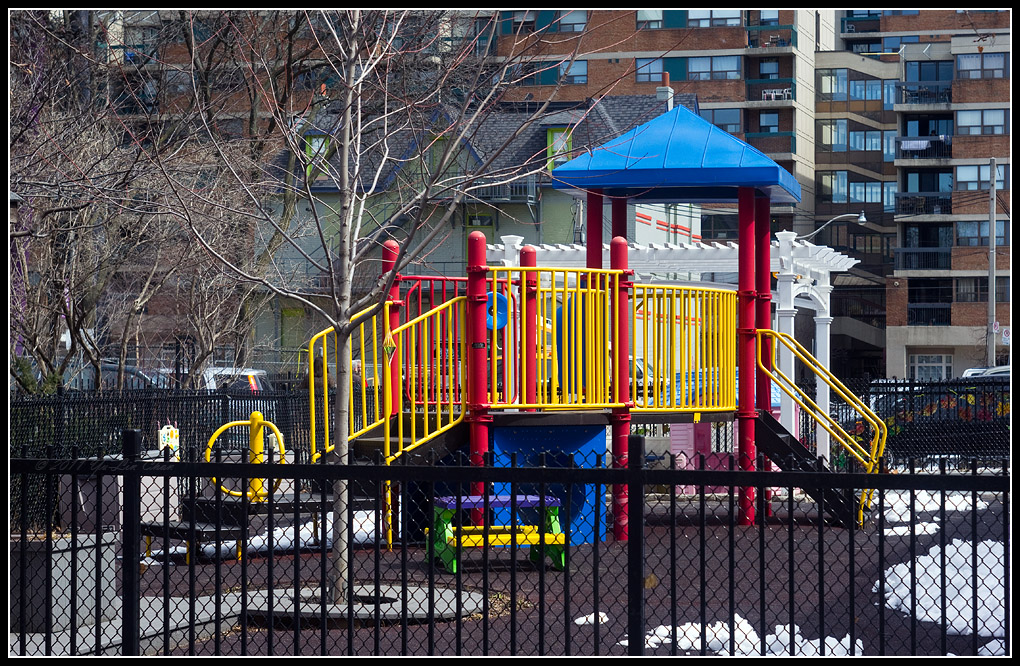
Playground -- NEX-5 & Biotar 5.8cm f2 @ f5.6 or f8. click to see larger.