Showing posts with label Enlarging Lens. Show all posts

Sunday, June 15, 2014

Spin Wheel Bokeh - Wollensak 162mm f4.5 Enlarging Raptar

We have looked at square bokeh, Spaceship shaped bokeh, ugly bokeh, swirling bokeh, and of course the normal bokeh, and today, the spin wheel bokeh. It's interesting how the shape of the aperture blades can create weird and unusual looking bokeh.

This one is a Wollensak 162mm f4.5 enlarging raptar that came with its own shutter. In the old days, large format enlarging lenses can be used for taking lenses, and vice versa. It has the spin wheel aperture blades, but lacks a focusing mechanism. I put the lens on a 135mm lens barrel, with the Yeenon Focus helicoid, so that I can take close up pictures. On it's own, the minimum focus distance is quite far. Let's not forget the lens hood, without which the pictures will come out hazy.

The lens is sharp but very low contrast. Not as good as my favourite Wollensak 209mm f4.5 Raptar Copy Lens, which has the traditional circular blades. The pictures come out of the Wollensak 162mm f4.5 lens is very interesting, and well worth the effort.

Wollensak 162mm f4.5 Enlarging Raptar with its own shutter. Click for larger.

Mounted on the lens barrel, Lens Bubbles style. Click for larger.

Bokeh #1 - Sony A7 & Wollensak 162mm f4.5. Click for larger.

Bokeh #2 - Sony A7 & Wollensak 162mm f4.5. Click for larger.

Bokeh #3 - Sony A7 & Wollensak 162mm f4.5. Click for larger.

Bokeh #4 - Sony A7 & Wollensak 162mm f4.5.  

Monday, November 5, 2012

New Canon Lenses - 24-70mm f4L IS and 35mm f2 IS

Rumour has it that Canon will be introducing the EF 24-70mm f4L IS and the EF 35mm f2 IS lenses in the next few days.  The 35mm f2 IS, like the 24mm f2.8 IS and the 28mm f2.8 IS before it, replaces its ancient predecessor,  the EF 35mm f2 that uses the Arc form motor.  The introduction of the 35mm f2 IS is easy to understand, but many people will no doubt wonder, why a 24-70mm f4 IS when the 24-105mm f4 IS already exists?

I owned the 24-105mm f4L IS for a few months, and while it was a very good lens, the distortion at the wide end should not be this bad for an L lens, in my opinion, and it's not exactly the sharpest lens in town.  I think it makes sense if Canon can make the 24-70mm f4L IS lighter but with the same optical quality as the more expensive 24-70mm f2.8L II, and sell it at the same price as the 24-105mm f4L. It would be a great lens for full frame.  The 24-70mm f2.8L IS is a stellar lens, optically.

More interesting is the 35mm f2 IS.  I also owned the non-IS version for a little while and liked it a lot.  I even did a comparison of it against the 35mm f1.4L, here.  Again, the price of the new lens is a bit ridiculous at about $900, more than twice that of the lens it replaces.  Hopefully, over time, the prices will come down and settle down to around $500 to $600.

Downtown Tower - NEX-5N & Rodenstock Rodagon-WA 60mm f4.


Friday, November 2, 2012

It's always sad to see the fall going away, along with the beautiful and vibrant colours.  The temperature is getting colder  I can already feel the chill in the air.  Better get used to it.  I think it's going to be a long and cold winter.

End of Autumn - Sony NEX-5N & Rodenstock Rogonar 50mm f2.8 Enlarging Lens

Tuesday, October 30, 2012

Using Enlarging Lenses with a Focusing Helicoid on Sony NEX

Unlike projection lenses, enlarging lenses have sort of a "standard" mount.  Most of them have a L39, or 39mm thread mount at the rear.  This is a good thing, because L39-M42 adapters are widely available and very cheap.  If the helicoid you have has an M42 mount on both ends, that's all you really need, if the focal length fits your helicoid.  The majority of helicoids on the market have this configuration and it makes a lot of sense.

Here are the reason why I chose something different: the helicoid with a M42 mount, and 52mm opening: 1. Some of my lenses have very large rear openings and 42mm is not large enough to accept the lens, and a 52mm opening gives me a better chance that the lens would fit.  2. I choose the M42 mount because it's interchangeable.  You can buy the helicoid with specific mounts like NEX E-mount, M43 mount, or Canon EF mount, etc.  With an M42 mount, I can use this helicoid on more than one camera system (I have NEX, M43 and EOS mount cameras), by simply screwing the helicoid onto an M42 adapter, or a c-mount adapter with M42 inner threads.  It has its compromises, of course.  For one thing, when used with enlarging lenses, I would need a M42 to 52mm step-down ring.  This would increase the thickness of the helicoid by about 3mm.

The picture below shows how I normally connect the enlarging lens to my camera.  For this particular lens (Rodenstock 50mm f2.8), it works almost perfectly, infinity focus is just slightly beyond infinity.  So, what happens if your enlarging lenses are longer than 50mm?  Very simple, just add 52mm filter rings.  The last picture shows an 80mm enlarging lens with 3 filter rings added to compensate for the longer focal length.  For very long lenses, like 150mm, it's better to buy a longer helicoid, or use extension tubes instead of filter rings.

It maybe worth mentioning that the c-mount to NEX adapter with inner 42mm thread is now hard to find.  So, it maybe be better to buy a helicoid with the mount of the camera you are using it on, instead of an M42 mount.

How the pieces are put together. Click for larger.

All connected.  In real life, the labels won't line up nicely like the picture. Click for larger.

Mounted to the camera.  Click for larger.

With extension rings (filter rings) for longer lenses. Click for larger.

Monday, October 29, 2012

Review: Yeenon 18-33mm Focusing Helicoid

If you read my blog for any length of time, you would know that I am a big fan of DIY lenses.  Projection lenses, enlarging lenses, odd ball lenses are my past time favourites, and all these lenses need a focusing helicoid, as the lenses themselves do not have a focus mechanism.  My first focusing helicoid was a converted Vivitar 2X Focusing macro teleconverter, which I wrote about it here. But, this home made helicoid is too thick (long) for wider angle lenses, so a thinner helicoid is needed.  I ordered two generic ones from eBay: a 12-17mm and a 17-32mm, which I covered here.  These two are widely available on eBay from many sellers, but they are essentially identical.  Typically they are selling for about $40 each, much cheaper than the time I bought mine. Sadly, they are very badly made.  Even when new, they have some play between the focusing and the mount. After only a few months of use, they have become wobbly, and pretty much unusable.  I did get a lot of use out of them, so it's not a total write-off.  I began searching for a better replacement, but couldn't force myself to forking out more than $100 for a different one.

There are basically four different makes of helicoids readily available on eBay.  They are: the generic ones that I bought and bad quality; one from Hawk Factory in Taiwan, which has good reviews, but at about $130; one sold by Fotodiox at $120, and the other, which I bought and I am reviewing, is a Yeenon 18-33mm, at $57 (free shipping if you offer to pay the asking price on eBay).  I chose the M42/52mm version, so that I can use it on NEX, Micro 4/3, and Canon EOS through the M42 adapter.

The Yeenon helicoid took exactly one month to arrive from China.  It came with a (relatively) nice box, and even a guarantee.  I could feel the difference in built quality as soon as I held it in my hand.  Much better than the generic ones I bought.  The Yeenon is slightly larger in diameter.  This has a negative effect on the NEX-5N, as the focusing ring touches my middle finger that grips the camera, while focusing. Also, there is still a very slight play between the focusing and the mount, just enough to feel it.  It's not a big deal, but nevertheless lessens the joy of using it. The focusing is relatively smooth, but a bit too much resistance.  I am sure with use, it will loosen up.

So far I have only used it for a week, but I enjoy it much more than the ones I had before.  It's not as good as the Vivitar 2X focusing helicoid, but very close.  I just hope that the build quality will hold up and last more than a few months.

The Yeenon 18-33mm helicoid. Click for larger

Face Off - Left Yeenon 18-33mm; right generic 12-17mm. Click for larger

Side by side. Click for larger

Intense colours - NEX-5N & Schneider-Kreuznach Componon-S 80mm f4. Click for larger.

Symphony of colours - NEX-5N & Schneider-Kreuznach Componon-S 80mm f4 @ f5.6

Sunday, September 23, 2012

Leaf on Fence

Dead leaf - NEX-5N & Schneider-Kreuznach Componon [Durst] 50mm f4 Enlarging Lens. Click for larger.

Of all the enlarging lenses I have, the Schneider-kreuznach Componon (Dusrt) 50mm f4 is the most elaborately built.  The entire lens barrel was made of brass and chrome plated.  It also sports a 15-blade aperture.  Interestingly, at maximum aperture of f4, the aperture blades are not hidden.  I suspect the lens is capable of f2.8, but is restricted to f4 as the maximum.  It came with both the front and rear lens hoods.  Very beautiful and heavy, with excellent optics to match.

Sunday, August 19, 2012

Set of Pictures with Schneider-Kreuznach Componar 50mm f4.5 Enlarging Lens

Even though I am not a big fan of the Schneider-Kreuznach Componar 50mm f4.5 with the square aperture, I decided to take it out again for some general shooting as a normal lens.  Found that it's not overly sharp at infinity, though it's not bad, except the corners is fairy bad, compared to other enlarging lenses I have used.  At close range, the sharpness is excellent.  Of course, this could be due to the mounting of the lens that created unevenness.  Overall, it's definitely an interesting lens to shoot, especially the weird bokeh.

Reflections - NEX-5N & Schneider-Kreuznach Componar 50mm f4.5 Enlarging Lens. Click for larger.

Close up - NEX-5N & Schneider-Kreuznach Componar 50mm f4.5 Enlarging Lens. Click for larger.

Grocery Shopping - NEX-5N & Schneider-Kreuznach Componar 50mm f4.5 Enlarging Lens. Click for larger.

Disturbing Bokeh - NEX-5N & Schneider-Kreuznach Componar 50mm f4.5 Enlarging Lens. Click for larger.

Thursday, April 21, 2011

Wheel

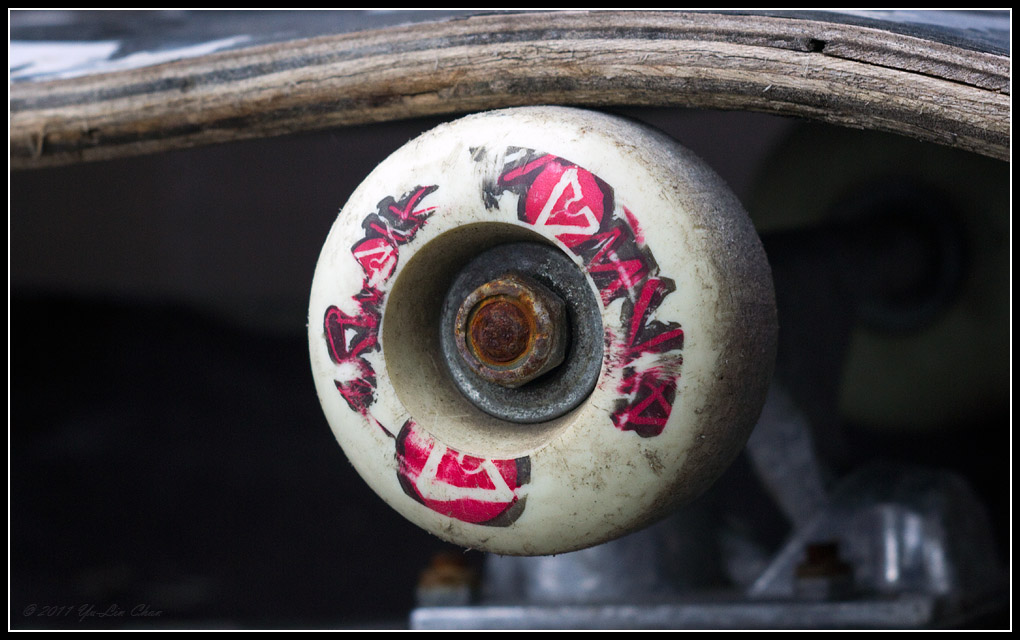
Skateboard Wheel -- NEX-5 & Kodak Enlarging Ektar 100mm f4.5. Click to see larger.

Like the Kodak cine lenses, this enlarging lens also finished in beautiful chrome.  I tried it before on the Canon, and found that the image quality was OK, but not spectacular.  Not as good as the Rodenstock or Schneider equivalent.  But, it's a nicely made lens.  One of the things about enlarging lenses is that they don't seem to be very good with flare or side lights.  Finding a hood for them is more difficult than you think.  Hope I will get to use it more often on the NEX-5 and see what it can do.

Monday, March 28, 2011

EL-Nikkor Supremo 50mm f2.8 Enlarging Lens

EL-Nikkor 50mm f2.8 on focusing helicoid. Click to see larger.

Many people, including yours truly, have been trying to make this lens focus to infinity on DSLRs, but without much luck, until the NEX, of course.  After acquiring the focusing helicoid, I find so many uses for it.  All those lenses that could not be used before suddenly are given a new life!

I mounted the EL-Nikkor 50mm f2.8 enlarging lens on the 17-32mm helicoid, through a 52mm filter ring.  Works perfectly, and actually focuses past infinity.  In case you are not aware, the EL-50mm f2.8 is a very highly regarded lens.  Truly flat field with excellent sharpness from corner to corner.  The best feature, of course, is its very fast maximum aperture of f2.8.  Don't laugh, f2.8 is very bright for enlarging lenses.  Most of them have maximum apertures of f4 to f5.6 or even smaller.  You can actually use this lens as a normal 50mm lens, except it's sharper than most 50mm lenses, especially at close range.  If you have an NEX camera and like to tinker with enlarging lenses, grab one from eBay.  It's still El Cheapo in price, but what you get in return in optical quality is unequaled.

Double Happiness -- NEX-5 & EL-Nikkor 50mm f2.8 @ F2.8. Click to see larger.

Tuesday, October 13, 2009

Using Enlarging Lenses to Make Pictures

No, I am not talking about enlargers. I am talking about making pictures with enlarging lenses. Sometime last year, I read a photography forum where someone showed off some of the most fantastic pictures I had seen, made using an enlarging lens.

I was intrigued, and bought a used Rodenstock Omegaron 150mm f4.5 enlarging lens. Found a cheap 135mm f2.8 T-Mount lens, and removed the glasses. The enlarging lens was then planted on the front of the T-Mount lens. Now I had a lens that could focus to infinity. I couldn't believed my eyes when I looked at some of the pictures I took with it. They were sharp, corner to corner, on a full frame sensor. I was hooked.

Since then, I have accumulated a dozen or so enlarging lenses from 50mm to 300mm and made various lenses out of them. I made some of my favourite pictures with a few of them.

Basically, there are two ways to use the enlarging lenses. One, and the easiest way, is to use a bellows. This usually allows you to focus to infinity if the lens is longer than 90mm or so, and it lets you use the enlarging lens as a macro lens. But, this setup is very bulky and inconvenient to carry around. The second way to go about this is to "plant" the enlarging lens in an existing lens barrel. The second approach is what I took.

Believe it or not, I have a few boxes of cheap lenses of various focus lengths that I have collected over the years. They make great parts to build your own lenses. I found that the older the lens, the easier it is to take apart and be usable. Primes are best. A 50mm lens would make a great barrel for a 75mm to 105mm lens, using tubes or spacers made from filters rims.

I must say that it's great fun. It's a cheap way to get exceptionally sharp pictures, since most enlarging lenses are flat field design. They are designed for optical performance, instead of speed.

In the future, I will talk about individual lenses that I have used. Below you will find some sample lenses I have made, and a few pictures made from them.

Rodenstock Omegaron 150mm f4.5. My first frankenlens.

Sample pictures from the 150mm f4.5 Rodenstock Omegaron. Taken with a 1D mark II. Larger Picture.

Schneider Componon-S 80mm f4, planted on a 55mm f2 Yashica lens.

Sample pictures from the Schneider 80mm f4. Taken with 1D Mark II. Larger Picture.

Wollensak 209mm f4.5 Copy Lens. One of my favourite.

Sample picture from Wollensak 209mm f4.5 and Canon 1Ds. Larger Picture.