Showing posts with label Sony A7. Show all posts

Wednesday, February 17, 2016

Canon EF 40mm f2.8 STM Pancake on A7

I failed to mention, when I wrote about using Canon AF lenses on the Commlite smart adapter, is that if you set the APS-C to Auto in the A7's menu, the A7 will default to APS-C mode when shooting with this adapter.  Please beware.

The 40mm f2.8 STM is the first pancake EF lens that Canon makes, and it was the first to employ the STepper Motor (STM).  This pancake lens is a huge success, judging from what the owners have to say; it's almost universally praised, and deservingly so.

Aside from it's petite size, the low price is a major contributing factor.  When on sale, it can be had for about $150 CAD, although the price has gone up somewhat since the Canuck Looney has depreciated quite a bit against the mighty US green buck, but the price is still very reasonable.  A third reason why it's so popular, is because it's optically excellent.

Canon EF 40mm f2.8 STM on A7 with Commlite Smart Adapter

I got mine when I bought the used Canon 5D II as a bonus.  The 5D II is long gone, but the 40mm f2.8 STM remains.  This is one of the few pancake lenses I have.  The other two I often is the Pentax 40mm f2.8, and the Contax Carl Zeiss 45mm f2.8.  All of these lenses are optically competent.

When used on the Sony A7, the tiny size is no longer very tiny when it's mounted on the Commlite adapter.  In fact, the adapter is thicker than the lens itself.  Still, the combo looks quite compact on the A7.  Of all the Canon AF lenses I have tried on the A7, this one works best, but not perfect.

The Autofocus speed is workable, but slow.  The A7 II and A7R II are better bodies to use for Canon lenses since they can use the phase detect pixels on the sensor to drive the lens to focus at a much faster speed.  On the A7, or any other E-Mount or NEX mount cameras, it's definitely not for moving objects.

Lone Tree in Snow - Canon EF 40mm f2.8 @ f8 & Sony A7

There is one bug with the CommLite adapter when used with this lens.  The maximum aperture is often stuck at f3.2 and can not be opened up to f2.8.  Sometimes it can be fixed by turning the camera off and back on, but in severe cases, the lens needs to be removed and re-mounted, or battery removed and re-inserted.  At odd times, it fixes itself.  How weird.

In terms of optical quality, there is very little to complain about.  The lens is very sharp even at full aperture of f2.8, to the corners.  I can't say the same thing for the EF 70-200mm f2.8L IS, although we are comparing apples and oranges, if you look at the price difference, the 40mm f2.8 pancake is a bargain for the quality it produces.

The lens can focus really close, to 0.3 meters, but AF doesn't work all the well at close range.  It's easily fooled with the background.  Full Time Manual (FTM) focus does not work at all, this means you can not focus the lens when it is set to AF after you half pressed the shutter to fine tune focus.  You can either focus by hand, or the lens focuses itself, but not at the same time.

Fiery Sunset - Canon EF 40mm f2.8 & Sony A7

If you shoot Canon, this lens is a no brainer, and if you own a A7 II or A7R II, it's also an excellent buy, since Sony does not make something like this.  If Sony has lenses like the 40mm f2.8 STM, and the 50mm f1.8 STM, it will help Sony sell a lot more full frame bodies.  Not everyone can afford or want the Zeiss 55mm f1.8 ZA, or the 35mm f1.4 ZA. What Sony lacks, is affordable line of full frame primes.  Ironically, their A7 II and A7R II cameras work so well with Canon (and Nikon) AF lenses that people may never buy another Sony lens.  That also makes it easy for them to switch back to Canon/Nikon when they introduce cameras with compelling features.  I know that if I had an A7 II or A7R II, I would definitely buy the Canon 50mm f1.8 STM in addition to this 40mm f2.8 STM.  I would also buy the Sigma 20mm f1.4 Canon mount if I need a fast wide prime.  In a way, this solves the lens problem with Sony.

Chained - Canon EF 40mm f2.8 & Sony A7

Tuesday, January 12, 2016

Fujinon 4.5cm f1.9 Rangefinder Lens

The Fuji 4.5cm f1.9 came with shutter blades jammed up inside the lens of a Fujica 35-EE rangefinder camera.  This camera is not known to have a reputation for reliability, probably due to the complex nature of its design.  This is one of the most complicated rangefinders I have disassembled, and removing the shutter blades were also a pain in the rear, but when it's all done, the results from this lens is well worth all the effort.

Fujinon 4.5cm f1.9 on a 58mm diameter focus helicoid

I opted not to use the build-in focus mechanism on this lens, and instead, use my newly acquired, though shoddy made focus helicoid with a 58mm opening.  The large diameter allows the lens to go inside the helicoid so that it's close enough to the sensor for the lens to focus to infinity.  The added bonus is that infinity focus does not need to be precise, as long as it can be be focused to infinity.  This is not true when using the built-in focus mechanism.  It must be exact, or either you can't focus to infinity, or it focuses pass infinity and causes its already long minimum focus distance to increase further.

When used with a 17-32mm focus helicoid, very close focusing is possible.  Click for larger.

Like many rangefinder cameras from the 60s, the lens was designed and made as a premium product, but the lens optical formula is relatively simple compared to today's lenses.  This may not be a bad thing, as fewer elements usually means more pronounced characters and better looking bokeh.  Highly corrected lenses of today produce pictures that look similar to each other.

Very sharp wide open.  Click on picture for a larger version.

The Fuji 4.5cm f1.9 produces very fine pictures.  It's very sharp in the middle of the frame wide open, and it has a very pleasing rendering characteristic; sharp but without the hint of harshness.  I like the bokeh too; nothing distracting or extreme.  When stopped down to around f11, sharpness shows itself across the whole frame.  I would say very good performance from a lens designed and made more than 50 years ago.

Tuesday, October 20, 2015

Full Frame Versus This and That


If you search the web on full frame vs. other sensor sizes (M4/3, APS-C, etc), you will no doubt be presented with all kinds of comparisons.  Some are very good, but many are pointless, to the point of being silly.  Consider a scene taken with a 24mm lens on full frame, and one taken with M4/3 with a 12mm lens, with aperture set at around f8, and compare away. With recently designed cameras, a picture like this will probably look identical in most cases, except the colour/white balance.  I am pretty sure few people can tell the difference between the two pictures if white balance is equalized. Personally, I think this is the wrong way to compare cameras systems.

Choosing a camera should reflect the kind of pictures you want to make, and you make sure the camera you choose has the lenses that allow you to realize the style of pictures you want.  Obviously, if you love to shoot architecture, you would want a camera that has tilt-shift lenses for it.  If you a thin depth of field freak, you want full frame with large aperture lenses, and if shooting sports is the primary use of a camera, then a DSLR with fast tracking focus system should be the main consideration.  The point is, the sensor format does not really matter much any more if viewed purely from the image quality standpoint, except when pushing the low light limit, in which case the full frame sensor usually has an advantage.  What really matters is that the chosen camera meets your needs.  Of course, if you have the means, and you really, really want, you can always have more than one system, to get the best features/functions from each system.

I chose a mirrorless full frame camera as my main system, because I like legacy lenses, and I am a thin depth of field freak.  The short flange of mirrorless cameras allows pretty much all lenses ever made for previous cameras to be used with proper adapter, which is what I like to do.

The Light -- Tamron Adaptall 60-300mm f3.8-5.4 & Sony A7

Tuesday, October 6, 2015

Haiou-64 (Seagull) 58mm f2 Biotar Clone

China is certainly not known for producing photographic equipment.  A little while ago, I saw a 58mm f2 lens that was made in China, I was partly fascinated, and partly because it was very cheap (probably something like $10) so I bought it. Definitely not a common lens in North America, as I don't think this lens and the camera it came with was for export to the West.  This lens is a Biotar 58mm f2 clone (or it could be a clone of a clone, the Helio-44) in Minolta MD mount, and was probably made in the 70s and 80s.  It's optically clean, but something is not quite right, because as soon as I start focusing, I can feel the there is some play, like something is loose inside.  Very annoying.   But then again, this lens is a few decades old.  It might have been abused before.

The lens mount and barrel is made of metal, and the focusing is still relatively smooth with a tiny bit of coarseness.  The aperture has 6 blades, like most old East German lenses from the same era.  I really shouldn't complain too much for such a cheap lens.

I am quite surprised the lens is optically quite good.  Very sharp even wide open, and by f8, sharp across the frame on the A7.  In terms of characteristics, no surprises here.  It's similar to the pictures rendered by the Helios-44 or the Biotar 58mm f2, and this is a good thing!  These lenses are known to produce creamy smooth bokeh.

At the end of the day, it's good value for the money.

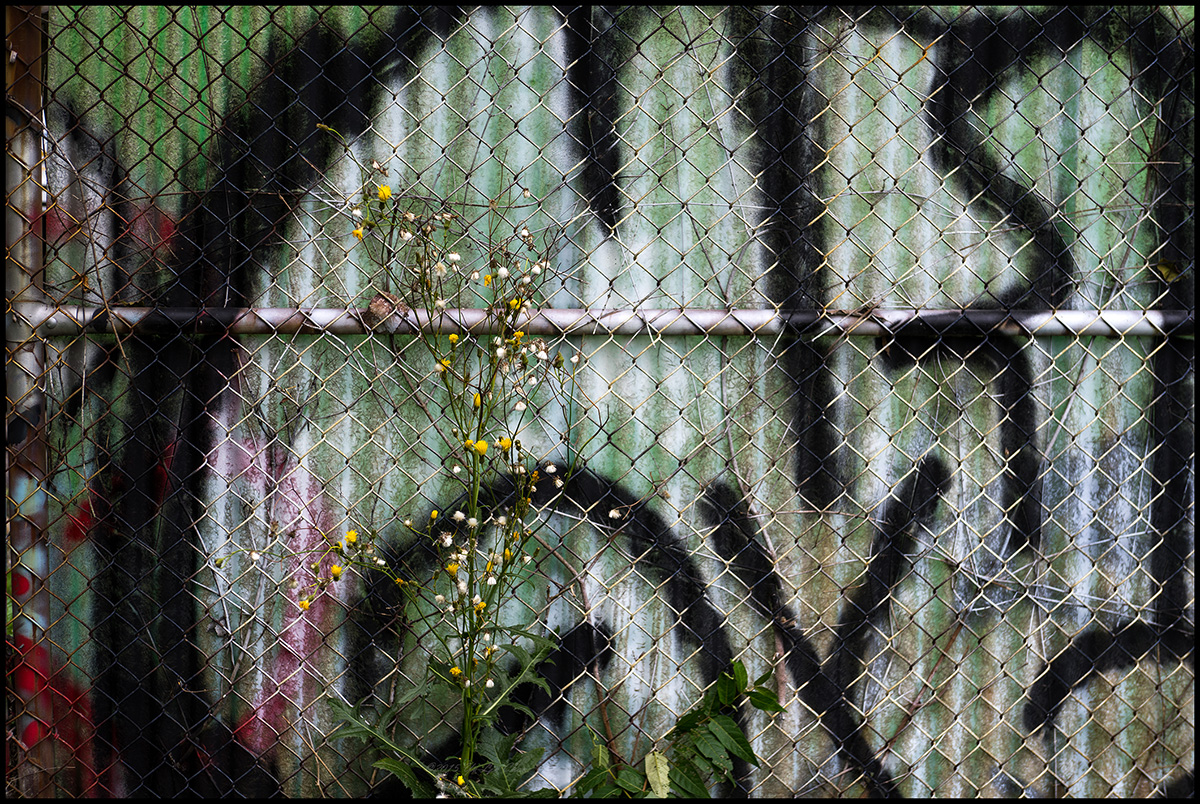
Grafitti & Wildflower - Sony A7 & Haiou-64 58mm f2. Click for larger.

Port of Toronto - Sony A7 & Haiou-64 58mm f2. Click for larger.

Milkweed Pots - Sony A7 & Haiou-64 58mm f2. Click for larger.

Haiou-64

Milkweed Pots - Sony A7 & Haiou-64 58mm f2. Click for larger.

Monday, September 14, 2015

Sony A7 After 48,000 Images

When I bought my A7 from the Sony store as a demo unit, I didn't know how many actuations it had, and it turned out to be quite a bit. 13,505 to be exact.  Yesterday I did a shutter count check and the current count is more than 61,000.  I shot more than 48,000 pictures in 16 months.  That's quite a bit for someone who only uses the camera for leisure.  I guess it's a good time to follow up on my initial review of the camera.

The Build
Other than some brassing on the edges of the top plate, the camera is physically in very good shape.  I bring a camera with me to work each day, or whenever I go out, without fail, and the camera is either the Sony A7, Olympus E-M5, or very rarely the Canon 20D Infrared camera, and a few times the Nikon D810.  I would say 99% of the time, the A7 was in my bag.  That means the camera is in my backpack (not a camera bag), enduring the sometimes rough biking trips, and it has held up extremely well.  The camera has worked flawlessly without fail so far.

The Annoyances
1.  the proximity sensor that switches between LCD screen and EVF is far too sensitive.  One fix for this, devised by Matt, is to cut a thin piece of black electrical tape and put in the middle of the IR LEDs window on top of the viewfinder.  This works well most of the time, but sometimes the sensitivity goes a bit wonky, probably because the tape moved, so at the end, I just removed it and reverted it back to its virgin state.

2.  Sensor dust.  Compared to the Olympus E-M5, or the Nikon D810, the Sony sensor-shake dust reduction system, like the Canon version, isn't as effective.  It's a royal pain to clean.  Luckily, most of the pictures I shoot are wide open and this is not a big deal, but when a slow lens is used, say f5.6 or slower, the pictures will have many dust specks.

3.  Image Magnify button.  In early NEX cameras, the magnify button is the OK button, which is within the reach of the thumb when the camera is held. Pressing it after the image is taken instantly magnifies the image.  But in the A7, the &#$%@#  magnify button has its dedicated button, located next to the EVF.  To press this button, I have hold the camera with my left hand loosen the grip of the right hand to press it.  As far as I know, this function could not be re-programmed.  Still drive me crazy after 16 months.

4.  I miss the fully articulated swivel LCD screen on the Panasonic G1, Canon T2i, and even the original 3.2 MP Canon G1 that I used.  This is especially useful for vertical shots when not using the EVF.  A minor annoyance.

Storage and Computer Issues
As the resolution of the cameras increased, so is the storage and computing requirements.  It's true that storage is cheap, but after losing 250GB of pictures, I now store my pictures with at least two copies on magnetic hard drive, plus one copy on BluRay disc, which triples the storage requirement.  At the moment, I have roughly 18TB of hard drive storage, and it's almost near capacity, and I am way behind on BluRay backup.  The computer I am using is a 7-year old Dell XPS Studio with an Intel Core i7-920, and 18GB of RAM.  Adequate at the moment, though painful when processing D810 images.  I can't even begin to fathom what it would be like if I ever get the 42MP A7R II.

Other Thoughts
I thought the lack of an external charger would be an big issue for me, but it turns out not so, for the kind of shooting I do.  I hardly spend more than 45 minutes per shooting session, since 90% of my shooting is done during my lunch time, or on my way to or from work.  I do not need an extra battery (although I do have one).  Once charged, it's good for at least a couple of days.  I actually find it convenient to be able to charge the battery in-camera, because more than a few occasions, I found the battery almost depleted, but was able to charge it at work through the computer before heading out.

The lossy RAW format that Sony employs ticked off more than a few people.  It bothers me a little, but not to the point where I find it a show stopper.  In most cases, this does not affect the image quality, at least not something clearly visible.  I don't see why Sony would not allow the user an option to use compressed or losslessly compressed RAW.

What I like most about this camera is that it's a very balanced camera.  Obviously, it's not an action camera.  Focus speed, especially focus tracking, leaves much to be desired, but you would be buying a wrong camera if the majority of your shoot is action based.  A DSLR is a better tool in that case.  The small size with a full frame sensor and very short flange distance, coupled with excellent image quality, is a dream tool for legacy lens addicts like me.  I thank Sony for making an affordable camera like this, that no one cared to make.  It's by far the best camera I have used for my shooting style.  I look forward to the A7R II.

Anchor - Sony A7 & Minolta RF 250mm f5.6 Mirror Lens

Saturday, September 5, 2015

Why I hesitate to buy E-Mount AF Lenses

The introduction of high quality lenses, like the Batis series from Zeiss, makes buying E-Mount lenses very tempting.  The thought of selling all my Canon AF lenses and buy Sony equivalent (or close to) lenses crossed my mind a few times, but I always resisted.  What's holding me back?  One experience taught me something about selling gear in the used market.  As many of you know, I was a Canon shooter for more than a decade, and more if counting the film days, and I have amassed quite a few Canon lenses.  My Canon camera bodies are gone, but the lenses remained (except the 16-35mm f2.8L II, and the 70-200mm f4L IS, which I sold to buy the Nikon 70-200mm f2.8 VR).  All this time, I never had trouble selling any Canon equipment, because there are such a huge Canon user base and finding a buyer is relatively easy.  While "sampling" other cameras, I bought a Sony A-Mount camera and a few AF lenses, Minolta 50mm f1.7, Sigma 28-300mm and Tamron 90mm f2.8 Macro to try.  At the end of the sampling period, I found that it was hugely difficult to sell Sony gear.  Eventually, they were sold rather cheaply and took a long time, compared to the Canon equivalent.  One example is the Tamron 90mm f2.8 macro lens.  I sold the Sony version at about half the price of the Canon version; there were simply not many Sony Alpha-Mount users out there, especially for a relatively specialized lens like a macro.

The introduction of the A7R II makes the decision even harder for me.  The advanced phase-detect AF capabilities in the A7R II allows Canon auto focus lenses to AF much faster with a smart adapter, to a point where it's actually usable.  Previous Sony E-mount cameras AF very slowly with smart adapters, that's practically useless.

For the time being, I am going to keep the Canon lenses and wait for the A7R II to become more affordable to buy one.  If the AF is actually good enough, the Canon lenses will become my main lenses to be used on Sony whenever AF is required.

Blue Dreams - Meyer-Optik Primoplan 58mm f1.9 & Sony A7.

Monday, April 27, 2015

A Walk Along the Keating Channel

I have been walking to work and back for the last three weeks, instead of biking like I have done for the last 15+ years.  The joints in my upper body is starting to hurt me, so I decided to walk for a month.  It takes about an hour each way.  Many would think this is nuts, but I rather enjoy the walk, except for the first few days when it was really tough.  The best thing is that I can now walk through sections of the of the road that I could not bike to, and this provides more photography opportunities and biking.

Today I decided to walk along the Keating Channel since I have been wanting to photograph it for a long time, but never made it a reality until today.  The south side of the Channel is not open to the public, and the north side borders on Lakeshore Blvd., and I wouldn't suggest anyone to walk the entire length from Cherry street to Don Roadway, as it kind of dangerous on some sections; you have to walk very close to the road, or very close to the channel.  You could get hit by a car, or fall on the channel.

In any case, I did take quite a few pictures along the channel, with the newly acquired Schneider-Kreuznach Radionar 5cm f2.9 lens from the Balda folder camera.  This lens has a good reputation, and I can confirm that it performs admirably, considering how old it is.  The most amazing part is that I didn't even need a hood for the lens, even though it's not coated, and flare was very well controlled, especially when stopped down.  At f2.9, the lens is very sharp at the center, and by f8, the edges are very good and at its best at about f11.  Contrast is a bit on the low side at wider apertures, but the bokeh is lovely.  With a bit of processing, the files come out quite nicely.

All the pictures were taken with the Sony A7 & Schneider-Kreuznach Radionar 5cm f2.9.


Wednesday, April 22, 2015

Voigtlander Lanthar 50mm f2.8 from Vitoret D


Scored 3 broken rangefinder cameras from the antique market on Sunday.  One of them is the Voigtlander Vitoret D with a Lanthar 50mm f2.8 lens, which I have been using for the last few days and I really enjoy it.

It's commonly believed that the original Lanthar lenses were made with glass containing lanthanum, a rare earth element that gives the glass high refractive index.  Later ones made by Cosina, like the Lanthar 90mm f3.5 and the 125mm f2.5, do not contain lanthanum, I believe.  Of course, lenses containing lanthanum does not automatically mean great lens by default.  The Color-Lanthar 42mm f2.8 that I tried was OK, but not great.  This 50mm f2.8 Lanthar, I like it quite a bit more.

The Lanthar 50mm f2.8 contains 4 aperture blades, as oppose to most of the old Voigtlander rangefinder lenses with 5.  This creates interesting bokeh, like the enlarging lenses I tried, here, here, and here.  But when shot wide open, the bokeh looks normal, of course, and it's quite nice in fact.

I also have no complains about the optical performance of the lens, given that it's not top of the line lens.  Wide open the center of the frame is acceptably sharp, but the outer edges are mushy, but improves as the lens is stopped down, but the edges are still not critically sharp until f16.  It's interesting how much difference between f11 and f16.  But of course the overall sharpness starts to suffer a bit at f16 due to diffraction limit, though still excellent.

To me, it's acceptable for a lens to have at least one aperture that provides uniform sharpness when needed.  My shooting style does not require uniform sharpness most of the time and when I do need it, I can stop it down to get it.

Overall, I think it's a very good lens for the money.  The Vitoret D I got was $20, and it was very easy to remove the lens.

All pictures below were taken with the Voigtlander Lanthar 50mm f2.8 and Sony A7.


Sunday, April 19, 2015

P. Angenieux 45mm f2.8 Lens from Tiranty ST280

Got the Tiranty ST280 last week, and the sole reason was for the lens.  I really don't care much if the camera body does not work, but I love French lenses.  All the French lenses I have used produce exquisite and beautiful bokeh, and this 45mm f2.8 is no exception.

I removed the main lens from the ST280, which was quite easy to do, but the aperture and focusing rings are another story.  I decided to just use my Yeenon 18-33mm focus helicoid instead, and it worked out quite well.

Went to Allan Garden yesterday and shot some flowers; wanted to see what the bokeh is like.  When I downloaded the pictures and looked at them on the screen, I was wowed and captivated by how beautiful the bokeh was.  The French sure knows a thing or two how to design lenses that produce mouth watering bokeh.  Wide open, the lens shows some astigmatism on distance objects, but I have not noticed the same effect with close up shots.  The center of the lens is reasonably sharp wide open, but with low contrast.  Stopping down improved sharpness markedly and the astigmatism is gone by about f4, at least at the middle of the frame.  The long edges aren't great even at about f8, but passable.  You will be disappointed if you care about the edge sharpness.  But I think the strength of this lens lies in its gorgeous colour and bokeh rendering.  Seriously, I could lose myself in it.

All lenses below were taken with the Angenieux 45mm f2.8 and Sony A7:


Tuesday, April 14, 2015

A Gift From John

I am extremely fortunate, and very blessed, to have "met" so many wonderful people in my life around the world; some I have never actually met and only interacted through the internet, and others I actually met face to face.  John was one of those that I have met.  He bought my Canon 1D III, and he brought with him an Aires 4.5cm f1.9 rangefinder lens to give me as a gift.  He knew me through my blog.  I am very grateful to John, and all who have been so generous to me.

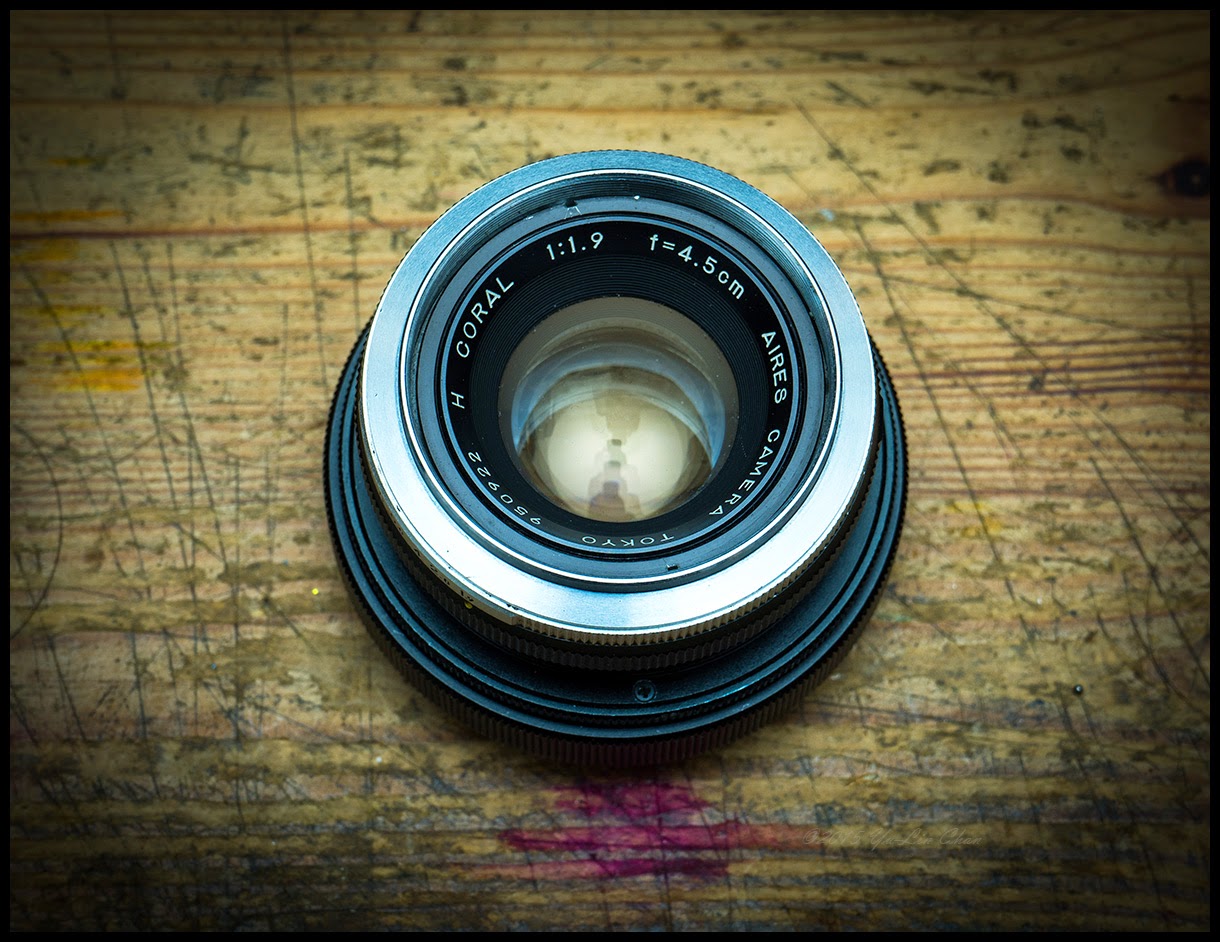
The Aires Coral 4.5cm f1.9 lens has a proprietory lens mount, and the focus, presumably is on the camera body since the lens does not have it.  The aperture does not completely open at maximum.  Perhaps that may have caused the strange looking, but still interesting bokeh.  The lens is quite sharp, especially when stopped down.  It has decentering problem, no doubt caused by my home made adapter.  In all, an uncommon lens that produces interesting results.  Thanks John!

Aires Coral 4.5cm f1.9.  Click for larger.

All pictures below were taken with the Aires Coral 4.5cm f1.9 and Sony A7


Saturday, April 4, 2015

Goodbye Canon. Hello Nikon!

Last week, I sold my last Canon body (1D Mark III), and for the first time since 2001, I do not have a Canon camera, except the infrared modified 20D.  After a long relationship with Canon, I have found the Canon cameras of late are getting stale; same iterations over and over again without much in ways of innovation. It's time for a change.

The Micro 4/3 and Sony mirrorless have been my primary camera system for the last few years, and the Canon was only used two to three times a year for swimming shoots, and occasionally used by Dillon for his school sports.  It was pure coincidence that I ended up with a Nikon D810, which was never even on my radar screen but after handling the camera, I found myself really drawn to it. This camera oozes quality but the one thing that sold me was the shutter. It's light, quiet, but with authority that instills confidence.  The 6 frames per second in crop mode is fast enough for my occasional swimming shoots.  I decided to buy it, essentially replacing my Canon 1D III.  But this has brought with it a dilemma for me.

I only have a few Nikon mount manual focus lenses, mostly Tamron Adaptall lenses plus the Sima 100mm f2 soft focus, Vivitar 24mm f2, and the Nikkor 105mm f2.5 in original F-mount that I bought from the camera show last year.  This camera really deserves a few nice fast primes, and hence the thought of selling some or all of the Canon lenses to fund the Nikon lenses.

Despite my less than enthusiastic feeling towards recent Canon cameras, I love the L lenses currently still in my possession.  Some of these lenses have no Nikon equivalent, like the 50mm f1.2L, 85mm f1.2L, and the 180mm f3.5L Macro.  So I have decided to sell the Canon zooms and I will just get a smaller set of Nikon mount AF lenses: wide zoom, Sigma Art 50mm f1.4, and a tele zoom(probably a 70-200mm or 80-200mm f2.8) which will allow me to do the occasional swimming shoots if needed.

So far, I have no problems with the D810.  It really is a nicely balanced camera that produces exceptionally good image quality.  I do hope that I will use it more often than now departed Canon 1D III.

Sony A7 compared to Nikon D810 in size.  Click for larger.

Fire Hydrant - Nikon D810 & Tamron SP 90mm f2.5 Adaptall.

Friday, April 3, 2015

Voigtlander Color-Skopar X 50mm f2.8

I am a big fan of the original Voigtlander lenses.  I would buy them whenever the price is reasonable.  There are many, many Voigtlander lenses out there, from large format, folder, to 35mm format.  They made a series of lenses in the DKL mount.  This Color-Skopar X 50mm f2.8 is one of them, which was used in some Voigtlander and Kodak reflex cameras.  The lens itself has a modified Tessar design and is very well corrected for chromatic aberration (colour fringing).  Quite amazing for a lens designed in the late 1940s when you compare it to today's modern lenses and many of them show heavy chromatic aberration.

The lens is very small, but made beautifully, like most lenses in DKL mount.  Sharpness at the centre of the frame is excellent even at f2.8.  Stopping down to f11 and the edges are also very good at the slight loss of sharpness.  The bokeh produced by this lens is exquisite and pleasing.  Colours tend to be more saturated than many other lenses from the same era.

The only negative, is the rather slow maximum aperture for a standard 50mm lens.  However, it should be considered an amazing feat to produce such a small lens with an f2.8 aperture more than 60 years ago.

Overall, a very enjoyable lens that produces nice results.

All pictures below were taken with the Voigtlander Color-Skopar X 50mm f2.8 & Sony A7


Thursday, March 12, 2015

Dallmeyer De Luxe 2 Inch f3.5 Enlarging Lens

Dallmeyer lenses seems to have a cult following.  Some of its lenses are rediculously expensive in the tens of thousands of dollars territory.  I can't lie.  I love Dallmeyer lenses; some of them are truly unique in image rendering, especially the bokeh with painterly quality.  But, these lenses are not affordable for most of us.

I don't have much experience with Dallmeyer lenses.  I had a Speed 1 inch f1.5 c-mount cine lens that I got in a junk bin for $5 when c-mount lenses were pretty much useless.  It produced very swirly bokeh on my Panasonic G1 M4/3 camera and it was fun for a little while, but I didn't like the effect, so it was gone.

Last year at one of the camera shows, I bought a Dallmeyer Dallon 12" f7.7 large format lens but only shot it a few times, because it was difficult to use due to the focal length and flare, but I like the pictures it produced.  The bokeh was captivating and attractive.  In fact, I am hoping to use it much more often this year.

Few weeks ago, I saw a Dallmeyer De Luxe 2 inch f3.5 enlarging lens in excellent condition, and it was somewhat affordable, so I went for it.  It came few days ago and I couldn't wait to give it a go.  The rear thread of the lens is slightly larger than standard 30mm used on many folder camera lenses; I had to enlarge my 30mm to 52mm step-up ring so that the lens thread could go through.  Once the hole was enlarged enough, I glued the lens to the step-up ring, and mounted it on the Yeenon 18-33mm focus helicoid.  It can focus relatively close but also able to attain infinity focus.  All set for a photo shoot!

I am not disappointed with the lens.  It's very sharp and produces nice colours. Stopping down to f11 to f16, the edges are almost as sharp as the center.  What I like most about it is the overall pleasing rendering, especially the bokeh, which I thoroughly enjoy.  The colour is also very nice, although it's not really an issue for most lenses as it can be adjusted in post.

Will update with more pictures.

All pictures below shot with a Dallmeyer De Luxe 2 Inch f3.5 & Sony A7


Thursday, February 26, 2015

O. Sichel 8.25 Inch f5.5 - An Old English Lens

Most people have never heard of O. Sichel Co. lenses, and that's understandable. According to the information on the web, they actually did not make their own lenses, but sold OEM lenses with their own name, like Birns & Sawyer (TEWE), or Sears that sold lenses with Sears brand.  O. Sichel was established in 1887 and existed until 1937, so they were around for quite some time.  Personally, I don't know who made the lenses for them.  It's possible they operated like Vivitar, which designed lenses but never really made their own but had other companies made them.

I have only one O. Sichel lens, the 8.25 inch f4.5 Anastigmat, which has lens separations clearly visible at the edges.  Lots of fine scratches, but is relatively clean without much haze. Despite all that, with proper hood, this lens can produce stunningly beautiful images with creamy bokeh. I am quite taken by this lens, and I am sure others as well when looking at it. With the hood on, this lens is about two feet long and it drew a lot of curious looks and remarks when I shot with it at Allan Gardens (a public greenhouse in Toronto).

The lens is very enjoyable to use; it puts me in a different state of mind when shooting with it. Just imagine the history this lens has and who knows what famous photographer might have used it before me.

All pictures below  were taken with the O. Sichel 8.25 inch f4.5 and the Sony A7.  Click on the picture will produce a larger version.