Showing posts with label Autumn. Show all posts

Saturday, November 2, 2013

Bokehlicious

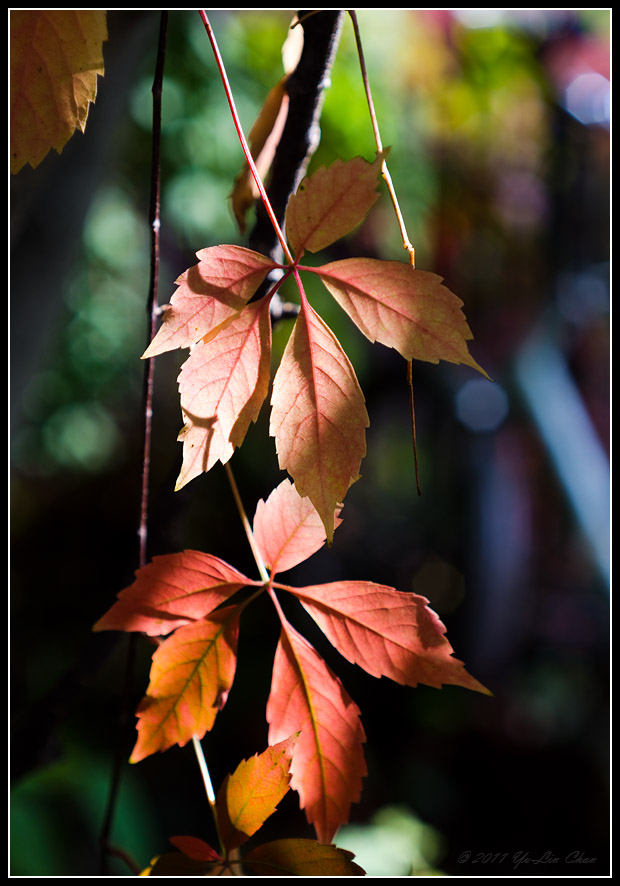
Autumn is my favourite season and I usually take a lot of pictures, but not this year.  Seeing that the colours of the trees are quickly changing, and the weather is getting colder, I know if I don't go out and take some pictures of fall colours, that would be it this year.

I like to use long lenses to shoot the fall and the at wide apertures, because I like the look of the bokeh. The Canon 200mm f1.8L would have been great for this, but it's semi-dead; I can take pictures with it, but it would not focus. Then I thought about the Kinoptik 210mm f2.8 Speciale Cine and it's beautiful rendering, I thought it would be a good lens to use.  I was not disappointed.

There is something about the cinematic lenses that renders pictures so beautifully that I like a lot. If it were not so large and heavy, I would have used it far more often.

All pictures below were taken with the Canon 5D Mark II & Kinoptik 210mm f2.8 Speciale Cine.


Friday, November 2, 2012

It's always sad to see the fall going away, along with the beautiful and vibrant colours.  The temperature is getting colder  I can already feel the chill in the air.  Better get used to it.  I think it's going to be a long and cold winter.

End of Autumn - Sony NEX-5N & Rodenstock Rogonar 50mm f2.8 Enlarging Lens

Monday, October 22, 2012

Guildwood Park - October 2012

Yesterday, Sally, Lisa, Dillon and I went to Guildwood Park to shoot the autumn colours.  Guildwood Park is one of my favourite places photograph in the fall.  We also went there last year and thoroughly enjoyed it.  In addition to the 200mm f1.8L, I brought a lot more equipment this year, including the 70-200mm f4L IS that I traded the 70-200mm f2.8L IS for, and never really used it, and the NEX-5N with the Wollensak 209mm f4.5 copy lens.

As usual, the 200mm f1.8L did not disappoint, but sadly, it's now broken, and may never be working again. The 70-200mm f4L IS is fantastic.  I actually like it more than the 70-200mm f2.8L IS version.  It's a lot sharper wide open and the IS is very effective.  Due to the dim lights in the woods, I shot most pictures either wide open or 1/2 a stop down.  If you don't need f2.8 for the popular zoom range of 70-200mm, I would suggest the f4L IS.  Well worth the money, and much lighter and easier on your body (and wallet).

More interesting is the comparison of the Wollensak 209mm f4.5 and the Canon 70-200mm f4L IS at 200mm.  The Wollensak was shot on the NEX-5N and you can see the very significant colour and rendering differences between the two lenses.  The NEX-5N and the Wollensak has a lot less saturation and contrast, where the Canon is the opposite.  I can't remember, but the lighting might be slightly different as the sun was doing hide and seek.  Aside from the colours, the bokeh is night and day too.  This shows how, despite the similar focal length, pictures can be vastly different between lenses; each has its own characters.  Which one you like is a personal preference.  For black & white photography, I think the Wollensak will be excellent.  

Young Tree - NEX-5N & Wollensak Raptar 209mm f4.5 Copy Lens. Click for larger.

Young Tree - Canon 1D Mark III & EF 70-200mm f4L IS @ 200mm f4. Click for larger

Bokeh - NEX-5N & Wollensak Raptar 209mm f4.5 Copy Lens. Click for larger.

Bokeh - Canon 1D Mark III & EF 70-200mm f4L IS @ 200mm f4. Click for larger

Fallen Leaf - Canon 1D Mark III & EF 70-200mm f4L IS @ 200mm f4. Click for larger

Reflection - Canon 1D Mark III & EF 70-200mm f4L IS.

Monday, October 8, 2012

My In-Law's Backyard

It's unbelievable how many hours I have spent in my in-law's backyard taking pictures over the last 15 years or so.  Considering that it does not even have a garden, what makes it so attractive to me?  Boredom, really.  We visit the in-laws once a week on the weekends, with very little interruption.  Most days, my kids can hang out with their many cousins, and I usually just go out and take pictures, and in the backyard I spent countless hours, taking mostly close-up pictures of whatever look interesting.  I actually was thinking about making a photobook with the many pictures I took there. Interestingly, I never get bored doing it.  There is always something that I can find worth photographying.

Colour Leaves at in-law's backyard - NEX-5N & Kern-Paillard Switar 50mm f1.4. Click for larger.

Tuesday, October 2, 2012

Sign of Autumn

Autumn has always been my favourite season.  For those of you who live in paradise where temperature is pretty much constantly warm all year round, you may not understand the big deal of changing of seasons.  To me, autumn is a perfect balance; no hot temperature and high humidity of summer, and no bone chilling winds of winter.  Just crisp clean air, with beautiful changing of colours.

Sign of autumn - NEX-5N & Apollo 135mm f1.8

Thursday, October 13, 2011

EL-Nikkor 63mm f3.5 - Samples

It took me a few days to get the Nikon EL-Nikkor 63mm f3.5 enlarging lens to focus to infinity.  Frankly, I am a wee bit disappointed.  Although I didn't shoot a lot of pictures with it, but the EL-Nikkor 50mm f2.8 is better in terms of image quality, especially at infinity.

Park Bench -- NEX-5N & EL-Nikkor 63mm f3.5 enlarging lens. Click for larger.

One interesting thing about the lens, like some other enlarging lenses, is that at wide open, the aperture blades are not hidden, like a normal lens does.  So, this lens probably has a maximum aperture of f2.8 when completely open.  The later version of this lens actually was rated at f2.8, at about the same size.  Quite possibly at f2.8, the image quality was not up to Nikon's standards, hence the stopped-down maximum aperture.  The picture below was shot at f3.5, but you can see the octagonal shape in the out of focus area:

Bokeh at f3.5 -- NEX-5N & EL-Nikkor 63mm f3.5. click for larger.

The image quality is by no means bad.  It's actually very sharp at close range.  Just not as good at infinity.  It does not have the micro contrast as the EL-Nikkor 50mm f2.8, possibly due to the coating (or lack of multiple coating) on the 63mm f3.5.  But, the built quality is fantastic with all metal lens barrel and mount.

Fall Leaves -- NEX-5N & EL-Nikkor 63mm f3.5.

This lens is believed to be able to produce pictures in the UV region.  I don't know if this is true or not.  Not that I care much as I don't have a UV capable camera.

Overall, it's a nice little lens which complements the EL-Nikkor 50mm f2.8 nicely.

Saturday, November 13, 2010

Prelude to Winter

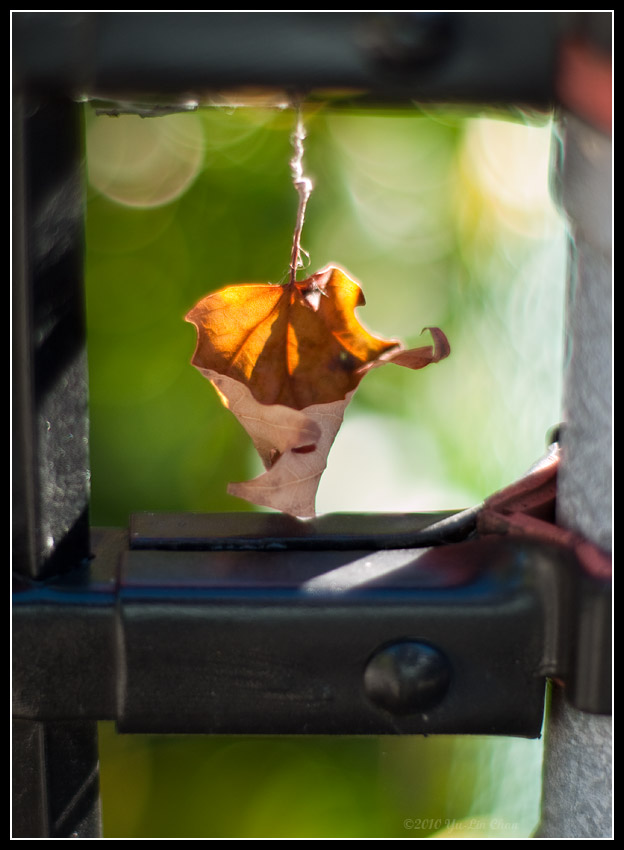
Lone Leaf - 1D IIn & 16-35mm f2.8L II. Click to enlarge.

Autumn has always been my favourite season.  Not too cold, not too hot.  It's Goldie Locks sort of season. Not to mention the beautiful colour that's a yummy feast for the eyes.

This year seems very warn in this time of the season.  We are in mid November but temperature is still in the low teens (Celsius).  Not that I am complaining or anything.  I rather enjoy it until the bone chilling Canadian winter hits, which won't be long.

Monday, November 1, 2010

When Your f1.2 Lens Is Not an F1.2 Lens

The Luminous-Landscape has an open letter to the camera manufacturers. Interesting and fascinating read.  Basically, depending on the individual camera, you could lose as much as a full stop of light by the time the light hits the sensor, according to the DxO Lab's findings. Most APS-C sized sensors would lose anywhere from 0.75 EV to 1 EV.  So, the actual amount of light from an f1.2 lens on the Canon 450D that the sensor receives is around f1.8.  Of course, you will still get the exposure value of f1.2, because the manufacturer raised the ISO to compensate.  This means when you set the ISO to 100 when at f1.2 on the 450D, it's actually f1.2 at ISO 200.

Should you care?  With today's high performance sensors, most people probably won't notice, or even care even if they know what's going on behind the sensor.  But that's kind of cheating, me thinks.

My take on this is this: Manufacturers should publish the behaviour of the cameras they make.  If the sensor raises ISO to compensate for the loss of light, they should mention that fact.  But, I also don't think it's a big deal, as long as you understand the image characteristics of a particular camera.  After all, the final image is what counts.

Leaf - Panasonic G1 & Minolta MD 50mm f1.2 @ f1.2.

Tuesday, October 26, 2010

Big Tree in Moss Park

Big Tree - Panasonic GF1 & Pentax-M 40mm f2.8 Pancake.

The weather has been nice and warm this year and consequently, the trees change colour gradually without turning brown from cold weather.  It's just beautiful everywhere you look, even in the city.  Autumn has always been my favourite season.  Too bad usually by November, snow will come and you can feel winter even before it's officially here.  Winter is too long in Toronto.