Showing posts with label Canon FD 35mm f2. Show all posts

Wednesday, January 30, 2013

Another Look at the Canon FD 35mm f2 S.S.C

I have lost count of how many lenses I have in the 35mm focal length, and yet, I continue to buy them. Sure sign of addiction to G.A.S (Gear Acquisition Syndrome). The Canon FD 35mm f2 was purchased a little over a year ago, but didn't get used much. I briefly wrote about it here. Dug it out and carried it around in the last few days trying to get a better feel for the lens. There is no doubt that this lens is very sharp and I found it excellent for street shooting on the NEX-6, which is roughly equivalent to 52mm in full frame terms.

The lens exhibits high contrast and sharpness is excellent. Already pretty good at f2 but much better when stopped down just a bit. I think it is perfect as a walk around lens.

Rain in winter - NEX-6 & Canon FD 35mm f2 S.S.C. Click for larger.


Tuesday, January 29, 2013

Evolution of the Canon FD Mount

Like the Nikon F mount, which has gone through many evolutionary changes, morphed itself from a simple mechanical mount to a fully electronic mount, the Canon FD also had a few changes. The difference is that Nikon made major changes to both the body of the camera as well as the lens, where as Canon did it mostly to the mount on the lens.

The FD mount started life as Canonflex R mount in 1959 with the introduction of the Canon Flex. The R mount became the FL mount in 1964, when Canon introduced the FX SLR. Both the R and FL mounts are  very simple mounts that had no automation capabilities at all. That means no aperture priority, shutter speed priority or any programmed modes you see in modern cameras. The R/FL mount was the only lens mount from a major camera maker that used breech lock mechanism for mounting the lens, whereas most others used a bayonet lens mount. The advantage of a breech lock mount, according to Canon, was that it put less stress/wear on the lens/camera and more precise alignment of the lens to film. Personally, I am not a big fan of breech lock. It takes longer to mount and the lens may become loose after a while if left on the camera.

Three Generations of the FD Family

If you look at the picture above, on the left is the original FL mount. You can see that the only part that the camera can control is the aperture lever. The camera does not know what maximum aperture your lens is, or what aperture you have set on the lens. Everything is manual.

Then in 1971, Canon introduced the flagship F1 Single Lens Reflex camera, along with the new mount, called the FD mount, to compete with the popular and mighty Nikon F. This iteration of the mount change includes maximum aperture detection (the big round dot at 1 o'clcok on the FD 55mm f1.2 in the picture above), as well as other programmed automatons such as aperture priority, but the mounting method remained the same as the FL mount.

Ten years later, in 1981, Canon gave the world the improved F1 called the New F1, and just like the original F1 introduction, a new lens mount, called, well, New FD. The lastest change to the FD mount essentially converted the breech lock mount system into a bayonet mount system, like very body else. With this new mount, which many people call it nFD or FDn to distinguish it from the old breech lock FD mount, mounting the lens is easy as twist and lock, instead of turning the lock ring to tighten the lens.

History tells us that Canon, in 1987, went off to a completely new path in Camera design with an all electronic mount and auto focus system, the EOS, and abandoned the FD mount completely. That was one very gutsy move on Canon's part, as it alienated all current FD users and essentially made their cameras/lenses obsolete with no future enhancements and support. But the new EOS mount proved to be a strategically successful decision. The new EOS mount made such things as Ultrasonic Motor (USM) and Image Stabilization possible. Lenses, regardless of size and focal length, focus lightening fast. This new mount basically left Nikon in the dust in the sports photography field, until Nikon started incorporating motors inside their lens, but ultrasonic motors wouldn't come until Canon's pattern on it expired.

Some of the best and most unique lenses were designed and made in the FD era. The insanely sharp and fast FD 200mm f1.8L, FD 85mm f1.2L, FD 24mm f1.4L, FD 55mm f1.2 AL (first lens to use an aspherical element) were some examples. Many of the auto focus equivalent lenses are derived from the FD designs. The mirrorless cameras have given second life to these exceptionally good and sometimes very cheap FL/FD lenses. All we need now, is an affordable full frame mirrorless to take full advantage of these lenses.

Park Bench - NEX-6 & Canon FD 35mm f2 S.S.C

Wednesday, October 19, 2011

Halloween Comes Early

Ghosts & Goblins -- NEX-5N & Canon FD 35mm f2. Click for larger. 

I was sitting in the car, waiting, and bored.  Rain was coming down pretty hard.  I looked through and windshield and found some interesting patterns, so I took out the camera and started to play around with various apertures.  Some of the pictures turned out interesting, like the one above, which looks like ghosts.  So yeah, there are picture opportunities everywhere.  They may not be master pieces, but definitely better than no pictures at all!

Tuesday, October 4, 2011

Why We Are Not Getting What We Want

EOSHD has a very nice article on camera manufacturers moving away from real camera enthusiasts and cater to the masses who don't care much about real cameras.  I agree with everything the article says, and it's truly sad where the market is heading.

Nikon is rumored to have a 36MP D800 coming very soon.  Think about it.  Couple of years ago, lower end medium format digital backs were at this resolution.  What is the real percentage of photographer who actually NEED this kind of resolution?  The rest just wanted a camera that can show off the fact that they have the highest resolution 35mm digital SRL in the world (at the moment, because Canon/Sony won't be far behind.  We can count on it).

Another case in point is the 24MP Sony sensor used in the A77/A65/NEX-7.  I am sure more people will buy the NEX-7 if the sensor is the excellent 16MP one used in the NEX-5N, especially if at a lower price point.  Alas, camera makers yield to their marketing department, instead of making sensible, balanced, affordable camera equipment that real camera enthusiasts want.  Instead of gitapixels sensors, why not an excellent 16MP full frame sensor that have good dynamic range, excellent colour depth, clean high ISO?  With today's technology, it's so easy to accomplish.

I know I sound like I am beating a dead horse, but perhaps, if more of us complain and let the manufacturers know, there is a chance, however minute, that they would listen.  So, let our voices be heard!

Colourful Streetcar -- NEX-5N & Canon FD 35mm f2.

Monday, October 3, 2011

Canon FD 35mm f2.0 SSC -- First Day Out

Church -- NEX-5N & Canon FD 35mm f2.0. Click for larger.

Today is sort of a perfect day for photographs -- overcast sky after a light misty rain and the greens are very green and colours seem to jump out at you.  I was eager to try out the FD 35mm f2 that I bought from the camera show yesterday.

It turns out that the warming effect was from the yellowing of the glass elements.  This version of the lens is "radioactive", because the glass contains thorium.  This is similar to the famous yellowing on many old Takumar 50mm f1.4 lenses.  The solution is to expose the elements to UV light.  For me, it really does not matter, as one of the advantage of shooting RAW is that you can adjust white balance afterwards.  I actually like slightly warmer colours.

The lens is very sharp, which is the consensus of most of its users.  There are six or seven versions of this lens and later design has a different optical formula with a convex front lens surface, whereas the older design has a convcave front element (my EF 180mm f3.5 Macro also has a concave front element).   Regardless design, all versions are very good lenses.

So far, the only aspect of the lens I don't like, is the bokeh.  The lens itself has an 8-bladed aperture, which I thought should give better looking bokeh, but to me, the bokeh just looks weird.

Bokeh -- NEX-5N & FD 35mm f2. Click for larger.

Sunday, October 2, 2011

Another Camera Show

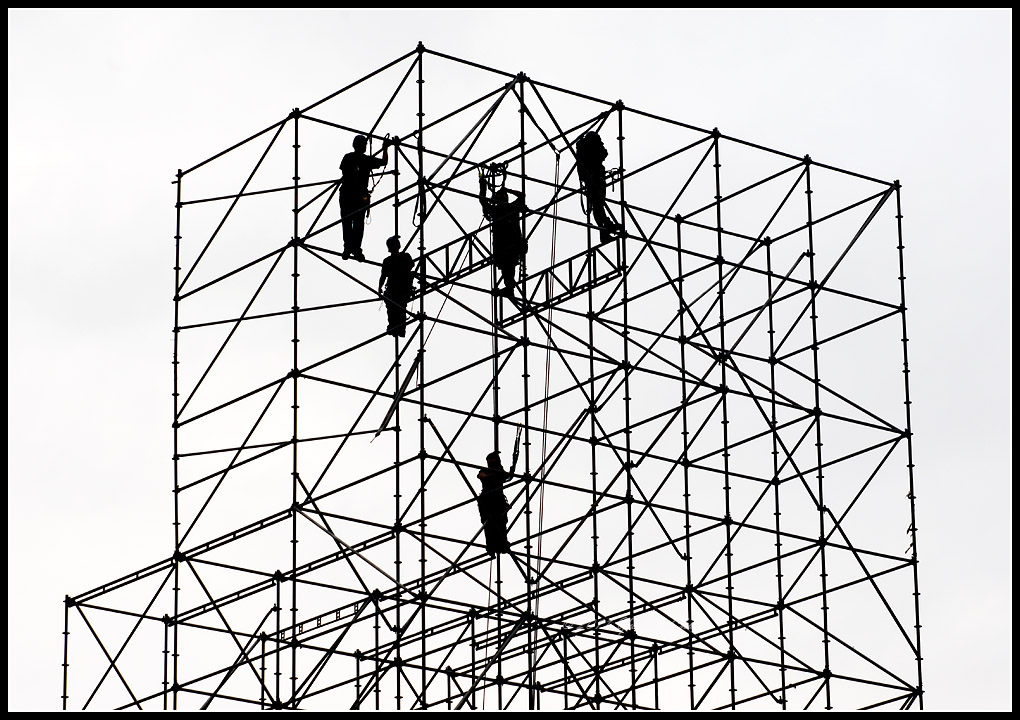
Men at work -- NEX-5N & Zoomar Kilfitt 90mm f2.8 Makro. Click for larger.

Went to another photo show today, but managed not to spend too much this time.  Picked up a couple of lenses and a couple of enlarging lenses, one of which is a EL-Nikkor 63mm f3.5.  This lens has been rumored to have the capabilities to produce photographs in the UV spectrum, and thus the price was very high.  Not sure what the situation is now, but I thought it would be a nice complement to my EL-Nikkor 50mm f2.8.  Held it to my NEX-5N and took a test picture, and indeed it's an extremely sharp lens.

Also picked up a Canon FD 35mm f2.  The lens is in pretty bad cosmetic shape, but the optic is clean.  This is the first fast wide angle Canon FD lens I have.  The FD 35mm f2 is a highly regarded lens and I can confirm that it's optically superb.  Took some shots against the Olympus 35mm f2 and two things were noticeable.  The colour is warmer on the Canon and the OM 35/2 is more neutral.  The Canon is slightly sharper at f2 and even the edge (on the NEX-5N) is very good wide open.  Can't wait to shoot some pictures with it.