Sunday, August 22, 2010

William

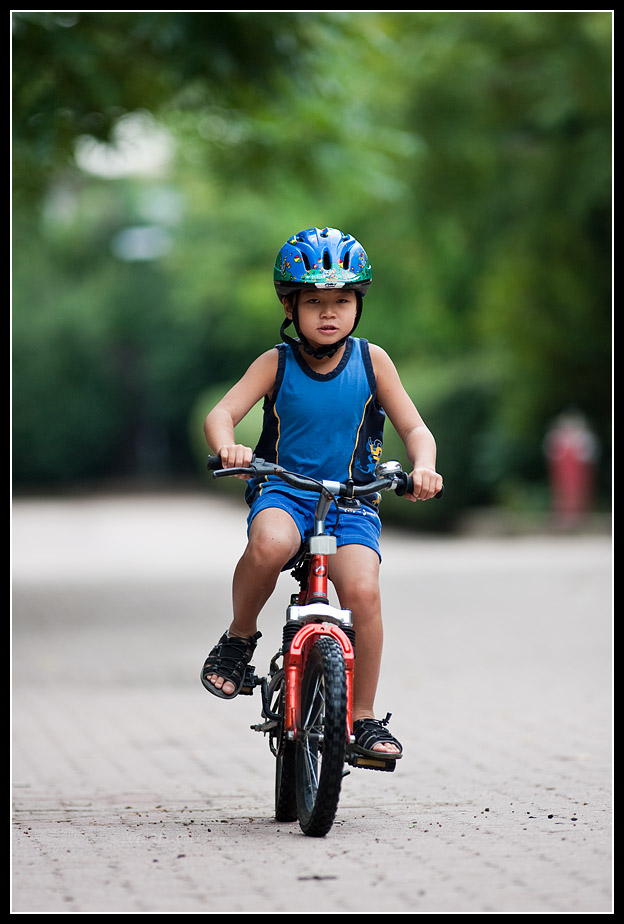
William -- 1D IIn & EF 200mm f1.8L @ f2.2.

One of the characteristics of a very fast telephoto lens, is the very thin depth of field (DOF), even at a distance.  This thin DOF makes the subject that's in focus look like it's carve out of thin air.  Unfortunately a lens like the 200mm f1.8 is just too heavy to be used all the time.  Without a monopod or tripod, it's hard to hand hold for longer than 5 minutes at a time on the 1D II.  But, whenever I have a chance to use it, it never disappoints me.

Red Leaf

Saw this tree today with beautiful fall colours.  It really stood out among all the green trees and grass.  It actually gave me a mild shock -- Is fall already here?  Come to think of it, it's really not that far away.  After all the humid and extremely hot days this summer, I am looking forward to cooler fall temperatures and colourful leaves.

On another note, what I have missed the most from the Canon T2i and 7D (and 1D III), is the sensor dust shaker.  I never had to worry about dust in the sensor of those cameras and after getting used to dust free images, it's almost unbearable to look at pictures taken with the 1D IIn (and the 5D), especially macro shots, where the aperture is very small and shows the dust particles so clearly.  Nothing I can do, unfortunately.  I just need to clean it myself once in a while.

Red Leaf -- 1D IIn & EF 100mm f2.8L.  Click to see larger picture.

Wednesday, August 18, 2010

Waiting

Ryan -- 1D IIn & EF 16-35mm f2.8L II. Click to enlarge

I am not a big fan of zooms, but I find the 16-35mm focal length very versatile and convenient.  The image quality is close enough to primes when stopped down a bit, though the maximum f2.8 aperture is a bit slow for indoors use. So far, very satisfied with the lens.

Tuesday, August 17, 2010

Canon EF 28mm f2.8 - The Unloved One?

Almost all of Canon's consumer primes have a large following, and garner good praises from their owners.  But, there are always exceptions, right?  The 20mm f2.8 and the 28mm f2.8 are two Rodney Dangerfield of lenses that seem to get no respect from prime lovers.

I happened to have owned both of these lenses (as well as the 28m m f1.8 version, brifly).  The 20mm is actually not bad, in the center, but the corners were not good the last time I used it.  Sicne this ultra wide angle was designed as a landscape lens, bad corners are definitely a no no, so it's understandable when it doesn't receive good marks from users.

The 28mm f2.8 was designed as a general purpose, go anywhere lens for film cameras.  It was one of the first very few lenses introduced back in 1987 with the new EOS mount.  Along with the 24mm f2.8, 35mm f2 and 50mm f1.8, they have the most common consumer primes in the EOS  mount.  But  the design has not been updated since with the exception of the 50mm f1.8, which was redesigned and downgraded to have a plastic mount and the removal of the distance window/scales.

Is the 28mm f2.8 really that bad?

Being a 28mm lens, it has to be pretty special to stand out, because this is one of the most common focal length in 35mm photography.  The other is the 50mm.  The fact that Canon also makes a 28mm f1.8 does not help promote the f2.8 version.  Most people who are looking for a lens in this focal length would get the f1.8 version, or spring for a third party version, like the Sigma 28mm f1.8.

The last time I had this lens was when I had my Canon 10D.  The 10D was not known for auto focus accuracy and not surprisingly, I didn't like the lens on this camera.  On the 1D series, or Canon bodies with more updated auto focus system, the lens works like a charm.

No, it's not sharp like the 100mm f2.8L macro, that's insanely sharp.  It's also not as sharp as the 35mm f1.4L, that's also extremely sharp, but it's sharp enough.  I would even go as far as very sharp.  It's also not contrasty as the L lenses, but keep in mind that this is the cheapest Canon prime lens you can buy, besides the Plastic Fantastic 50mm f1.8 II.

I am happy to say after f8, on my 1D IIn, the corners are very good indeed.  Could be worse on full frame though.  I only notice slight degrade in image quality at the far edges (1.3x crop).

If you have a good body that can drive this lens accurately, you will be very happy with the results.  It's very light and small and has a metal mount with distance window/scale.  The bad?  Arc-Form Drive (AFD) motor is nosier (but not too objectionable), and a redesign is really needed.  My verdict?  It's good value for the money.

Corner of Soho & Queen -- 1D IIn & EF 28mm f2.8. Click to see larger.

Observation Deck -- 1D IIn & EF 28mm f2.8. Click to enlarge.

 
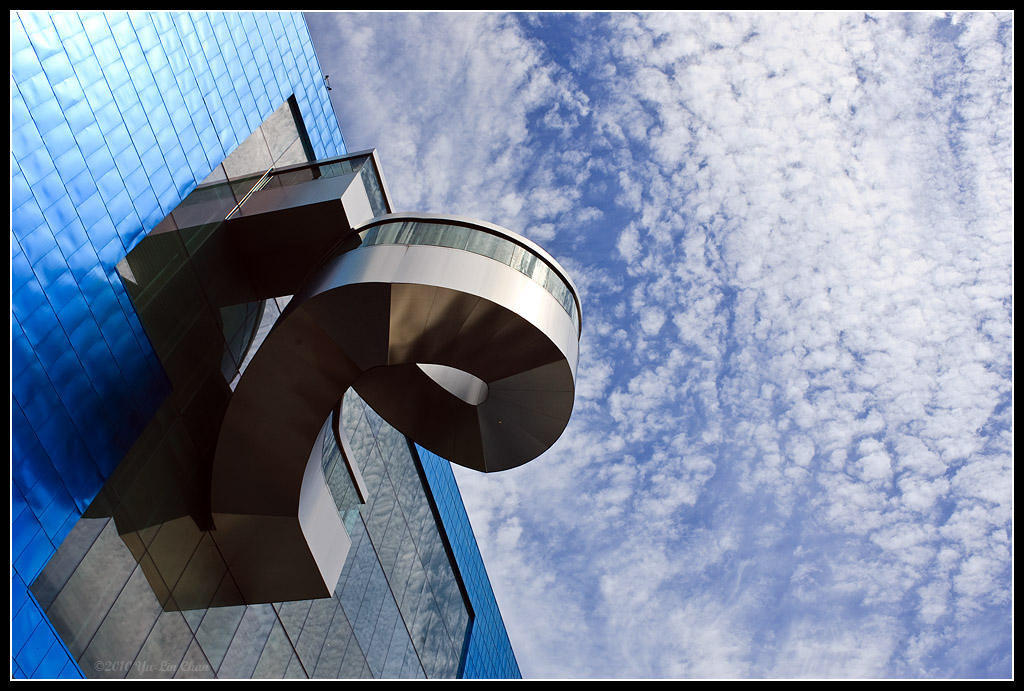
Umbra Building -- 1D IIn & EF 28mm f2.8. click to enlarge.

Monday, August 16, 2010

Varsity Stadium

Took Ryan and Dillon to the music exam this morning.The Royal Conservatory of Music building has been renovated and looks really nice.  Retains most of the old characteristics of the building but adds a modern touch.  Nice.  The waiting room on the fourth floor has a great view to the Varsity Stadium below.  Imagine watching a football game from this room.  It would be amazing.

 
Part of the Varsity Stadium -- 1D IIn & EF 16-35mm f2.8 II. Click to enlarge.

Sunday, August 15, 2010

Speed Cubing: Toronto Open, Summer 2010

The Toronto Open, Summer 2010 Speed Cubing competition was once again held at the Seneca College's Resident Conference room in Toronto.  The usual competitors showed up, except Harris Chan, who did not attend this event.

The winners 3x3 of last event were all overtaken by new winners.  Eric Limeback and Emily Wang didn't even get into the third place, though they made it to the final round.  Anthony Brooks from Texas won the 3x3 first place with a 10.79s average of five solves. Rowan Kinneavy won second place with average of 11.09s and Jai Gambhir held third place with average of 12.50s average.  The most amazing event was the 5x5 blind fold solve by Mike Hughey of Indiana.  Though he didn't finish the official event, but he did it later on his own in about 17 minutes.

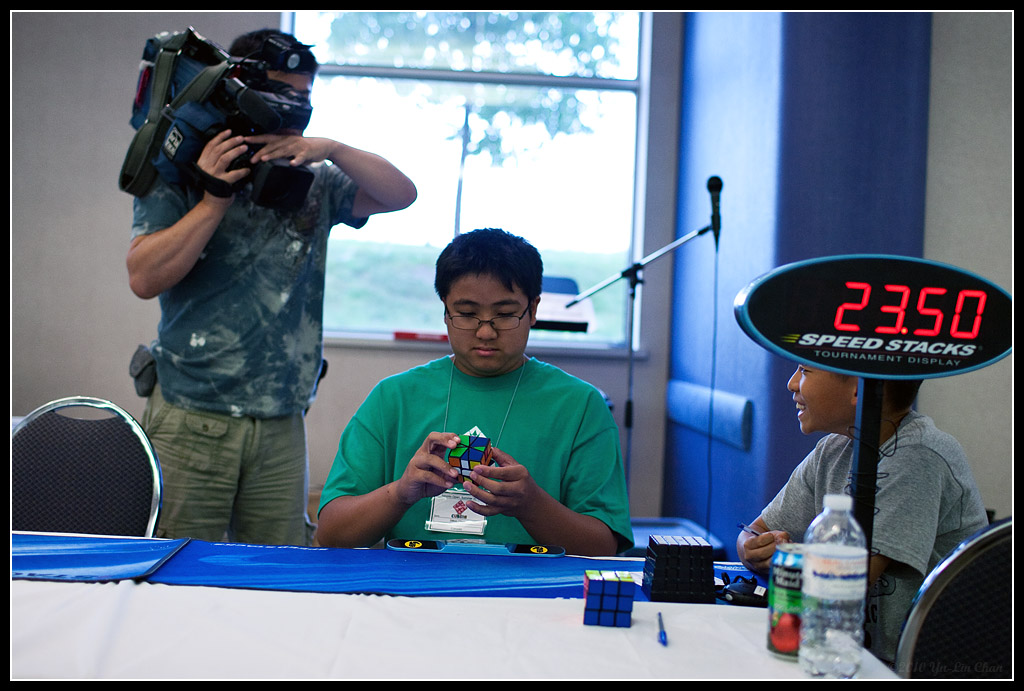
Dillon and Ryan did better than last time.  Dillon achieved his best official time of 16.44s for a 3x3 solve.  Unfortunately, with the average of 20.89s, it was not enough to get into the second round.  Ryan on the other hand, won first place in the Rubik's magic solve with an average of five solve at 1.28s.  He's in the top 100 average world record holders.  Very proud of him. 

Best official Record. Click on enlarge.

Dillon Solving a Square-1 with Fairchild TV cameraman filming in the background. Click to enlarge.

Mike Hughey just completed an unofficial 5x5 blind fold solve in 17 minutes, with his daughter Rebecca making sure he's not cheating.

Ryan (middle) took 1st Place for Rubik's Magic. Click to enlarge.  Dave Campbell on the right is the organizer.

Tuesday, August 10, 2010

Canon EF 100mm f2.8L IS Macro

 just realized that I like lenses more than camera bodies.  I started my equipment reshuffle few months back, and the plan was to have a fast camera, in the case, the 1D Mark IIn, and a full frame camera, which I haven't got.  Originally, the 1Ds Mark II was my choice, but changed my mind midway and instead decided on the 5D Mark II, a more modern sensor, whose image quality I really like.  Unfortunately, the plan isn't working.  I use the money saved for the 5D II to buy the 100mm f2.8 IS macro lens instead.

This seems like a stupid idea, because I already have the 180mm f3.5L macro, which I used two to three times a year.  Besides, I have four other manual focus macro lenses in various focal lengths.  Why on earth did I buy another macro lens?  I don't even shoot macro that much.  Further more, I have had the EF 100mm f2 lens for years and really like it.  I know, I am out of my mind, but I am not regretting it.

You see, the 100mm f2.8L is such a marvelous lens, once you use it, you will immediately think it's worth every penny.  Really.

I know I have had it only two days, but it really impresses me.  The much hyped hybrid IS really does work.  The image from the viewfinder is rock solid with the IS on.  This is one of the best advantages about lens based versus camera body stabilization.  You can see the effect in the viewfinder with lens based IS.  I don't have very steady hands, but sharp pictures taken on 1/8 of a second is very repeatable.  Not every time, but very good chance.  It's less effective at minimum focusing distance, but still much better than without.

The other feature that stands out is the focusing speed.  Sure, if you rack it from closest focusing distance to infinity, it takes a couple seconds, simply because the focusing throw is very long, typical of macro lenses, but within focusing range, the subject snaps in focus instantly, even in full macro.  Much faster than the 180L in this regard.  Simply amazing. 

The 100mm f2.8 IS is sharper than your mother-in-law's tongue.  Much much sharper.  Easily one of the sharpest lenses I have used.  I am talking about sharp wide open, not stopped down.  Stopping down only improves sharpness marginally.  The colour and contrast is typical L lens.  Oh, the bokeh is amazingly good and pleasing.
 
If I have to find fault with this lens, it would be the missing tripod collar that should be included with the lens, and instead, Canon charges something like $200 for it!  Insanely greedy on Canon's part.  The other thing is the depth of field is not as shallow as I would like, even at f2.8, but I am splitting hair here.

If you are looking for a macro lens, please try the 100mm f2.8L.  You will be sorry if you don't and end up with something else later on.

Is it time for me to get rid of the 180L macro, and the 100mm f2 L like lens?  Not right now, but intend to test the two 100mm lenses, not for their close up capabilities, but the affect of one stop of light on depth of field.  Stay tuned.

Flower at f2.8 -- 1D IIn & EF 100mm f2.8L IS. Click to see larger.

Bee -- 1D Mark IIn & EF 100mm f2.8L IS. Click to see larger.


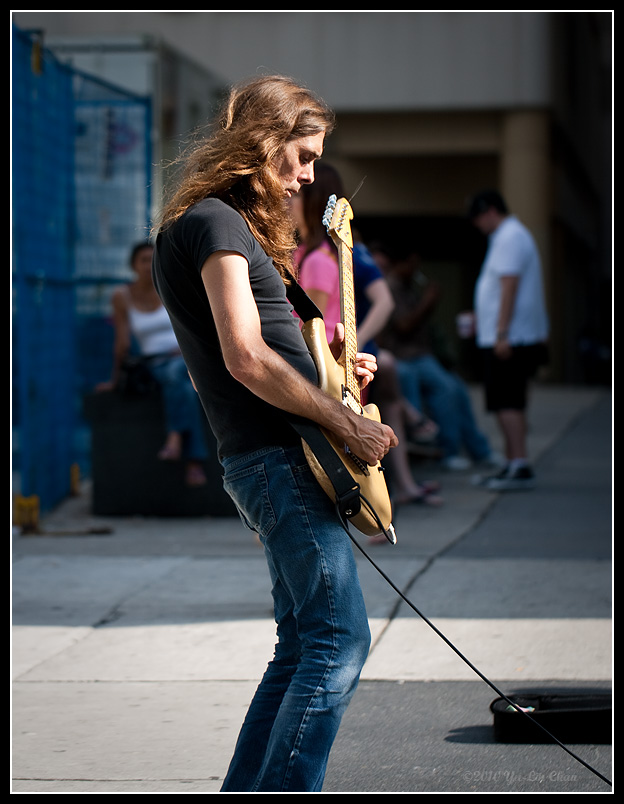
Street Musician -- 1D IIn & EF 100mm f2.8L IS @ f2.8. Click for larger
Monday, August 9, 2010

Rest In Peace - Karl

Today I heard the sad news that Karl Wright passed away on August 1, 2010.  Karl was a regular at the old Henry's Outlet Store on Queen & Church, and that's where I first met him.  For his age, Karl was very strong and looked fantastic.

I think a couple of years ago, Karl underwent heart surgery, and he never looked the same ever since.  Few weeks ago, I met him again at the new Outlet Store in Mississauga, and I could not recognize him.  If it were not for Paul pointing him out, I wouldn't have known it was Karl.  He was very frail and weak.  In fact, he told me his wife had to drive him to the store.  See, Karl was a photo nut until the very end. 
 
May your soul rest in peace, Karl.  You will be missed.

Thursday, August 5, 2010

Men at Work

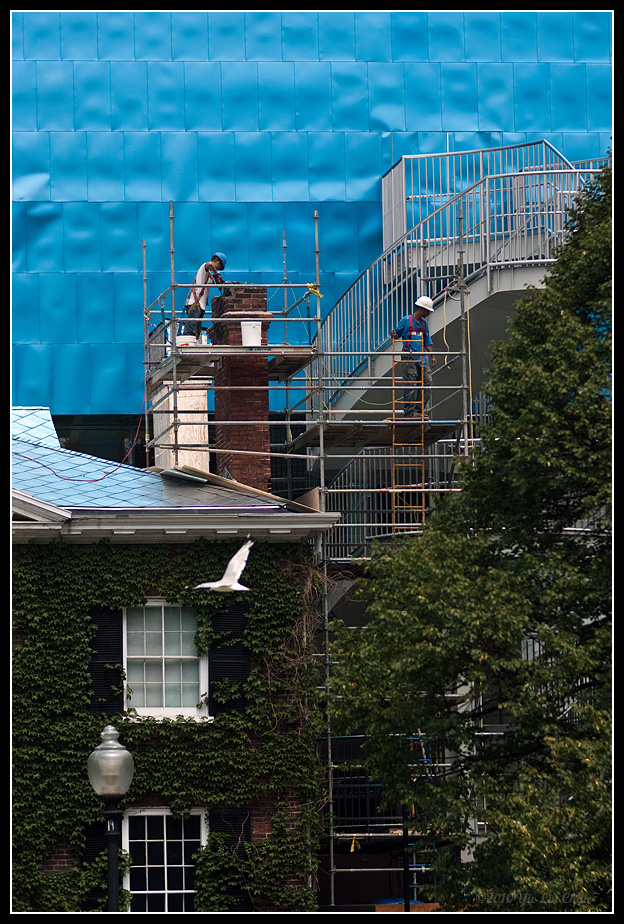
Men at Work -- 1D IIn & Kinopik Special Cine 210mm f2.8

Feeling lazy lately and wasn't actively taking pictures, even though I have had my camera with me.  Decided to take a walk around the back of AGO, and saw these two men working on the chimney.  Took along the Kinoptik 210mm f2.8 (T3) cine lens, but somehow, this lens works best with the 5D.  I mean it works fine on the 1D IIn, but it seems to lack something that was present on the pictures taken with the 5D.  In any case, this Kinoptik is one of my favourite cine lenses, certainly one of the most expensive cine lens I have paid for, and I am sure it will also be the last.

Tuesday, August 3, 2010

Sharing a Moment

A moment shared -- 1D IIn & EF 85mm f1.2L @ f1.2, ISO 400. Click to see larger

One of the biggest advantage of having a very fast lens is that you can shoot in dim lights with relatively low ISO and fast speed.  Even better if the lens is usable at it's widest aperture.  The Canon EF 85mm f1.2L is such a lens.  Absolutely my favourite next to the 200mm f1.8L.  It's much more portable, and a full stop faster than the 200mm f1.8.  The 85L is stunningly sharp at f1.2, if focus is nailed, which is quite often with the 5D/1DII.  Less so with other cameras I have tried.  To be sure, there are drawbacks.  Mainly the high price, slow(ish) focus, prone to purple fringing (so is the 50L), and a bit heavy (although after using the 200mm f1.8L, the 85L is featherweight).

The 85L is a lens I always take with me when shooting in dim lights.  It does not have the focus shift problem of the 50mm f1.2L, and I can always count on its image quality, even shooting at f1.2.  If you can justify it, you will love it, and may never shoot another 85mm lens again.