Monday, August 2, 2010

Canon EF 16-35mm f2.8L II - First Impressions

So this is my second try with the EF 16-35mm f2.8L lens -- the widest full frame flagship zoom lens that Canon makes.  My first one was the original version, which I wasn't quite impressed with the edges on full frame.  When introduced, this lens was expensive and only recently has the price dropped a bit.  I saw someone on Craigslist who wanted to trade this lens for a 100-400L so I went for it.  Really can't justify keeping the 100-400L and used it once or twice a year.

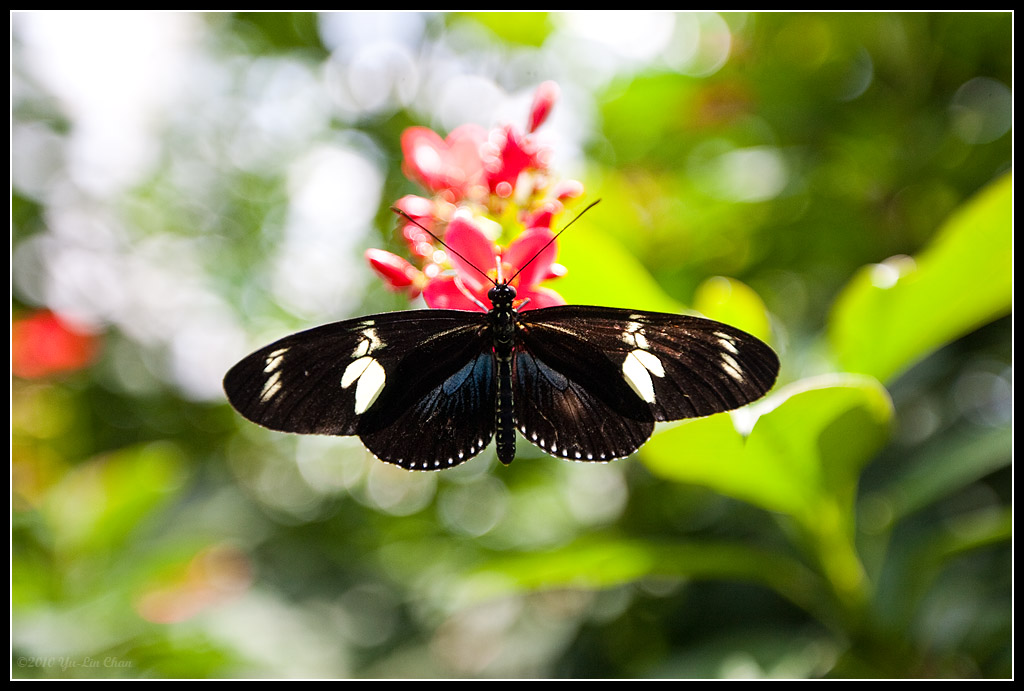
I am more than happy with the optical performance of the lens.  Very sharp wide open at the center, and the edges (on the Mark IIn anyway) is vastly improved over the original version.  As with most wide angle lenses, this one can focus really close.  So, in a pinch, you can use it as a mini macro lens, which was what I did to photograph the butterflies in the Butterfly Conservatory in Niagara Falls.  I meant to bring my 180L macro lens, but forgot to at the last minute.  The 50mm f1.2L that I also brought has an even less magnification ratio than the 16-35.

It's normal to expect great colour and contrast from Canon L lenses, and this one is no exception.  Distortion is well controlled and focusing is very accurate, at least with my copy.  I am surprised to see that the bokeh is actually quite nice, for an ultra wide angle lens with three aspherical lens elements.  The size is similar in both versions.  The only thing I am complaining about is the huge filter size at 82mm, from 77mm of the original version.  A good 82mm circular polarizing filter could put a small dent in your bank account.

Overall, it's a great lens, albeit expensive.  A worthy upgrade from the original version.

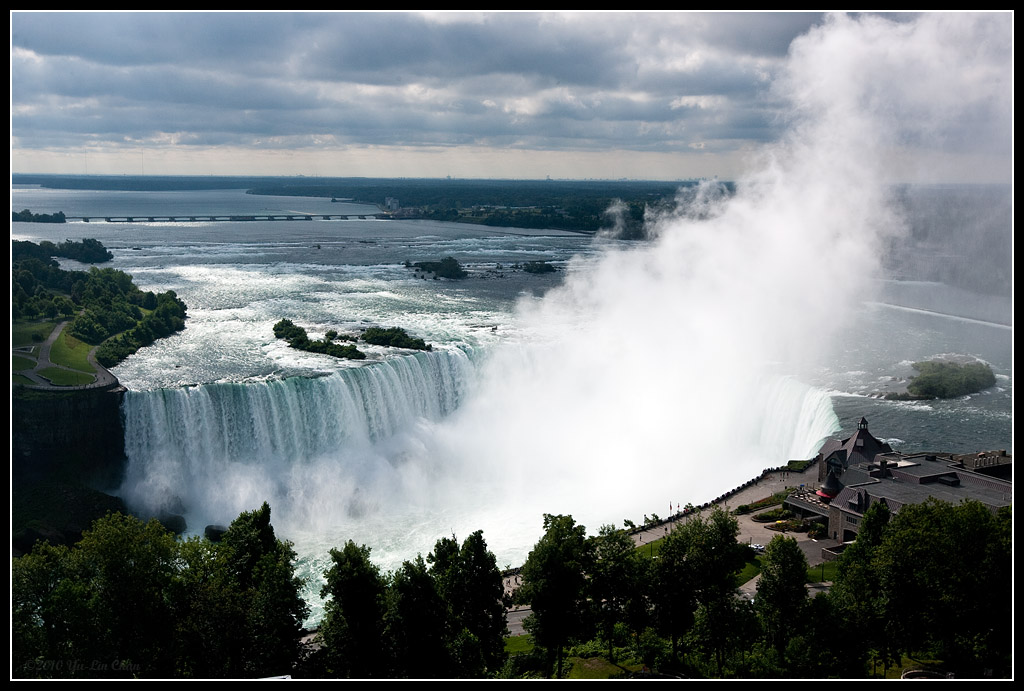
Niagara Falls looking down from the 20th Floor -- Canon 1D IIn & EF 16-35mnm f2.8 II. Click picture to see larger.

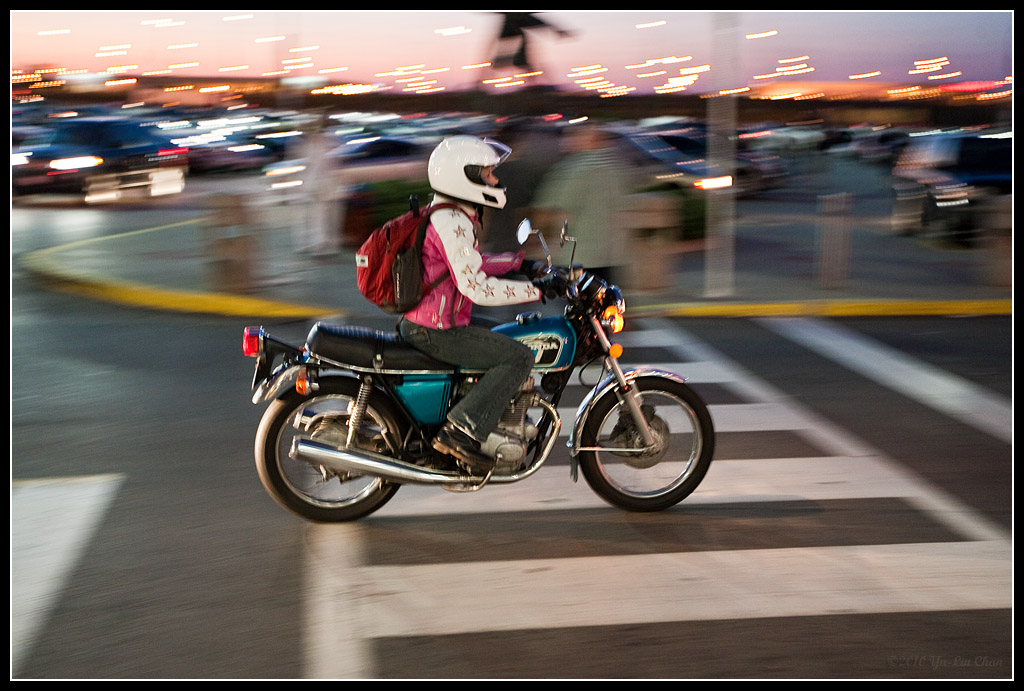
Night Rider -- 1D IIn & EF 16-35mm f2.8L II. Click to see larger.

Butterfly - 1D IIn & EF 16-35mm f2.8L II. Click to see larger.

Tuesday, July 27, 2010

Ontario Place

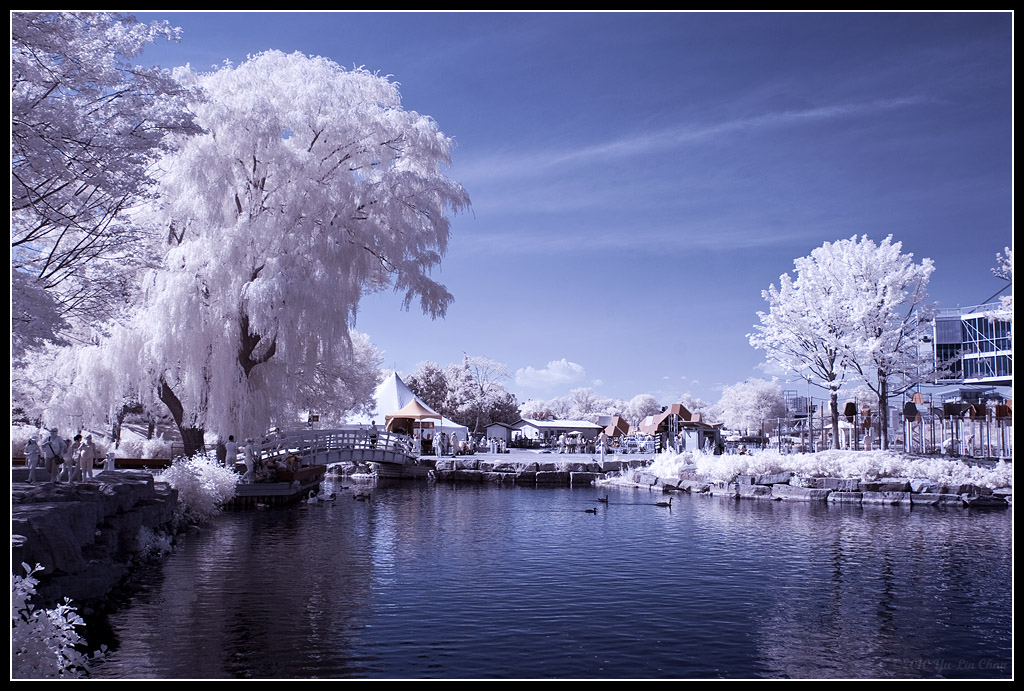
Ontario Place in IR -- Canon 20D IR & Pentax-M 20mm f4. Click to see larger

This year has to be the hottest and the most humid year I remember.  As much as I love summer, this weather is driving me crazy.  I am even looking forward to winter if this weather continues!  The good side to this is that sunny days like this are perfect for IR pictures. 

Sunday, July 25, 2010

Saturday, July 24, 2010

Going Wide

More equipment shuffle.  Today I swapped my seldom used Canon 100-400mm f4-5.6L lens for a 16-35mm f2.8 II.  Two extremes.  I find myself not using the very long lenses much, and the wide angle is far more useful to me as a everyday shooting lens.  The Sigma 15-30mm f3.5-4.5 that I have been using is not bad, but has no HSM, and extreme corners are also a bit soft, though on the 1.3x to 1.6x crop bodies, it's actually not bad.  But, it's time for an upgrade.

The 100-400mm is very decent lens.  Sharp enough for most occasions even wide open.  And it's usable with a 1.4x converter and still able to auto focus on 1-series bodies.  I enjoyed the dozen or so times that I used it in the last two years.  The image stablization was more effective than I expected.  The only thing I didn't like it much was the f5.6 maximum aperture in the long end, and the fact that this thing looks intimidating when fully zoomed and with a hood on. I also didn't mind the push-pull zoom either.  The lens was sealed well enough that I haven't noticed any dust inside the lens.

The 16-35mm f2.8 II is the second generation of this bread and butter lens for most pros.  I owned the original version and didn't know how Canon could charge such an insane amount of money for a lens with such bad edges on full frame.  I eventually sold it back to the person whom I bought it from, a year later, and he seemed not to mind the soft edges at all.  The MK II is improved, no doubt, but not to the extend that it could compete with the ungodly sharp Nikon 14-24mm f2.8. What's a Canon user to do?  Switch to Nikon?  For most of us, we just take what Canon offers, unfortunately.  At least most users of this 16-35mm lens seem to be quite happy with it, and I am sure I will be happy with it as well. Time will tell.

Thursday, July 22, 2010

Kew Beach

Kew Beach -- Canon 1D Mark IIn & EF 135mm f2L. Larger.

One of the things that makes owning a flagship Canon camera is that you can trust it to give you what you expect, especially with the autofocus.  Whenever I use my 1-series camera, with the exception of the short lived (to me) 1D Mark III, I have complete trust in its autofocus system, and that's a liberating feeling.  I can concentrate of capturing the moment instead of worrying about if the picture will be in focus or not.  And, you know the image quality is the best that Canon can produce in that generation of sensor design.  I have never been disappointed with image quality, when you remember its limitations.  The original 1D and 1Ds weren't great at high ISO, but they were clean and near perfect at base ISO. With each generation of sensor design, they only get better.  Remember, I am talking about the 1-Series, not the 7D or T2i, which I wasn't impressed with at all.

So, I am quite happy with the Mark IIn.  It's a very balanced camera and the most reliable. I am sure this will be with me for a couple of years at least, until I can afford a 1D mark IV.

Tuesday, July 20, 2010

Adam's FM2N

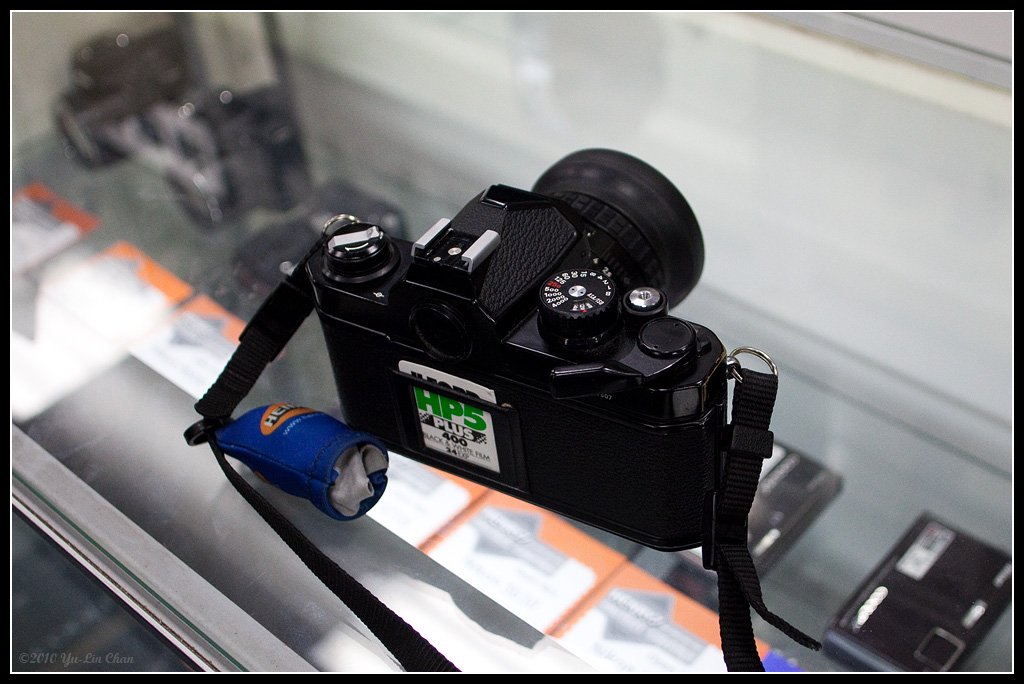
Adam's FM2N -- Taken with 5D II & Canon 24mm T/S lens, ISO 1600. Larger

Was doing some research on the 5D Mark II, which I really want to be my next camera.  After some thought, I have decided to go for the 5D II instead of the 1Ds II.  So I was digging into my archives for some sample pictures I took almost a year ago at the old Henry's Outlet Store with the 5D II.  So far, I am quite happy with the 5D's images at 1600 ISO.  It does not have the muddiness that the 7D and T2i images do at anything over ISO 200.  This re-enforces my decision to get the 5D II.

Anyway, Adam's FM2n is gone.  I am sure he will miss it, and I won't be surprised that he even buys it back later.

Monday, July 19, 2010

Port of Toronto II

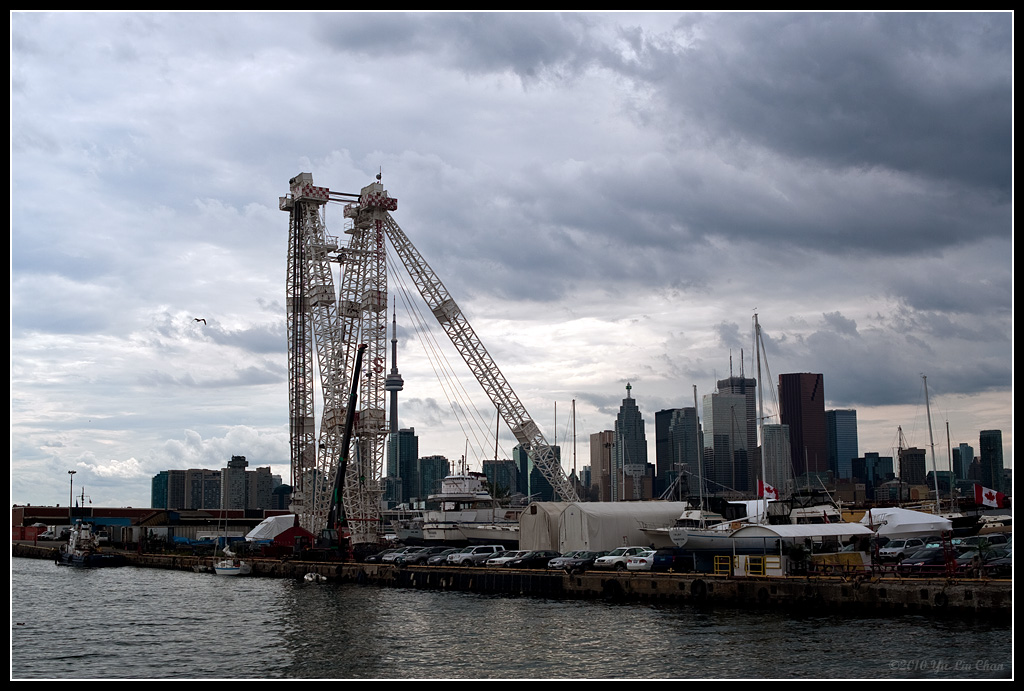
Port of Toronto -- Canon 1D Mark IIn & Tamron SP Adpatall II 35-80mm f2.8-3.8. Larger.

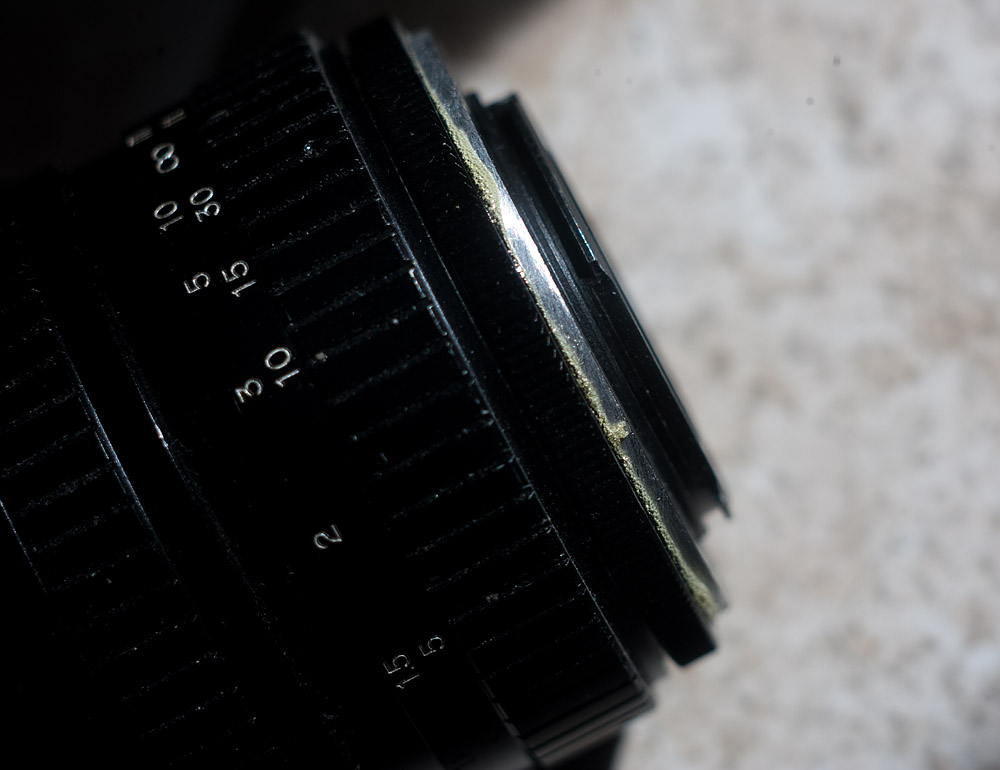
I am really surprised how good this lens is.  I don't normally like zoom lenses, especially this kind of awkward focal length on non-full frame cameras.  But, the SP moniker is not just a marketing ploy, at least not with this one.  Besides the very sharp images with good microcontrast when stopped down a bit, one of the cool features of this lens is the very close focusing capabilities, down to 0.27 meters at 80mm, and at a 1:2.5 magnification ratio.  This is almost at the macro territory.  For a lens that costs so little used, it's indeed a bargain.  You do need to look out for loose rubber focusing/zoom grip skins.  I had to replace my rubber grip on the focusing ring with one from another lens.

Sunday, July 18, 2010

DIY Lens Mods

anmol, who has a Navitar 50mm f0.95 lens, had a request to see the lens mount of the JML 50mm f0.95 that I modified to fit the G1 so that it could focus to infinity.  The Navitar is essentially the same lens as the JML. Unfortunately I didn't take any pictures of the lens before the mod.  But I think I would go through how I did it.

JML is an OEM lens maker that designs/manufactures lenses for other companies, but occasionally, you also see their own brand of lenses.  I have the JML 25mm f0.95 and the 50mm f0.95 TV lenses that I purchased from locally. Both are c-mount lenses and the 25mm mounts and focuses to infinity without problem, and is one of my favourite c-mount lenses.  The 50mm f0.95, unfortunately, has a very large mount that it can not be mounted and focused to infinity on my G1.  The good news is that the c-mount itself on the lens is removable, so I decided to sacrifice one of my c-mount adapters and make it semi-permanent.

The first thing to do is to remove the c-mount from the JML 50mm lens.  This is easy as all you need to do is the unscrew the mounting ring which holds the c-mount.

Next thing is a bit more work.  The c-mount to m4/3 adapter needs to be filed down.  Most c-mount adapters are made with two "sections".  One section goes inside the body mount, and the other section basically a handle to hold the mount to be mounted/unmounted.  What needs to be done is to file away the "handle" section so that you will have just a flat, mount piece that you will need to secure to the lens.

This part needs to be done as precisely as possible because if the mount piece is not flat, the image field will not be flat and the pictures will come out half in focus and half out of focus.  If you could get someone with some sort of machine to do this, it's probably worth it.  I just used a Dremel grinder to  remove the "handle" section until it's all gone.  What's left is the flat piece of the mount itself. 

If your adapter was made in two pieces that has screw holes, that's perfect, otherwise you should drill some holes, either to secure the adapter piece by screw, or by glue.  If using glue, the holes will form grips for the adapter piece.  Probably not much, but at least a bit.

The tricky part is how to achieve flatness and securely mount it.  I am not a tools person and my tools are limited.  I also do not want to destroy the lens mount either, so I opted to use glue, Gorilla glue to be precise. I think this is the wrong kind of glue to use because Gorilla glue expands as it hardens, but this was the only one I had at hand.  Before the glue was set, I put some really heavy objects on top of the mount to keep it flat as the glue sets.

One optional step is the mark the mounting position of the adapter before securing it to the lens, so that when mounted, you see the aperture on top instead of sideways or up side down.

Below are few pictures of the mount after it was done.  Click on the pictures to see a larger version.


Shinobi

Shinobi -- Canon 1D Mark IIn & Leica-R 90mm f2 Summicron. Larger.

I now realized why I didn't like the 7D & T2i's image quality as much as my older cameras -- the missing details in the images.  Yes, there are 18 mega pixels in the image, but these 18MP images seem to have less details than I am used to see in the 1D Mark II/5D/30D.  At low ISO, the 7D & T2i seem to contain lots of chroma noise in the shadow area, whereas in the previous cameras, like the 1D II, 5D, 30D, etc, it's very clean.  At higher ISO, the 7D & T2i seem to be muddy and lack even more details, no doubt due to the heavy noise reduction. I guess there is a price to be paid for more pixels, which I don't really care for.  Give me D700 pixel quality and resolution, I will be a very happy camper.

I hope Canon will not increase the pixel count for the 5D Mark III.  21MP is more than most sane people will ever need.  Better yet, they should reduce it to 16MP but increase the Dynamic Range and even cleaner images.

Friday, July 16, 2010

Megan

Megan -- 1D Mk IIn & 35mm f1.4L @ f1.6. Click to enlarge

It feels good to have the 1D II back.  The familiar shutter sound, the nice balanced feel in the hand,  and most of all, the split screen.  No matter how good the AF-Confirm chip is on the adapter, it can not compete with an accurate, Canon made cross split screen.  I have found that manual focusing on the 7D is very difficult, for some reason.  Perhaps it's the screen overlay inside the viewfinder that affects the perception of being in-focus; I just couldn't get very good keeper rate for in-focus pictures.  The AF-Confirm chip didn't help much either, but the AF lenses work extremely well. 

I am happy, for now.  It's almost a full frame camera, and I can live with that.