Monday, March 15, 2010

Canon Rebel 550D T2i -- Normal AF vs Live View AF

Did a very brief and unscientific test on normal AF and Live View AF on the T2i. Accuracy seems to have improved quite a bit from previous Digital Rebels that I had used. When I purchased the original 300D, I had to send the camera to Canon for focus calibration twice. Even then, focus was still not very consistent.

From the first day of use, I found the focus on the T2i quite consistent. The test I did today showed that normal focus and Live View focus essentially yields same results. The interesting thing is the exposure is slightly different. Normal AF tend to expose a bit more on the brighter side whereas Live View is slightly more conservative.

Test Setup:
Tripod -- Velbon Carmagne 630 Carbon Fiber
Head -- Acratech Ultimate Ball head (original version)
Lens -- Canon EF 50mm f1.2L
Lighting -- Natural window light
Camera Setting -- Self-timer with mirror lock up enabled, ISO 200
Output -- In-Camera jpeg (RAW +jpeg)


100% crop -- f1.2 normal AF


100% crop -- Live View Focus f1.2


100% crop -- Normal AF f2.0


100% crop -- Live View AF f2.0

Sunday, March 14, 2010

Canon nFD 100mm f4 Macro Samples

So I went crazy last week and bought a bunch of lenses from Henry's Outlet Store, because they were clearing out manual focus lenses. This 100mm f4 macro was one of the many I bought. Before Micro 4/3 cameras came along, Canon FD mount lenses could only be used on old Canon FD mount film bodies, and prices for them were very low. The Micro 4/3 cameras give FD lenses, among others mounts, new life. If you work with telephoto or macro lenses a lot, this is even better because the Micro 4/3 cameras essentially make the focal length 2x longer. So this 100mm f4 macro lens becomes a 200mm lens. The slow f4 maximum aperture is not even a problem, as the Electronic View Finder will just make the view finder brighter to compensate.

The nFD 100mm f4 macro lens (I also have the older FD 100mm f4, which I will try later) is very sharp. Well, there are no bad macro lenses, but some may not perform as well at infinity as at macro. This particular lens is pretty decent at infinity. Too bad I haven't taken any macro shots yet, but a couple of sample below will give you some ideas.


Naked Tree -- Panasonic G1 & Canon nFD 100mm f4 Macro.


Hot Cross Buns -- Panasonic G1 & Canon nFD 100mm f4 Macro.

Friday, March 12, 2010

Canon Digital Rebel T2i -- Auto ISO

Canon came to the Auto ISO game later than most, and the early implementations were not as good as other manufacturers. On the Rebel T2i, it's a lot better, but one annoyance.

The Auto ISO is set to on most of the time on the T2i, and it works very well most of the time, except when you have a long lenses mounted. The reason? The minimum shutter speed is set too low. Often, when a 50mm lens is mounted, the shutter speed is set at 1/60 of a second, and this in some cases are too low when you multiply the focal length by 1.6. It should be around 1/80 to 1/125 of a second to avoid camera shake. Sure, you can use manual mode, but it's not as fast as AV mode, which I use almost exclusively.

Obviously, this can be enhanced by making Auto ISO shift-able. We already have shift-able Program mode, why not implement this in Auto ISO? Allow the shutter speed to be changed while maintaining the same aperture, and thus making the ISO change its value to compensate. This can even be done with a firmware update, but I doubt Canon will do it. Hopefully the next Auto ISO version will have this feature.

While we are on the topic of Auto ISO, as I have already mentioned before, the ISO can be incremented in 1/3 stops. But, this can not be done manually. The ISO can only be changed in full stops. This is puzzling move on Canon's part. Clearly, it's not a pro feature to be able to set ISO in 1/3 stops, as you can do that with the 30D, 40D, 50D, etc.

Wednesday, March 10, 2010

Canon Digital Rebel T2i VS Panasonic G1

If you are a first time DSLR buyer, you probably have thought about these cameras. They both appeal to first time buyers. Since I have both, I will chime in and give my 2 cents.

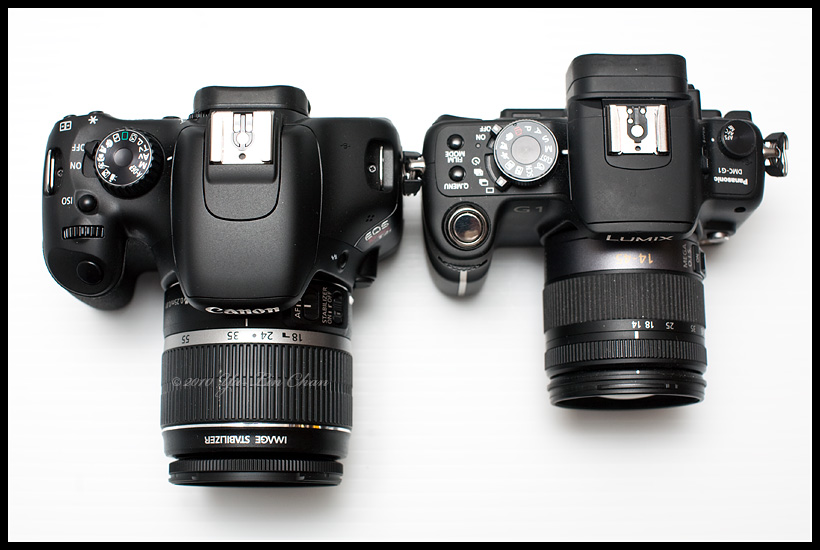
First of all, The T2i and the G1 are very capable but are in fact very different cameras. On one hand, the T2i has a traditional SLR design: optical viewfinder with interchangeable lenses; the G1 is an Electronic Viewfinder Interchangeable Lens (EVIL) camera. There are advantages and disadvantages to both designs: Optical viewfinder offers real time viewing without delays, but the pentaprism/mirror assembly makes the camera larger. EVIL cameras uses an mini LCD screen inside the camera in place of the optical viewfinder. The benefits are two fold: cheaper to make, and smaller/lighter camera.

Which one is better? As with most things in life, everything has its good and quirks.

Advantage for the T2i over the G1 include:
  • 1080p movie mode -- this is the primary reason I bought the T2i
  • Beautiful 3" 1 million pixel LCD
  • Slightly better image quality, especially in high ISO
  • Focuses faster, especially on tracking focusing
  • Faster frame rate
  • Selection of lenses
Advantage for the G1 over T2i:
  • Swivel LCD screen
  • Electronic Viewfinder (only an advantage if you use manual focus lenses a lot)
  • Smaller and lighter with kit lens
  • Very short lens to sensor register. This means it can take all kinds of manual focus lenses though adapters (an advantage only if you are a fan of manual focus lenses)
  • Less expensive with kit lens.
To me, the only feature that made me buy the G1 was the fact that it can take all sort of manual focus lenses, including some fantastic cine lenses. Small size, swivel screen, etc are not feature I consider deal breakers. If you mainly use auto focus lenses, the Canon has more selections, from 15mm fisheye, 50mm f1.0 exotic, to 1200mm f5.6 super telephoto. On the other hand, if you only want a couple of zoom lenses for travel, the G1 would be an ideal choice, just be warned that the only fast lens Panasonic has for micro 4/3 is the 20mm f1.7. Anything faster (brighter) would have to be manual focus lenses through adapters.

Please keep in mind that these are my opinions. What features you are looking for is probably different than mine.


Side by side from top. The Canon is chunkier. Notice the pentaprism housing. This is what makes the Canon larger.


Side by side -- the Canon is taller but not by much.

Tuesday, March 9, 2010

Monday, March 8, 2010

Visited Old Friend, and Found Step Brother

So, I went visit an old friend, Henry's Outlet Centre Plus today, on my day off. The Outlet store re-opened today in Mississauga. It's a nice size store about 3 times larger than the old one. Very spacious and open with high ceiling. It does indeed feel less compressed, compared to the old place. Lots of stuff, include new items which were missing from the old store. Only about half of the original sale staff made it to the new store.

Naturally, I could not restrain myself, and bought a whole bunch of lenses. Including one that had been on the shelf in the old store for many years -- the Tokina AT-X 80-200mm f2.8 Contax mount. I was waiting for it to drop to about a $100, but alas, it never did. Today, it was $25! Not that I needed this lens, but I was green with envy when my friend Tony, who bought the same lens in Nikon mount around 1983, for over $700, and that was dollars in 1983! Being a poor student, I could only salivate at an expensive lens like this. Well, 27 years later, I have my copy for $25, in like new condition. LOL!

Also bought a few Canon FD mount lenses, including a 100mm f4 Macro, 35-105mm f3.5, Tokina 24-40mm f2.8 and a Kiron 28mm f2, all for $25 each. What a bargain! I will be trying them on my G1 when time permits.

There is one more lens I bought today at the Outlet store. Last time I wrote about the Bushnell 70-220mm f3.5 lens, I was thinking who made that lens, because Bushnell, like many companies in its time, did not really make their own lens (although its parent, Bausch & Lomb, did make cine lenses and other optics). Well, three weeks later, I found its step brother in M42 mount -- the Soligor 70-220mm f3.5 C/D. Soligor C/D lenses are premium category of lenses, like the Vivitar Series-1. This indicates that the 70-220mm f3.5 should be a pretty good lens. Haven't used this Soligor version yet, but I expect identical performance from both lenses.


Separated at birth? Bushnell 70-220mm f3.5 on the left, and the Soligor 70-220mm f3.5 on the right. Note that Soligor has a rotatable tripod mount, and the Bushnell does not.

Saturday, March 6, 2010

Canon Digital Rebel T2i - Low Light Samples

If you read the specs, you will no doubt be impressed with the low light capabilities of the Rebel T2i -- ISO 100-6400 and expandable to ISO 12800 if needed. How does it perform in real life use?

I have said it too many times, the T2i has way too many pixels. As a consequence, it suffers in the low light performance department. The noise reduction system works pretty well removing noise and the jpegs are quite clean, but details are lacking at ISO 800 or higher. Comparing ISO 1600 with the 5D, I prefer the 5D output. The T2i files show much more artifacts and look muddy. The 5D files are cleaner. This sounds wrong, considering that the T2i goes all the way to ISO 12800, and the 5D only goes to ISO 3200. But to me, I wouldn't use the T2i above ISO 800, but I would happily use ISO 1600 or even the 3200 on the 5D.

The high pixel count does have one advantage -- resize the files by half makes them look much better.


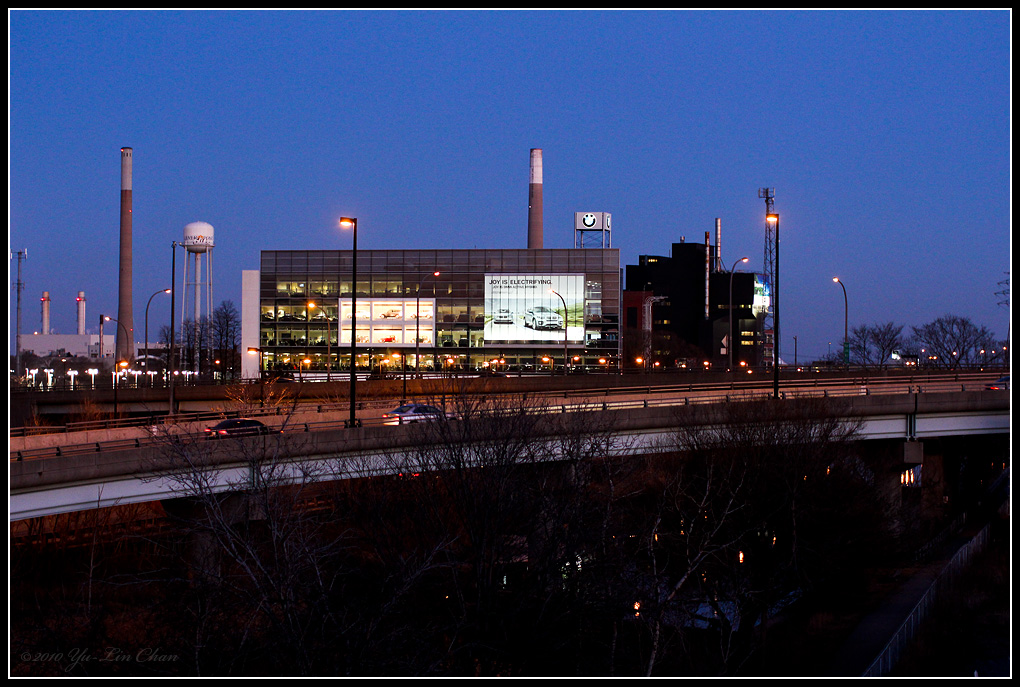
BMW Dealership building -- T2i & 50mm f1.2L @ f2.2, ISO 800. Larger Picture.


The Red Rocket at the end of King Street. T2i & 50mm f1.2L @ f2.2.


Ryan -- T2i & EF 50mm f1.2L. ISO 3200. Larger Picture.

Friday, March 5, 2010

Canon Digital Rebel T2i -- Exposure and Focus

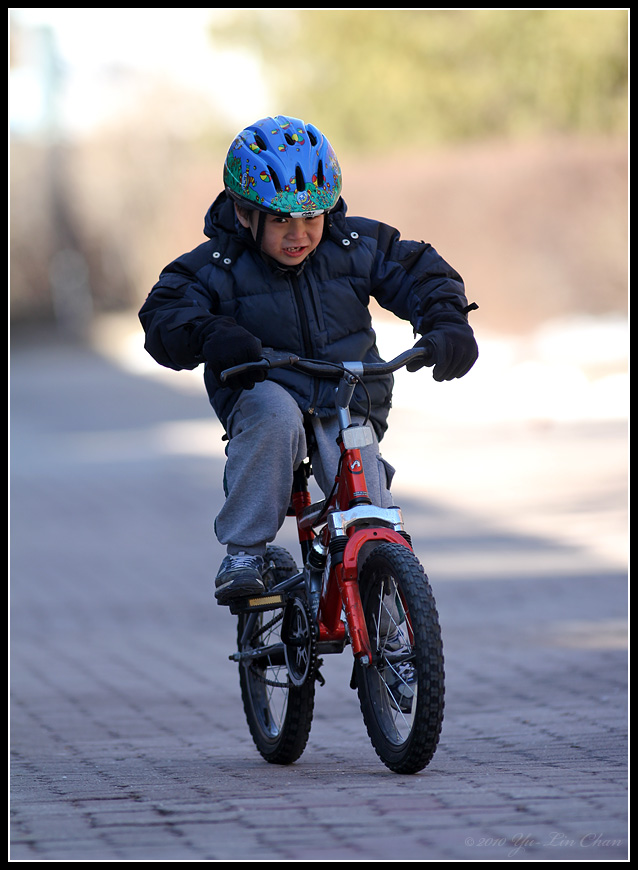
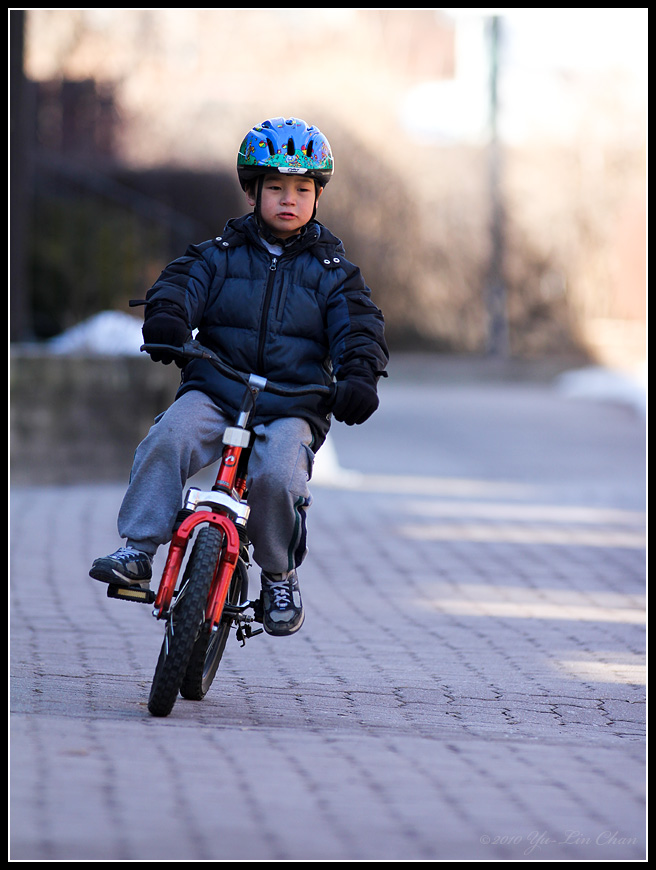
Not too much surprise here in terms of focusing. I did some test with AI-Servo tracking mode and took pictures of my son riding his bike. The success rate at tracking a slow moving (~15km/h) bicycle is about 50%. For those that were out of focus, a few were very out of focus, but most are in the vicinity of the focus zone. This is about on par with the 20D and 30D I had before. Interestingly, I got more keepers when using all focus points (automatic focus point selection by the camera) than just using the centre point.

On the other hand, one-shot focus has been very consistent. I dare say more so than the 1D Mark III I used to own. There is still differences between the 5D and the T2i. My 5D is almost always spot on, even at extreme apertures like f1.2 and f1.4. The T2i, when shooting wide open with the Sigma 50mm f1.4 or the Canon 50mm f1.2 lenses, seems to have much less contrast and more green fringing than the 5D. Not really sure if this has to do with the sensor or not. I will do a separate comparisons between the 5D & the T2i in a later article on this topic.

The exposure, though, has been greatly improved over the previous cameras. It's very accurate and tend to give a much more balanced reading, instead of clipped highlights or tend to underexpose. This new 63-zone exposure sensor, which takes colour information into consideration, has tangible benefits over its predecessor. Add to this improvement, the Highlight Optimization feature works very well too, especially when there are shadows on the face. The exposure metering is one area I am really happy about.

I didn't own any Digital Rebels after the XT, both the original 300D & XT had very very small, tunnel like view finders. This incarnation of the Rebel T2i has relatively large viewfinder, which is a real plus when using manual focus lenses. On the whole, it feels nothing like the old Rebel in operation, in terms of speed, features and capabilities. I have not touched on the video yet, as I have yet to get a hang of it. It's one heck of a camera at a bargain price. My original Rebel with kit lens was around $1600 in 2003. The only thing I wish that were different is the sensor. It's got too many pixels and quality is not even as good as the 5D (to me any way, perhaps the RAW converter makes a difference). If you have no better camera to compare to, or you are not as picky as I am, you will be extremely happy with the T2i.


William on his bike -- T2i & Canon EF 200mm f1.8 @ f2.2.


William on his bike -- T2i & Canon EF 200mm f1.8 @ f2.5.


Future Gretzky? -- T2i & EF 200mm f1.8 @ 2.2.

Thursday, March 4, 2010

Canon Digital Rebel T2i - More Sample Pictures


The Red Rocket -- T2i & 18-55mm IS kit lens @ f8.


Megan -- Canon T2i & Canon EF 50mm f1.2L @ f1.6.

Played a bit more with DPP. ISO 400 on the T2i is very acceptable. Not that much better than the 5D, if even. I like the image quality better on the 5D overall, but the T2i feels a lot more snappier than the 5D. Everything is faster and more responsive on the Rebel.

Tuesday, March 2, 2010

Canon Digital Rebel T2i - Fun with the Kit Lens

I think I made a good decision buying the T2i with a kit lens. This lens pairs well with the T2i and the combo is very light and portable. When I hold them in my hands, one word comes to mind: Fun! It's very different feeling in usage when a 50L or 85L lens is mounted on it.

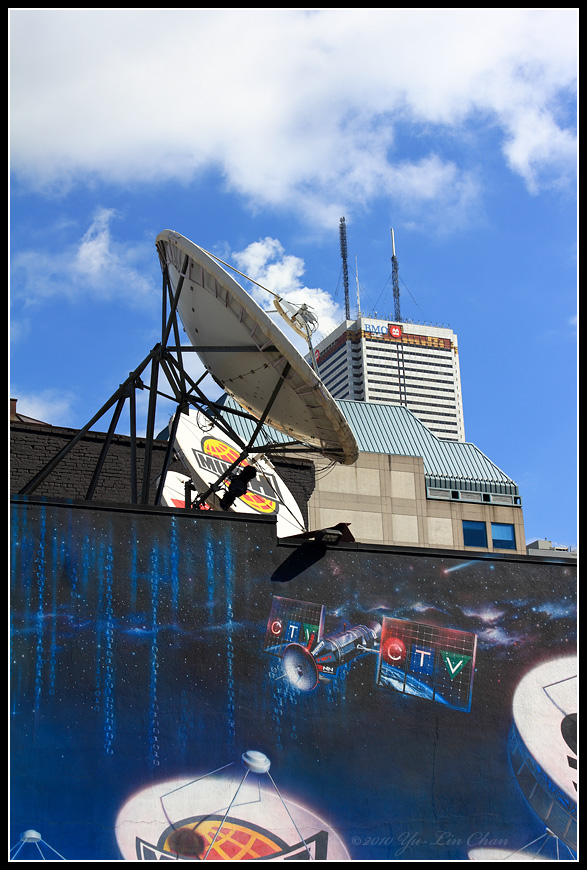
The lens turns out to be quite a good performer. Surprisingly sharp when stopped down a bit, although, as with most entry level lenses, distortion is not well controlled, especially at the wide end. The far edges are actually very respectable. I have included one 100% crop on the satellite picture. This picture was processed in DPP. I played with DPP a bit today and I think I am getting a hang of it. Still not quite used to it yet, but the quality and colour fidelity is much higher from DPP than the in-camera jpeg.

I do wish the range is a bit longer, say 18-85, but then of course there is the EF-S 17-85mm. It will be sufficient for most occasions, though.

Discovered an oddity. The ISO on the T2i can only be manually changed in whole ISOs, like 100, 200, 400, etc. But, if you use Auto ISO, the camera will use ISO 320, 640, etc. Now, why not give us the same thing when we want to control the ISO manually?

I really do like the 18-55mm IS lens. I am actually happy with it. Now only if I can get a hood for it.

Still working on the focus test...


Calling ET -- Canon T2i & EF-S 18-55mm IS lens, f7.1. Please check out the edge crop on the next picture.


100% crop from the picture above at the lower right corner @ f7.1. Larger Picture.


Bird's eye view from a 13th floor downtown building on York Street. T2i & Kit Lens @ f6.3. Larger Picture.


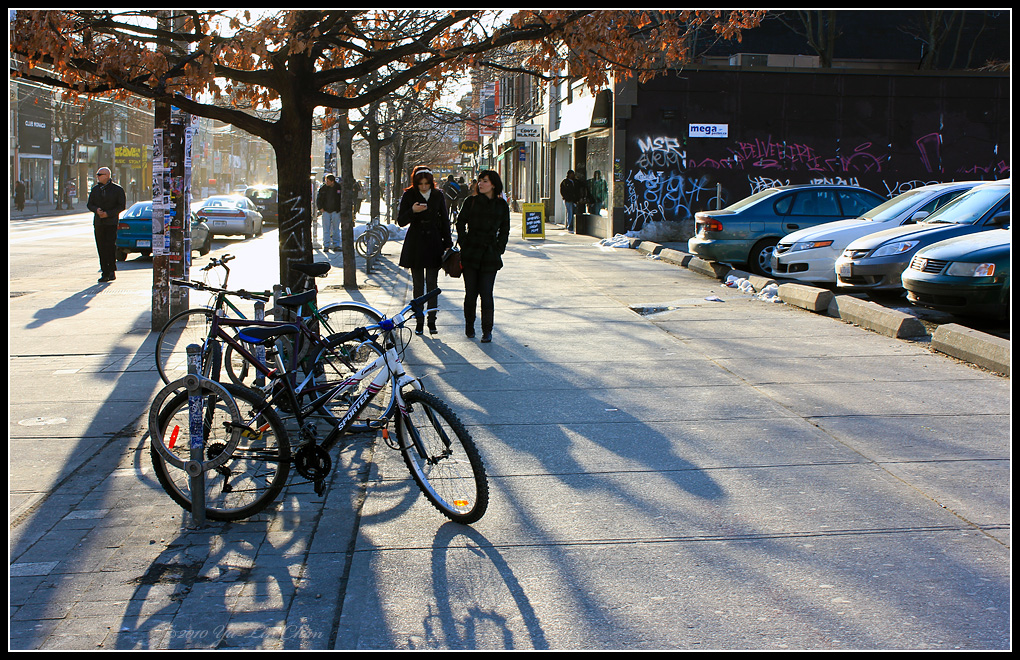
A stroll on Queen & Soho -- T2i & Kit Lens @ f8. Larger Picture.