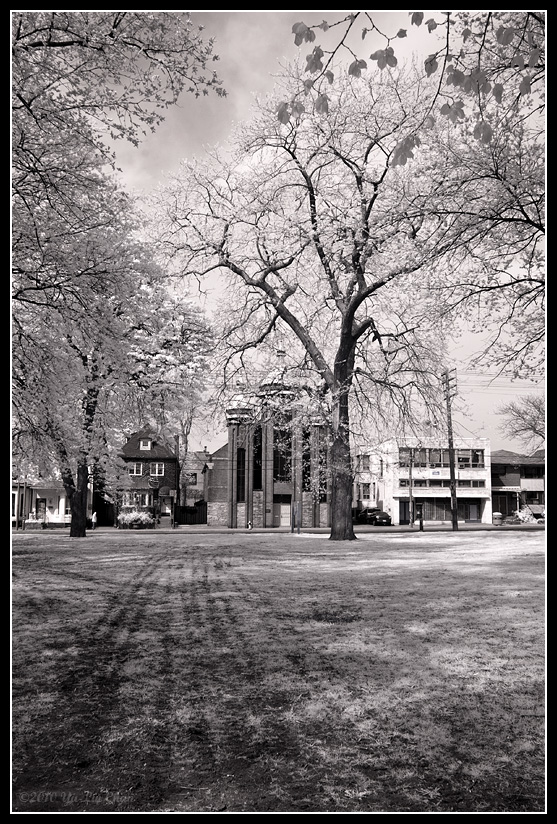
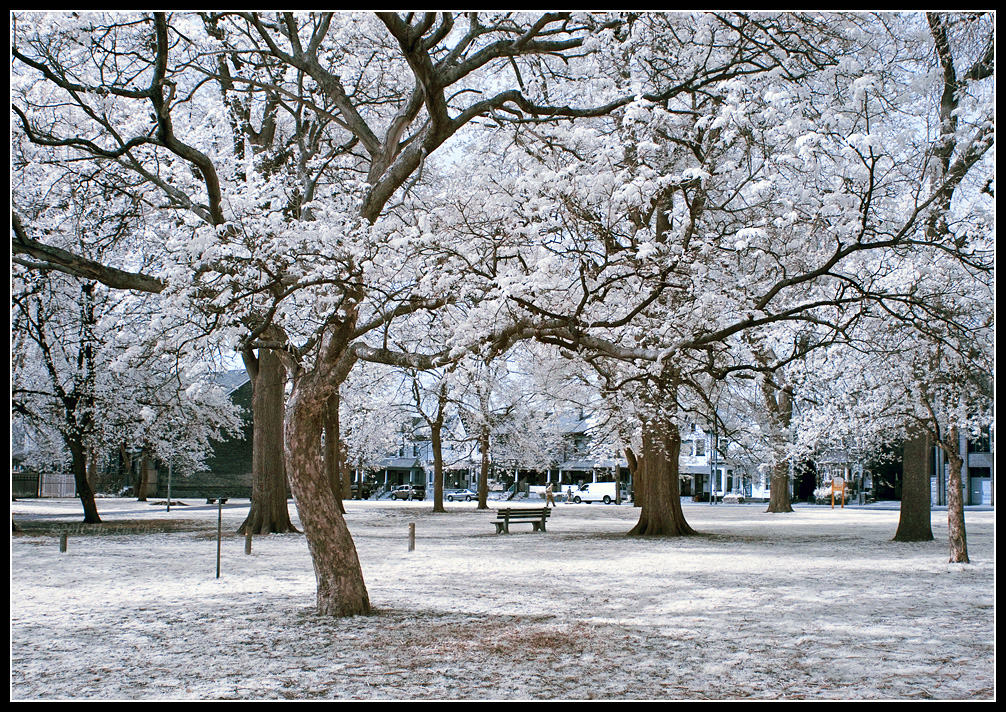
Showing posts with label Canon 20D IR. Show all posts

Tuesday, April 22, 2014

Infrared Picture Set with Pentax-M 20mm f4

For some reason, I have been itching to bring out the Infrared modified camera and shoot some IR pictures. The weather has been finally cooperating, and I took this opportunity to try an autofocus lens with the 20D. It's a known fact that IR spectrum affects the focus point; most camera's AF system are calibrated for visible light and if you take a picture with the default AF, the picture will come out blurry. For this reason, AF lenses are not very good for IR work, as you would always have to focus it abit behind the indicated focused point. For lenses with USM that support full time manual focus, this is much easier, but still, it's hard to know the exact amount of focus shift you need to do in order to attain critical focus.

I tried the Canon 16-35mm f2.8L II lens today with various degrees of success. For starters, this lens is not a good lens for IR. It has a large hot spot in the centre of the frame, even when there is no stray light hitting the lens. Almost all Canon USM lenses allow you to focus beyond infinity, and that's what is needed to achieve infinity focus for IR. Most pictures turned out to be in focus when the lens was set beyond infinity to the maximum allowed. This is good for pictures that focus to infinity, but not too good if the focus distance is closer. Some experiment is required. This is the reason I like using manual focus lenses, especially the Pentax-M 20mm f4, for IR. When set to infinity, everything is pin sharp from a couple meters away at small apertures.

Redpath Sugar Refinery in IR - Canon 20D IR & Pentax-M 20mm f4. Click for larger.

The cemetery - Canon 20D IR & Pentax-M 20mm f4. Click for larger.

Geese - Canon 20D IR & Pentax-M 20mm f4.

Thursday, September 12, 2013

For Paul

If you frequented the old Henry's Outlet Store on  Queen, you probably know Paul. Paul is one of those rare people who are genuinely nice, and always eager to help others. I have known Paul for many years, and he is the huge part of the reason I have so many old and sometimes weird lenses. As a matter of fact, without Paul, I probably would not have this blog to write about old lenses.

Paul - Photo by Prof. Robert Hudyma

Paul is a big Pentax fan, second only to his love of Zeiss glass. He shot various Spotmatics and Pentax lenses over the years; often with a wide angle, but sometimes with a Takumar 300mm f4. His last known camera was a Pentax MV with a 24mm lens. Paul loves film. He has a large collection of Kodak Chromes he shot back in his youth, and I had an opportunity to view some of them; they are marvelous. 1/125 f8, as he would like to say.

Pauls also likes infrared pictures, especially with the Pentax-M 20mm f4. He asked me to post more yesterday, so I shot some more today. For Paul. I hope he likes them.

All pictures below were shot with a Canon 20D IR modified, and the Pentax-M 20mm f4 at f8 and f11.

Misty morning

Entertainment in the park

A view to the lake

Picnic Table

Sail Boats


Thursday, August 29, 2013

Pentax-M 20mm f4 - Infrared Photo Set

Today is a perfect day for infrared photography.  As usual, my preferred lens for IR is the Pentax-M 20mm f4. This lens could be very bad with distortion if not careful, but I find it to be excellent on the APS-C cameras. The signature of this lens is its sharpness, especially on the low density sensors like the Canon 20D. The images captured by this lens has excellent definition. This is one of my favourite K-mount lenses.

All photos below were taken with the Canon 20D IR & Pentax-M 20mm f4.


Sunday, August 11, 2013

Zeiss Distagon 55mm f1.4 - The Best 55mm Lens in the World?

Since the introduction of the Zeiss Distagon 55mm f1.4 lens, the net is abuzz. Some love it, many question the purpose of such product, and yet others love it but hate the price.  For those who are negative toward the (seemingly) amazing lens, I question why.  If we only produce "good enough" products that most people can afford, the world will be filled with mediocre products. Without these best of the breed products, produced where money is no object, we would not know how far we can go. Sure, most of us will not be able to afford the new lens, but there is a chance that we could afford a used one later on.

The Canon EF 200mm f1.8L is one of the best lenses in the world. It was created to showcase Canon's technical prowess in lens design. Even by today's standards, it's still one of the best, certainly still the world's faster autofocus 200mm lens. I would not have been able to afford it when it was new, but I was able to buy one used. Canon never sold many of these lenses and I am not even sure it they made a profit from this lens, if you factor in the time it took to design and the tools needed to make it. But, I am glad they made it.

Still, many lambasted Zeiss for making such an expensive lens and it won't even autofocus. I am glad they made it a manual focus lens. Every time I think of the EF 200mm f1.8L lens sitting here, and cannot be fixed due to parts shortage, I wish the lens was a manual focus lens; manual focus lenses have a much longer service life. Some of my manual focus lenses are more than 50 years old and they still work wonderfully like the day they were made.

So Zeiss, bring us more lenses that are the best of the best.

Looking South of Yonge Street - Canon 20D IR & Pentax-M 20mm f4 @ f8

Thursday, June 21, 2012

Photo Essay: Around My Work Place in Infrared - Part II

This is the second part of a three part series on Infrared around my work place.  Today I headed west toward Bathurst on Queen street.  As always, this is a very busy section of the city, especially at lunch time in a nice day like today, when many people just wanted to go out for lunch and enjoy the weather.

I started from Spadina & Queen.  This intersection is one of the busiest in the area, partly because many people get on or off here from streetcars.

Spadina & Queen North East Corner -- Canon 20D IR & Penatx-M 20mm f4. Click for larger.

Hot Dog Stand -- Canon 20D IR & Pentax-M 20mm f4.

In the picture above, the same hot dog stand has been here for many years in this spot.  It opens 24 hours.  It almost becomes a fixture at the north east corner.  On the left of the picture, you can see my colleague Mark, with a camera on his right hand.  If you like street photography, you will love Mark's pictures on Flickr.  Mark is a collector and user of vintage cameras/lenses.

Trees -- Canon 20D IR & Pentax-M 20mm f4. Click for larger.

Even with a very ordinary and boring street scene, infrared makes it look different and interesting, and the false colours adds some weirdness to it.

St. Stanislau R. C. Church -- Canon 20D IR & Pentax-M 20mm f4.

Wednesday, April 11, 2012

A Set of IR Pictures from High Park

On Monday I went with Dillon and Sally to High Park early in the morning hoping to photography cherry blossoms.  It turns out we didn't go at the right time yet.  Perhaps we will do it again this weekend.  It was fun as I had not gone to High Park for many years.

Took along the almost forgotten IR modified 20D with me, and the trusty Pentax-M 20mm f4.  I must say this lens is a perfect match for the 20D/IR.  A relatively wide angle of around 32mm equivalent, almost a comfortable 35mm.  I ended up shooting more IR pictures than with the NEX-5N.  Hope you like these pictures.

House at the bottom of the hill -- IR 20D & Pentax-M 20mm f4. Click to see larger picture.

There are two dogs in the picture below.  They were so obedient and they were posing for the owner!  Lovely dogs.

The only cheery tree in full blossom in High Park -- IR 20D & Pentax-M 20mm f4

Sally shooting with the EF 180mm f3.5 Macro Lens - IR 20D & Pentax-M 20mm f4

Sunday, March 11, 2012

The (Forgotten) Fun of Infrared Photography

Ontario Place in False Colours of Infrared
Ontario Place in False IR Colours -- Canon 20D IR Modified & Pentax-M 20mm f4

While importing my old pictures into Lightroom, I realized how few picture I took using the IR modified Canon 20D, and almost none for the whole year of 2011, and I really should be using it more.  Why?  Because it's fun! The IR filter used in my 20D does not completely fall into the infrared spectrum.  There are still some visible spectrum that go through the filter.  I love the mix of visible light and Infrared, because of the weird colours you can get, whereas a true infrared filter will give you only infrared pictures (B&W).  When the weather turns warmer, and the vegetation comes back, I will sure be out there more often with this camera this year.

Wednesday, May 25, 2011

20D Infrared Sample

Relaxing under the tree -- Canon 20D IR Modified & Pentax-K 28mm f3.5.

Dusted off the IR Modified Canon 20D today.  It hadn't see much action for many months.  The recent nice sunny days are perfect for IR pictures.  The Pentax-M 20mm f4 lens continues to be my favourite lens for IR on the 20D, and now the Pentax-K 28mm f3.5 is also winning my heart.  Both are fantastic lenses, although the 20mm f4 has pretty severe distortions if not used carefully.  They are insanely sharp lenses and the built quality is excellent.  My PK-EOS adapter is slightly thinner than specification,  which turns out to be even better, as it allows focus slightly past infinity.  The focus point is actually slightly ahead in IR spectrum than in visible light.

Sunday, April 10, 2011

Pacific Mall North Buildings in IR

Pacific Mall North Buildings -- Canon 20D IR Modified & Pentax-K 28mm f3.5. Click to see larger.

One of the difficulties of taking pictures with IR cameras, other than focus shift, is exposure.  Buildings and non-organic objects generally don't emit large amount of infrared energy, and thus would take much longer to expose.  For this reason, for IR shots, you can't really rely on the camera's metering system, which is optimized for visible light spectrum.  Histograms are much better for this purpose.  Trial and error is also a good way to go.

There is one feature on Canon lenses that not many people know about.  Those Canon lenses with Ring Ultra Sonic Motors (USM) can focus past infinity.  This is a feature that lets you shoot critically sharp IR pictures, because the infinity focus point for IR pictures normally goes past the focus point set for visible light photography.   Another benefits for USM lenses is that you can adjust focus at any time without switching the lens to Manual Focusing (MF), as all Ring USM lenses (and the EF 50mm f1.4, which uses a micro-USM motor but allows MTF) allows Full Time Manual focus (FTM).

Wednesday, May 19, 2010

Ontario Place in IR


Ontario Place -- IR Modified Canon 20D & Pentax-M 20mm f4. Larger Picture.

Went to the Ontario Place on Saturday, I think it was the opening day and what a mistake! The place was jam packed with people. I guess the $5 play all day pass was too much to resists for most people, including us. The wait for the ride could be more than an hour. The kids just went to Soak City and play with the water instead. Good thing it was a nice sunny day, but not hot enough. Perfect to take pictures.

I took the Rebel 550D with kit lens and the 35L, 50L and 135L, and the IR 20D with the Pentax-M 20mm. In reality, I really only used the kit lens with the 550D and the 20mm lens on the 20D. Next time I will know better.

I must say I am very impressed with the optical performance of the 18-55mm IS kit lens. It's very sharp and produced pictures indistinguishable from L lenses when shot at the sweet spot of f8 to f11. With a polarizing filter on a sunny day, the colours are excellent as well. Also, I have grown very fond of the Pentax-M 20mm f4. It's just so perfect on the 20D and Rebel, giving a mini wide angle of 32mm, close to my favourite focal length of 35mm. This lens works especially well on the Infrared 20D because I almost always set the focus at infinity and left it there. I am glad I have kept it, after a couple years of sitting on the shelf (because it didn't work on my 5D/1D III).

Surprisingly, I have not used the IR 20D as much as I had anticipated. I think the weirdness of IR wears away after a little while, but when used occasionally, I enjoy it, very much.

Monday, April 26, 2010

Fun with Infrared Photography - Part III


Don River and Gardner Expressway -- IR Converted 20D & Pentax-M 20mm f4 @ f8. Larger Picture.

There are different flavours of infrared, depending on the cut-off frequency of the IR filter. Most common IR filter is the Hoya R72, which has a cut-off frequency of 720 nanometers (nm). Lots of people like this filter because the R72 allows some visible colours to get through the filter, thus gives the "False Colour" you see in some IR pictures.

The higher the cut-off frequency, the less visible light and the image will become more monochromatic. Anything above 800nm will be basically just black and white. Some like the monochromatic look, but I personally prefer false colours in IR. This was what attracted me to IR photography in the first place. Besides, you can always convert the picture to black & white if needed.

Lucky for me, the IR converted 20D I bought has an internal IR filter similar to R72. It allows small amount of colour through, especially the blue and deep red. As with everything in life, having too much of one thing will quickly make your bored. I have shot with the IR 20D for just a few days, and I am already having IR fatigue. IR pictures need high contrast scenes to look interesting, like blue skies and lots of trees and water. An IR picture of a building will not be very exciting, regardless how wonderful the lighting is. IR photography is like a fish-eye lens -- it's fun and interesting when used in moderation. This begs the question, should you convert your camera to a dedicated IR camera?

I would say no to expensive cameras, unless you have an obsession to IR. But if your Rebel 300D, 10D, 20D, etc, is collecting dust and hardly sees the light of day, it maybe a good idea to have it converted to be a dedicated IR camera. Just keep in mind that the conversion itself will cost more than what your camera is worth.

Saturday, April 24, 2010

Fun with Infrared Photography - Part II

There are many problems that need to be overcome with infrared photography, depending on how one goes about doing it. For people who just use IR filters on unmodified cameras, the biggest issues are exposure time and black viewfinder. For a modified camera, they are focus and metering.

Unless your camera was designed from ground up as an IR camera, the metering and auto focus system are geared to and calibrated for visible light. On an IR modified camera, these two components will no longer work reliably. In most cases, the metering needs to be adjusted by at least 1 stop, but most of the time, 1.5 to 2 stops on anything that do not emit heavy infrared like buildings. For trees or flowers on a sunny day, negative compensation is required, sometimes as much as 2 stops. Thanks to digital, this is not as a big deal as it sounds, as you can always take a picture and adjust exposure as needed. The trickier part is achieving accurate focusing.

If you have a manual focus film SLR with a lens at home collecting dust, you will almost always find an infrared index on the lens. In the case of a zoom lens, there maybe multiple IR marks. Even the cheapest of lenses in the old days would have this index. Now a days, you will be lucky to get a distance scale on the lens, let alone IR mark. Unfortunately, to get accurate focusing, you will need to reference this IR marking on the lens.

The focus point for infrared is always ahead of that of the available light. If focus is achieved at 1 meter, the infrared mark is usually at around 1.1 to 1.2 meters. What this means is that once you see the picture is sharp on the view finder, you will need to turn focusing ring slight farther where the IR mark indicates. The amount of compensation is different for each lens. Some more and some less. This sounds like complicated, but it's not. After you have tried it a few times, you don't need to look at the mark any more, you will now approximately how much compensation you will need. Of course, if you use very large apertures like f1.2 or f1.4, this will be much harder to achieve critical focus.

Today I shot with a Pentax-M 20mm f4 lens on the IR 20D, and I am surprised how many sharp keepers. Partly because the 20mm f4 lens has a very short focus throw, anything farther than 2 meters is considered infinity, so the lens was set at infinity most of the time. The trick I used was focus bracketing. Take a picture at the indicated visible light, than turn the focus slight ahead for another pictures, and still a little further ahead for a third picture. This turned out really well.

Next time, we will talk about different IR filters and their effects on the picture.


St. Mary's Dormition Ukrainian Catholic Church -- IR 20D & Pentax-M 20mm f4.


Tool Shed in false colours -- IR 20D & Pentax-M 20mm f4. Larger Picture.


Bench in false colours - IR 20D & Pentax-M 20mm f4. Larger Picture.

Fun with Infrared Photography - Part I

Years ago, when for the first time I saw Daniela's infrared pictures taken with the Minolta Dimage 7, my jaws dropped to the floor, with a loud thud. These surreal, mystique, and fascinating pictures looked so otherworldly. I told myself that I would have to try it. The only problem, was money, or lack thereof. Back then, most infrared pictures were taken with an infrared filter screwed onto the front of a lens. Dedicated infrared cameras were very rare, partly because digital cameras back then were very expensive. Few would risk damaging the camera to convert it to IR.

Over the years, I tried some IR filters, but, most Canon DSLRs are not sensitive to IR, it would take many seconds to minutes to expose for an IR picture. On top of that, you can't see your composition with the filter on, because the filter is opaque. I soon gave up.

Next was the Sigma SD10 that was semi defective that I bought in a camera show. The batteries would only last about 30 shots. Something was wrong with it. But, the SD10 had a removable IR blocking filter. By removing this filter, you would expose the sensor to all spectrum of the light. So, I tried again, with an IR filter, but the image never came out the way I liked it. After that, it was enough for me. The only way I was going to try again is to get a dedicated IR camera that shoots just like a normal camera.

My chance came a few years ago when someone was selling a IR modified Canon 10D. I went for it, but soon discovered that I could not make any sharp pictures with it, regardless of aperture or focus point. The pictures were always soft. I returned it to the seller, who gracefully accepted the return, minus $50. My heart was broken. I have not touched, or even thought about IR until I saw someone was selling an IR modified Canon 20D on Craigslist, and I was lucky enough to be the person who bought it, at a great price.

I took some shots with the kit lens the day I bought it, and it proved to be excellent. A few sharp pictures, but mostly soft.

Next time, we will talk about the pit falls of IR modified cameras, and how you can avoid it.


Cheery Tree in full blossom - Canon IR modified 20D & EF 35mm f1.4. Larger Picture.

Thursday, April 22, 2010

United Metropolitan Church in IR


United Met in Infrared - Canon 20D (IR) & EF-S 18-55mm f3.5-5.6 IS.

Got an IR Modified 20D today (Thanks John!). I have been wanting an IR DSLR for like an eternity. Bought an IR 10D few years before from someone, but turned out it could not focus. Everything was soft regardless where the focus point was (yes I know focus shifts for IR cameras). The 20D I got today is nothing like the 10D. Very happy.