Saturday, May 18, 2013

Tamron SP 17mm f3.5 - Infrared Photo Set

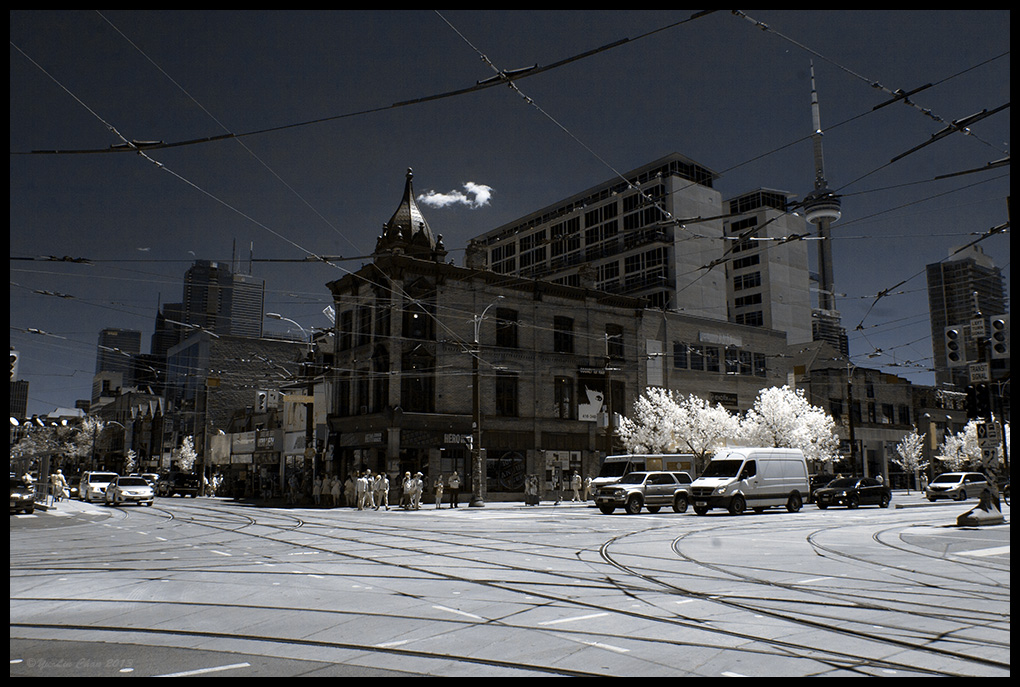
This is probably the last set of infrared pictures from the Spadina & Queen area, taken the day before my last day of work at lunch time.

I wanted to experiment with different wide angle lenses for IR photography other than the Pentax-M 20mm f4 lens I almost exclusively used before. Last time I tried the Flektogon 35mm f2.8 with good results, and I decided to try my widest manual focus lens - the Tamron SP 17mm f3.5. As it turned out, it wasn't bad at all. I was afraid I could not get infinity focus, but with aperture set at f8-f11, it was fine. What I really should have done, is try the Canon FD 20mm f4 against the Pentax-M 20mm f4, but there is always the next time.

The Tamron SP 17mm f3.5 is not as sharp the Pentax-M 20mm f4, especially at the edges, but it's a much wider angle therefore not a fair comparison.

The Hug Me Tree 2013 - Canon 20D IR & Tamron SP 17mm f3.5 Adaptall. Click for larger.

Spadina & Queen 2013 - Canon 20D IR & Tamron SP 17mm f3.5 Adaptall. Click for larger.

Grange Park - Canon 20D IR & Tamron SP 17mm f3.5 Adaptall. 

Tree outside Umbra building - Canon 20D IR & Tamron SP 17mm f3.5 Adaptall. 

Friday, May 17, 2013

End of a Chapter

Today is my last day at a job that I have had for the last 14 years. Couple years ago, our company was taken over by a big corporation and everyone at our department was given a "transition" period; a fancy term used by the big company to mean that "we will lay you off as soon as we've got what we want from you". I am the last of the MIS team to stay and take care of legacy stuff until everything is "transitioned".

It's been a wonderful 14 years. The Spadina & Queen area in Toronto, is a great place to work, eat, and of course, photograph. No doubt you have seen many pictures in my blog posts over the years, that were taken in this area. I would take a 45-minute walk around the area in my lunch hour, pretty much each day, and took pictures. I will surely miss this area, and most of all, miss my colleagues who have been so wonderful to work with. I will look back and cherish the memories, but as Canadian astronaut and commander Chris Hadfield said, "Don't look back. That's not where you are going!", I look forward to the next chapter of my career, which will soon start.

AlgoCafe - Canon 20D IR & Tamron Adaptall 17mm f3.5.

Wednesday, May 15, 2013

Meyer-Optik Gorlitz Oreston 50mm f1.8 vs Pentacon 50mm f1.8

Other than the very long name of the Meyer-Optik, these two lenses are indistinguishable from each other, if the name ring is removed. By all accounts, these two lenses are identical.  When Meyer-Optik was merged with Pentacon, all its lenses were renamed Pentacon. At least initially, the zebra versions of the Pentacon lenses are probably the same lenses as the Meyer-Optik lenses. I am speculating here, but I think it's pretty close to the truth. That said, I wanted to see if there are any differences optically, between these two lenses. Keep in mind that when comparing decade old lenses, there are just too many parameters that can affect the optics. How heavily each lens was used, any abuses from previous owners, initial manufacturing tolerances (remember these are East German lenses), copy variance, etc. So, you have been warned. Take this comparison with a handful of salt.

In use, both lenses behave very similarly, even the colours are the same. The Meyer-Optik Oreston 50mm f1.8 clearly has a de-centering problem, if you look at the 100% crops. The right side is blurrier than the left side. The Pentacon is much better, showing both sides identically sharp/blurry. In terms of sharpness, both are very sharp even at f1.8 at the center, but the edges are just not very good, even at f8, on full frame. The bokeh is not so bad though.

From what I can tell, these two lenses are optically identical. Both focuses down to 0.33m, which is very good, as most 50mm lenses can only focus down to 0.45 or 0.5 meters. I do have a few MC version of the Pentacon, and I wonder if they behave the same as the Meyer-Optiks. Might be a comparison for another day.

As you can see, these lenses are no match even for today's cheap auto focus lenses in terms of sharpness and edge performance. They were cheap consumer lenses when new. For day to day use, you probably won't notice any bad corners unless you shoot flat surfaces all the time. I used the Pentacon version quite a bit before, and I enjoyed using it. The pictures it produced were good and pleasing to look at.

Identical twins separated at birth? Click for larger.

From the side. Look identical. Click for larger.

Bokeh - Canon 5D Mark II & Meyer-Optiks Oreston 50mm f1.8 @ f1.8. Click for larger

Bokeh - Canon 5D Mark II & Pentacon 50mm f1.8 @ f1.8. Click for larger

Bokeh - Canon 5D Mark II & Meyer-Optiks Oreston 50mm f1.8 @ f1.8. Click for larger

Bokeh - Canon 5D Mark II & Pentacon 50mm f1.8 @ f1.8. Click for larger

100% Crops at f1.8, f2.8 and f8. Click for 100%. Sorry for the bad framing

Tuesday, May 14, 2013

Adobe Has Gone to the Cloud. Should You Care?

Adobe has decided that the Photoshop and its suite of products will only be available as monthly rentals. Thankfully, LightRoom is not on the list. For most photographers, I don't believe it will be a big deal, as most will use LightRoom (or Aperture) to convert their RAW files and organize their photos. Personally, I only use Photoshop for some final adjustments and add boarders to my photos after exporting the pictures from LightRoom, and I will be just as happy with Photoshop version 7, or without Photoshop at all. It is the professional Photoshop users that are most affected. Adobe simply does not care about the little fish (consumers like me, who use almost none of Photoshop's advanced functions). They are after the big tuna; professionals and corporations who can afford it. It's all greed, if anyone asks me, but you'd better get ready for it; this is the future of software licensing.

Companies like Symantec has been doing this for many years. They charge an annual fee for virus definitions. The difference is that if you stop paying, your old virus definition is still functional. But with Adobe, your software won't work if you don't pay. One danger I see is that all the Photoshop files you have created, while you are using the software, and you can't open them if you are no longer a subscriber. This is just wrong. You are basically held hostage by Adobe. Perhaps that's what they are counting on for continuous subscription. If you want to open your files created with Photoshop, pay up!

As good as Adobe products are, I think it's time for me to consider alternative. Corel, Phase One, and many others offer RAW converters and image manipulation software. I am pretty sure more players will enter this market to fill the gap that Adobe has left open.

No software is irreplaceable. Not even Photoshop.

Untitled - Canon 10D & Pentacon 50mm f1.8. June, 2005.

Thursday, May 9, 2013

Schneider-Kreuznach Edixa-Xenar 50mm f2.8 - Photo Set

The last time I used this lens was almost three years ago, and I wrote about it here. I praised the lens on the Canon 550D, but it works equally well, if not better, on full frame. Thankfully, this lens does not hit the mirror on the 5D Mark II.

From experience, many lenses have unique colour signatures. The Sigmas (older ones anyway) tend to have a yellow colour cast to the pictures, and Canon L lenses tend to have more vibrant colours than non-L versions. Would digital, the colour is no longer very important, especially when you shoot RAW, as it can be adjusted. Some lenses would produce beautiful colours from the beginning, so very little, or no adjustment is necessary in post processing.  I find many Zeiss lenses product very nice, pleasing colours natively. Certain, this Edixa-Xenar is one of them.

Magnolia - Canon 5D Mark II & Schneider-Kreuznach Edixa-Xenar 50mm f2.8. Click for larger.

Scooter - Canon 5D Mark II & Schneider-Kreuznach Edixa-Xenar 50mm f2.8. Click for larger.

Sculptures Outside TIFF building - Canon 5D Mark II & Schneider-Kreuznach Edixa-Xenar 50mm f2.8. Click for larger.


Pink Tulip - Canon 5D Mark II & Schneider-Kreuznach Edixa-Xenar 50mm f2.8. 


Wednesday, May 8, 2013

Carl Zeiss Jena Flektogon 35mm f2.8 as a Close-Up Lens

One of the unique traits of Flektogon lenses is the extreme close-up capabilities. For the 35mm f2.8, the closest focus distance is 0.18m (0.6 ft). This opens up some unique possibilities; you can use the lens as a pseudo macro lens. Also notable is the very nice bokeh, at least from the 35mm f2.8 Flektogon. In some cases, wide angle lenses do not have pleasing bokeh, especially those with aspherical elements.

Kaiser's Crown - Canon 5D Mark II & Carl Zeiss Jena Flektogon 35mm f2.8. Click for larger.

Tulips - Canon 5D Mark II & Carl Zeiss Jena Flektogon 35mm f2.8. Click for larger.

Pink Tulip - Canon 5D Mark II & Carl Zeiss Jena Flektogon 35mm f2.8. 

Monday, May 6, 2013

Infrared Photography with Carl Zeiss Jena Flektogon 35mm f2.8

So far, most of my infrared photography was done with the Pentax-M 20mm f4 lens, and mostly at infinity. The reason is because with infrared photography, what you see focused in the viewfinder is not what is actually focused in the image, because the viewfinder is calibrated for visible light and focus point for infrared is not the same as visible light . This combo works perfectly when I set it to infinity focus.

But, it's time to try other lenses and different kinds of pictures. I picked the Flektogon 35mm f2.8, for no particular reason. Only because it was already there with the adapter on. I tried some pictures with close focus. Close focus is always a hit and miss with infrared, especially with large aperture settings. I use focus bracketing to at least get one or two pictures in focus; take a series of pictures with slightly different focus points. The results turned out quite satisfactory.

Kaiser's Crown - Canon 20D IR & Carl Zeiss Jena Flektogon 35mm f2.8 @ f2.8. Click for larger.

Leslie Groove Park - Canon 20D IR & Carl Zeiss Jena Flektogon 35mm f2.8. Click for larger.

Kaiser's Crown - Canon 20D IR & Carl Zeiss Jena Flektogon 35mm f2.8.

Reading in the park - Canon 20D IR & Carl Zeiss Jena Flektogon 35mm f2.8 

Saturday, May 4, 2013

Taylor-Hobson Ortal 3 Inch f2 TV Lens - Photo Set

After a few iterations of trying to get the Taylor-Hobson 75mm f2 TV lens fitted, I have finally settled down on the Yeenon 18-33mm focusing helicoid. The width of both the lens and the helicoid are almost the same, making them look nicer together than the cheap generic helicoid I used before.

This lens has a nice, big imaging circle and I think it even covers full frame, but due to very short lens flange, it's would be very difficult to make it focus to infinity without major modifications. When I bought it, it had a geared aperture ring, which I removed, and put on the rubber covering instead. Because the lens body is mostly made of brass, it's very heavy.  Even the 12 aperture blades look like they were made of brass. The glass itself is very yellow, suggesting that the elements may be radio active. It was common practice in the old days to use thorium in glass to increase the refractive index.

I have never seen a better built lens than this one. It truly fits the phrase "built like a tank".

Mated with Yeenon Helicoid. Looks nice, no?

From the front of the lens.

Yellow Daffodil - NEX-6 & Taylor-Hobson 75mm f2 TV Lens @ f2. Click for larger.

Artist at work - NEX-6 & Taylor-Hobson 75mm f2 TV Lens. Click for larger.

Valve - Sony NEX-6 & Taylor-Hobson 3 Inch f2 TV Lens @ f2


Thursday, May 2, 2013

Spring at Last

Officially, spring has been here for a while now, but the weather didn't feel like spring, and young buds and leaves didn't want to come out, until now. I took a walk today in the afternoon, and I saw nature was starting to paint the boring gray left over from winter. Spring, the most anticipated season of the year (except for the allergy that comes with it).

Magnolia - Sony NEX-6 & Taylor-Hobson Ortal 75mm f2 TV Lens.

Wednesday, May 1, 2013

Olympus OM 100-200mm f5 - Sample

This lens came with the OM-1 camera I bought many years ago, and today is the first time I actually used it. My particular copy has a severe case of zoom creep. Actually, it doesn't creep, it just slides. There is no friction on the zoom action at all. Not sure if this is copy variant, or designed like this. Add to this the very slow maximum aperture of f5, you know why I haven't shown much interest using it.

It is quite compact, and perhaps that was the primary goal of the design of this lens. The 49mm filter thread goes with many of the OM lenses with the same filter size in that era. The built-in hood is very short and not sufficient to shade the stray lights. It's better than nothing, but not much more.

Optically it's decent, but not earth shattering. I would rank it slightly better than average of the zooms from its days. One thing I dislike of this lens, is that it clips highlights abruptly, as you can see in the picture below, which kind of ruins the feel of the picture.

Is it worth buying one? I probably won't buy one, as I am not really a zoom lens fan, but if you can get it for $20 or so, it's probably good for the occasional day time use when a telephoto lens is needed.

Bokeh - Sony NEX-6 & OM 100-200mm f5 @ f5