Sunday, December 20, 2009

Fun with Sima SF 100mm f2 Soft Focus Lens -- Part 2

I forgot to mention that this lens is also a macro lens.  There are advantages for a lens with sliding focus.  To get macro, you simply pull the inner tube out as far as you can get focus.

There is no helicoid in this lens, as you can see from the picture from the last blog entry.  Focusing is achieved by sliding the inner lens tube in and out.  Once in focus, you hold the inner tube and press the shutter on your camera.  That's it.  This sounds awkward to use, but it isn't. It's as fast as any manual focus lens.  The beauty of a lens like this one is that you don't need "critical" focus.  If it's slightly out of focus, the picture will be just a bit more soft, instead of blurry.

In use, I found that wide open at f2 is not usable, because the effect is too soft and you won't see much details.  The best compromise is set the lens to f4 with the supplied aperture disc.  At f4, the images are still soft, but it creates more depth of field and improved contrast and sharpness, as well as better details.  From f5.6 on, the lens behaves almost like a normal lens, except the colour is still wacky, and you lose that soft effect.  This is similar to the Canon 135mm f2.8 SF lens, which I will talk about in a future blog entry.

Soft focus lens is a special application lens that has limited use.  Great for women, or couples to create that romantic/dreamy quality.  I especially like it in black and white, but for certain subjects like flowers under certain light conditions, colour is also very enjoyable.  Just don't expect accurate colours from it, that's all.  As a specialty lens, which you won't use too often, it's probably not a good idea to buy an expensive dedicated soft focus lens, unless you can turn off the soft effect.  The Canon SF 135mm f2.8 and Nikon 135mm f2 DC can turn off the effect and can be used as a normal lens, but I am not sure about other soft focus lenses.

I found that strong, directional lighting can create some very nice effects, especially in the evening, or early morning light.  Back lit subjects are usually disastrous because the flare and internal reflection can make the images appear to be in a thick layer of fog.  In normal photography, you would avoid direct lighting, because that would create shadows or the picture will look harsh, but for this lens, it's best used this way.  The strong light will create a luminous, very pleasing soft effect.


Rose in the evening light -- Pentax *ist DL & Sima 100mm f2 @ f4.  Larger Picture.
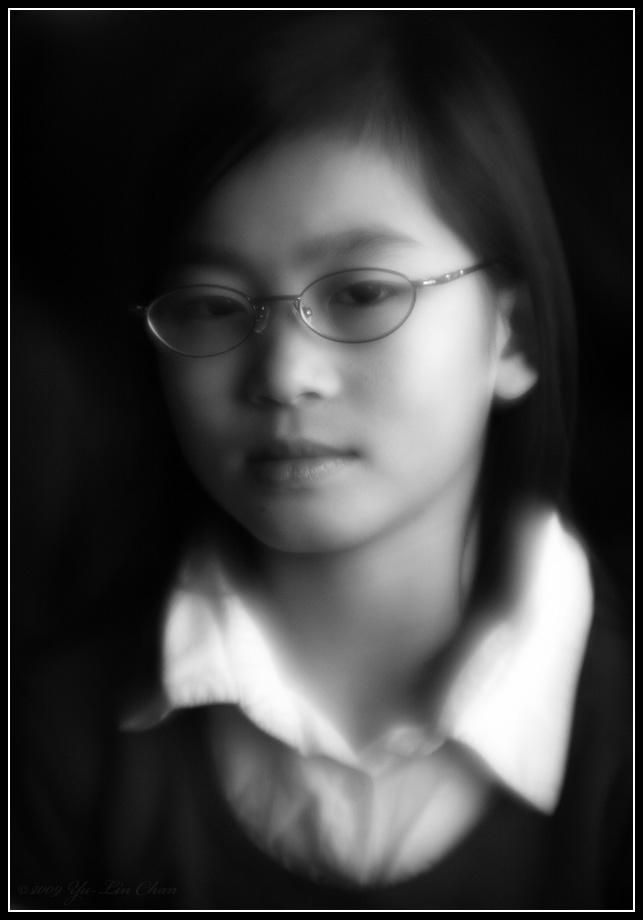


Megan -- Canon 5D & Sima 100mm f2 @ f4. Larger Picture.

Saturday, December 19, 2009

Fun with Sima SF 100mm f2 Soft Focus Lens -- Part 1

Almost all major manufacturers makes a soft focus lens.  Canon has the SF 135mm f2.8, Nikon has the 135mm f2 DC, Pentax has the 85mm f2.8, FujiFilm has the 85mm f4, and Minolta makes a 100mm f2.8 and a 85mm f2.8 Varisoft.  I don't know if Olympus ever made one.  If you know, please let me know.  All of these soft focus lenses are very expensive or rare, costing hundreds of dollars or more.

There are many ways to achieve the soft focus effect. There are lots of soft effect filters of all kinds, the more expensive (Zeiss Softar comes to mind) ones cost almost as much as a cheaper soft focus lens.  So, as you can see, you can get soft effect from very cheap to very expensive.  In the olden days as a poor student, I made my own soft focus filter by applying a light coat of Vasoline on a UV filter.  Still others use a stocking to cover a normal lens to soften the light.  Which way should you choose to go?  Vasoline is messy, soft filters are a nuisance to carry around and use, dedicated soft focus lenses have a narrow application and expensive.

There is a nice compromise.

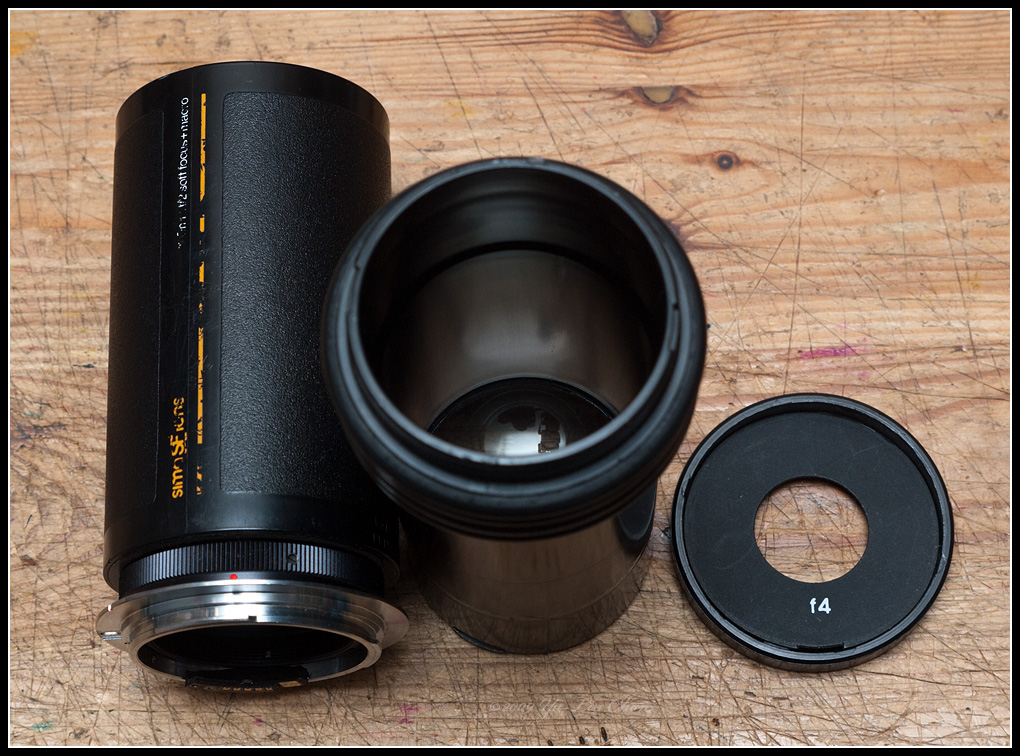
Enter the Sima SF 100mm f2 soft focus lens.  The lens comes with 3 filters that goes in the front of the lens.  This filters makes the lens f4, f5.6 and f8.  Without the filter, it's f2.  This is one of the cheapest, yet the most fun lens I have.  Very often turns up on eBay and can be had for about $25.  Very cheaply built, this T-Mount lens is made entirely of plastic, even the mount.  The lens comes in two parts as tubes.  The focusing part has the lens element, and is smaller.  It goes into the other, larger tube which has a lens mount.  The lens element is very deep into the tube and very hard to clean.  The good thing is that this is a soft focus lens, a bit of dust will just add a bit more softness to the pictures!  If you must clean it, just put it in the dishwasher, and it will come out nice and clean.  Probably the only lens I know of that can be washed without fear.

The lens element is un-coated, and uncorrected, thus giving you lots of aberration -- the colours captured with this lens is unprodictable.  What you see on the view finder is almost never what you get.  It's kind of a nice surprise, sometimes.

Next part, we will talk about how to use this wonderfully cheap lens.


Sima SF 100mm f2 plastic soft focus lens in its basic parts. Left is the outer tube that houses the inner tube with the lens element (middle), and on the right is the lens filter made of plastic. Larger Picture.


Megan -- Canon 5D & Sima SF 100mm f2 @ f2. It's a bit too soft at f2. Larger Picture.


Cube -- Canon 5D & Sima SF 100mm f2 @ f4. Larger Picture.


Friday, December 18, 2009

A stroll in Chinatown


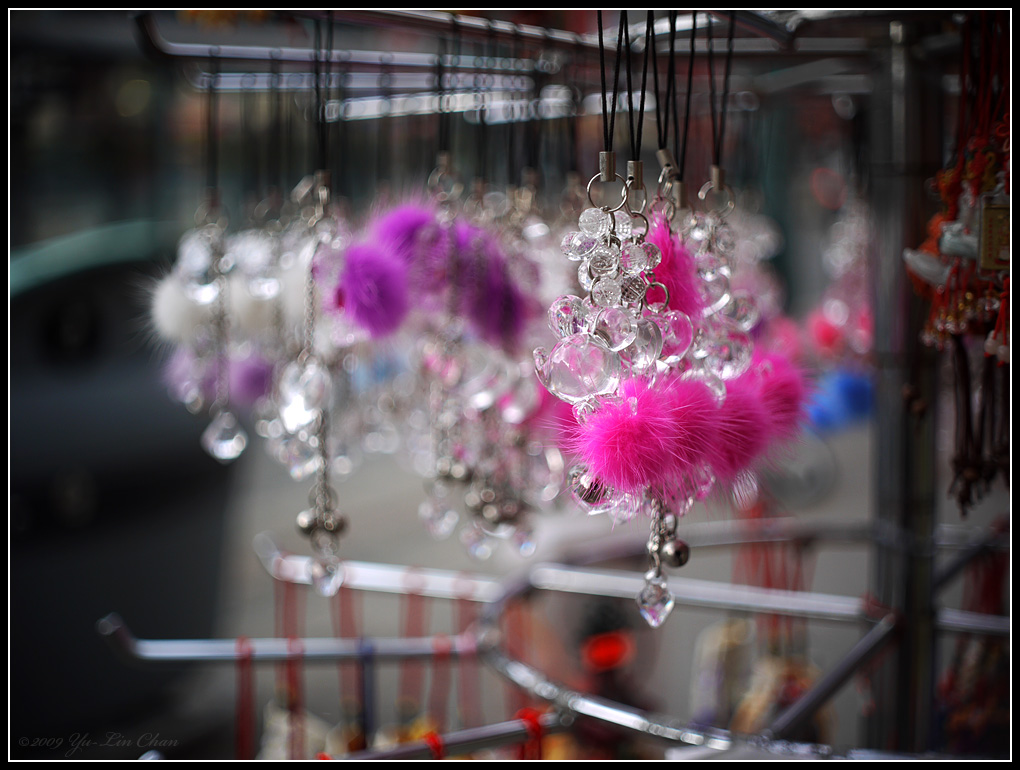
Hanging thingies -- Panasonic G1 and Kodak 25mm f1.9 @ f1.9. Larger Picture.


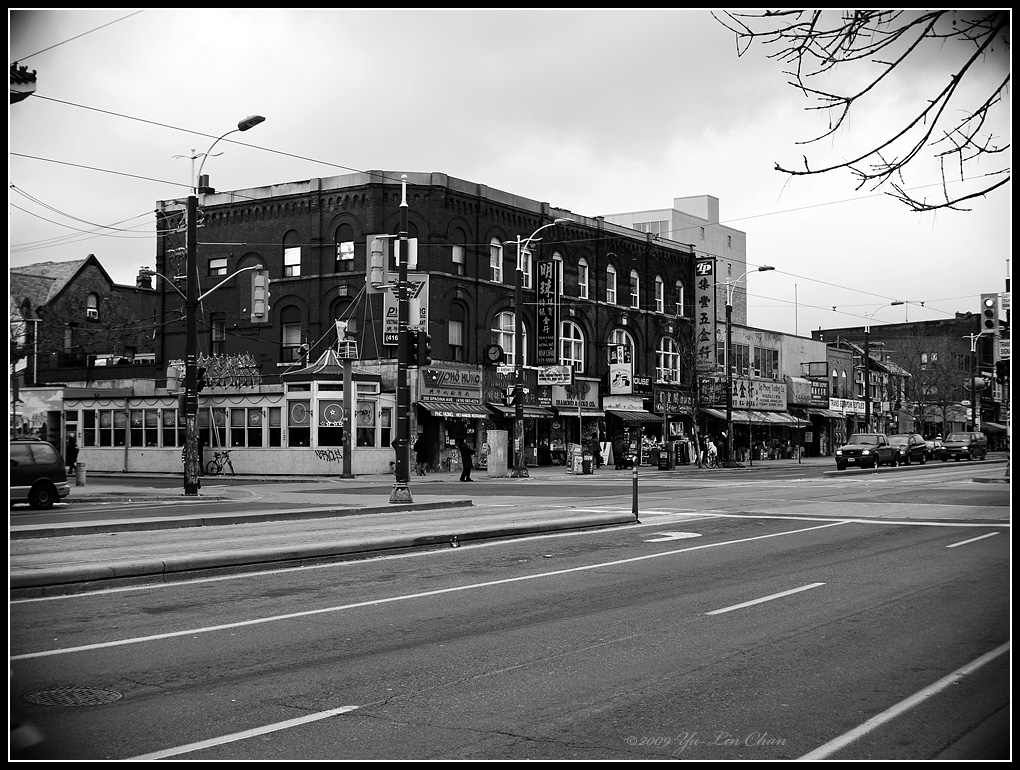
North Chinatown at Spadina & St. Andrew -- Panasonic G1 and Kodak Cine Ektar 25mm f1.9.  Larger Picture.

Took a walk up Chinatown at Spadina & Dundas in Toronto.  Don't usually go this way on my lunch time, mostly because it's always busy, too crowded, and I can never seem to find anything interesting to shoot.  There is the Kensington Market, just off St. Andrew and Spadina, that perhaps I should explore one day.

Thursday, December 17, 2009

Wednesday, December 16, 2009

Kinoptik Special Cine 210mm T3 Part III

The Kinoptik Special Cine 210mm f2.8 (or more accurately, T3), is a large lens, as expected for a fast lens of this focal length.  It weighs 1.87 kg with my home made adapter, original front cap and the rear cap.  It's roughly the same weight as the Canon EF 70-200mm f2.8 IS lens I have.  Despite being so heavy, the lens is surprisingly easy to focus.  I can focus it with two fingers, it's that smooth and light.  The aperture ring is also very light and easy to set.  The apertures are step-less.  There are no clicks between apertures. 

When mounted on the Panasonic G1, it looks kind of ridiculous and very hard to attain critical focus, due to the 2x focal length factor, making the lens having a view of a 420mm lens.  But, on the 5D, it's a much better fit.  Getting critical focus is surprisingly easy, although I do have an EE-S screen installed to aid manual focus lenses.

I quite like the images that come out of the lens and the 5D.  The pictures have a more 3-dimensional affect than my other lenses of similar focal length.  The bokeh is especially beautiful.  This is not a high contrast lens, but is the lens is very sharp, but not "dry".  Some lenses, especially older Nikon lenses are very sharp, but are very high contrast and thus giving the dryness feel to the pictures.  If I have to compare, pictures from the Kinoptik is like a medium rare steak done well, whereas pictures from other lenses are like well done steaks.  It's a well balanced lens between sharpness and contrast.  And the colour is wonderful.

I can't wait to shoot some portraits with this lens.  I think it's a nice portrait lens.  We'll see.

All pictures were taken with a Kinoptik 210mm f2.8 and Canon 5D.  Click on picture to see a larger version.


Monday, December 14, 2009

Kiron 24mm f2.0 Lens in Olympus OM Mount

I like Kiron lenses.  No nonsense design, well made, and optically good though not phenomenally good.  They only have one fatal flaw -- oil in aperture blades after a few years of use.  I had a 28mm f2 Kiron lens that had oil in the blade.  This 24mm f2.0 also had oil in the blade.  In fact, it's so bad that aperture can not be closed down manually.

Bought this lens from the last camera show for $25, thinking that it's worth fixing it for $25 for such a wide and fast lens.  I finally got the courage (and time) to open it last weekend.  It sat in two small plastic bags for a whole week, because I could not remove the rear element group.  The aperture blades themselves are even harder to get access to.  At the end, I decided to remove most of the parts except the front elements group and the apertures.  The rear group of lens came off after some considerable effort.  After removing the rear group, I had access to the apertures.  They were almost soaked in oil.

Since I could not remove the blades, I did the only thing I could -- dabbed lighter fluid on the blades as they were and then rapidly open and close the blades many times.  This allowed the lighter fluid to flow to both sides and dissolved the oil.  Repeated this a few times and finally the blades were free of oil.  The lighter fluid evaporates without much residue.  Cleaned up the lens elements and put the rear group back, and reassembled the lens.

The hardest part was adjusting infinity focus.  There are two parts where you need to be careful.  When putting back the focusing helicoid and adjusting focusing screws.  First time after I put it back, it could not focus to infinity.  After about three tries, I was very close.  The lens now focuses slightly past infinity, which is ok.  I now know where it I could adjust it more finely and I will get it just right the next time.

Took the lens to work but it rained at lunch time and therefore didn't get a chance to do any shooting.  On my way home, I decided to drop by the Gooderham Flatiron.  It was raining but not too badly. I had a nice Konica 24mm lens hood on the lens to shield the rain (and flare).  It was difficult focusing because rain kept falling on my glasses.  Didn't get a lot of keepers, but happy to have a few.

I noticed today that the street lights across from the Flatiron are turned off every 10 minutes or so, for a couple of minutes.  This is a very nice consideration for the photographers, because when the lights are on, with wide angle lenses, you will get flare and unwanted lights that distracts from the beauty of the Flatiron.  Next time you are there, just wait a few minutes for the lights to go off, and then take your pictures.

Very happy with the sharpness of the lens.  Slightly soft at f2 but hey, it's an old lens and 24mm wide angle!  Stopped down to f2.8 and it feels like a completely different lens.  At f4, it's excellent.  It's hard to judge colour at night, but it looks OK to me.  Even the edge is very good, on full frame.

Will post some day light shots when I get a chance.

All pictures were shot hand held at ISO 1600 f2.8, except the first one at ISO 3200 f4 on the Canon 5D.  Click on the picture to see a larger version.


Sunday, December 13, 2009

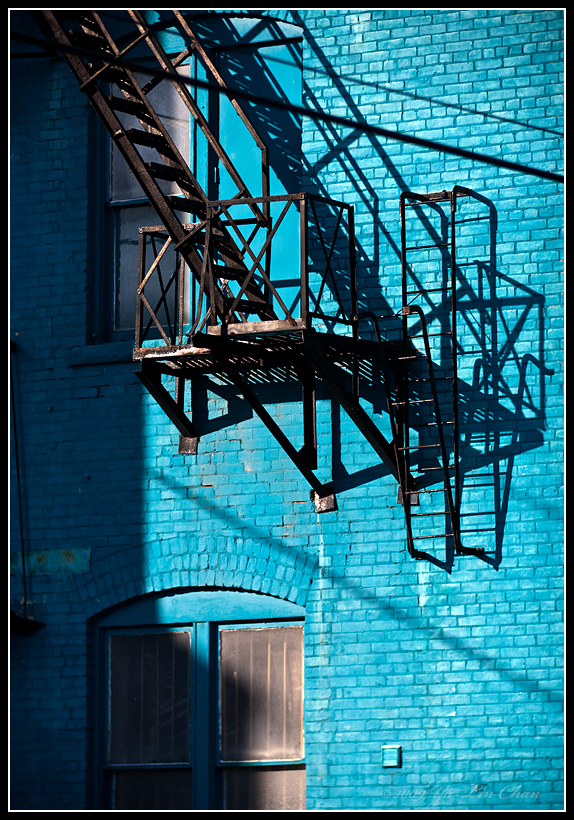
Blue


Blue -- 5D & Kinoptik Special Cine 210mm f2.8/T3.

These fire escape stairs are at the back of the Marty Millionaire's Antique Furniture store.  They have recently parted the whole building blue/turquoise.  Very striking.

Saturday, December 12, 2009

Friday, December 11, 2009

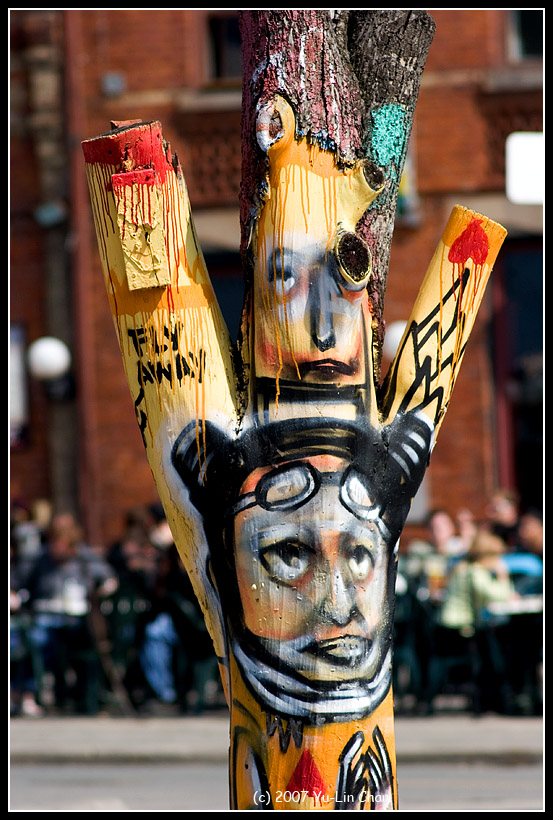
The Hug Me Tree in Toronto

If you hang around the Queen & Spadina area often, you will no doubt see the Hug Me Tree at the north west corner of Soho and Queen. Considered a local landmark, this artistically decorated dead tree was once displayed in Royal Ontario Museum. Well, if you have never seen it, be sure to stroll by next time you are in the area.


The Hug Me Tree in 2004 -- Canon 300D & Spiratone 18mm f3.2 M42 Lens. Larger Picture.


Hug Me Tree in 2007 -- Canon 20D & Leica 180mm f2.8. Larger Picture.


The Hug Me Tree in 2009 -- Canon 5D & Kinoptik 210mm f2.8. Larger Picture.