Showing posts with label Tamron SP 17mm f3.5 Adaptall. Show all posts

Tuesday, September 17, 2013

Tamron SP 17mm f3.5 Adaptall - Sample Pictures

It has been a while since I last used the Tamron Adaptall 17mm f3.5, so I decided to take a walk during my lunch hour, instead of my normal bike ride. The 17mm lens is an ultrawide angle on full frame, but on NEX-6, it's not that wide, at roughly 26mm. Still, it's wide enough for most wide angle needs. Anything wider than 24mm (35mm equivalent) tends to be difficult to compose, as the lens sucks in so much visual information.

As far as ultrawide angle goes, the Tarmon SP 17mm f3.5 performs quite well, at least on the NEX-6. Adam said that it didn't work quite as well on the NEX-7, so I guess the sensor density has quite an affect on the optics. I tried a different copy of this lens on the 5D classic and the image quality was quite good. Perhaps I should give it a go on my 5D II and see how it compares to the NEX.

Lenses this wide tend to have problems with distortion and edge sharpness; even the Zeiss Distagon 21mm f2.8, regarded as one of the best wide angle lenses, has distortion issues, though it's sharp as heck. I find the Tamron 17mm f3.5 is well controlled on the distortion front, if the camera/lens is not tilted, but it's still very hard to keep lines straight.

In all, a nice lens that still performs well with most digital cameras. You may want to reconsider if you have a high density sensor like the NEX-7, or D800.

All pictures below were taken with the Sony NEX-6 and Tamron SP 17mm f3.5 Adaptall.


Saturday, May 18, 2013

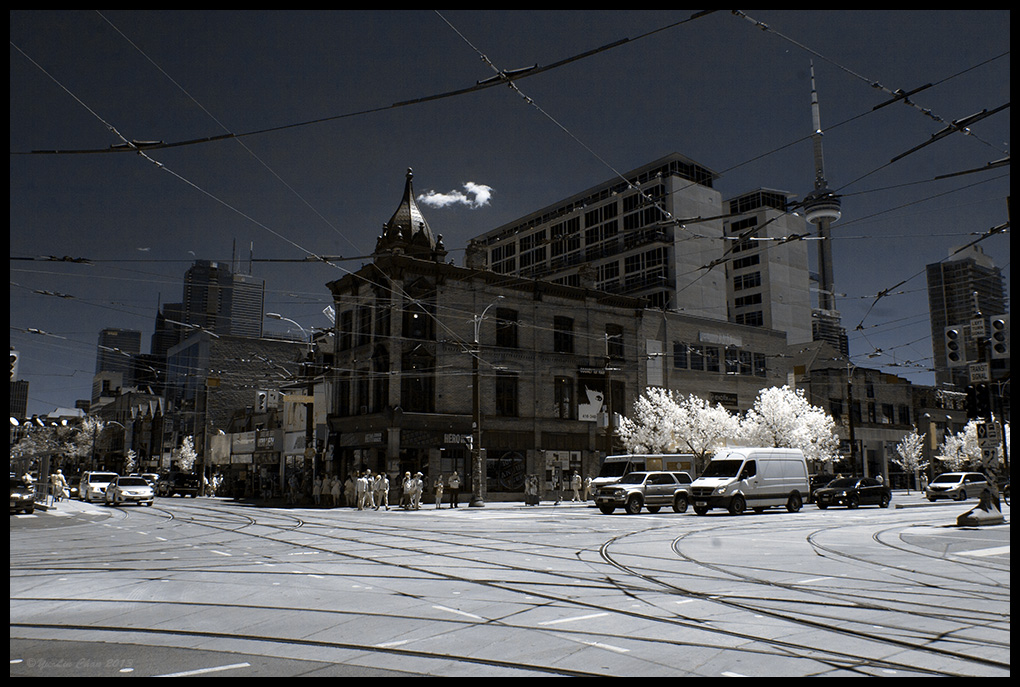
Tamron SP 17mm f3.5 - Infrared Photo Set

This is probably the last set of infrared pictures from the Spadina & Queen area, taken the day before my last day of work at lunch time.

I wanted to experiment with different wide angle lenses for IR photography other than the Pentax-M 20mm f4 lens I almost exclusively used before. Last time I tried the Flektogon 35mm f2.8 with good results, and I decided to try my widest manual focus lens - the Tamron SP 17mm f3.5. As it turned out, it wasn't bad at all. I was afraid I could not get infinity focus, but with aperture set at f8-f11, it was fine. What I really should have done, is try the Canon FD 20mm f4 against the Pentax-M 20mm f4, but there is always the next time.

The Tamron SP 17mm f3.5 is not as sharp the Pentax-M 20mm f4, especially at the edges, but it's a much wider angle therefore not a fair comparison.

The Hug Me Tree 2013 - Canon 20D IR & Tamron SP 17mm f3.5 Adaptall. Click for larger.

Spadina & Queen 2013 - Canon 20D IR & Tamron SP 17mm f3.5 Adaptall. Click for larger.

Grange Park - Canon 20D IR & Tamron SP 17mm f3.5 Adaptall. 

Tree outside Umbra building - Canon 20D IR & Tamron SP 17mm f3.5 Adaptall. 

Friday, May 17, 2013

End of a Chapter

Today is my last day at a job that I have had for the last 14 years. Couple years ago, our company was taken over by a big corporation and everyone at our department was given a "transition" period; a fancy term used by the big company to mean that "we will lay you off as soon as we've got what we want from you". I am the last of the MIS team to stay and take care of legacy stuff until everything is "transitioned".

It's been a wonderful 14 years. The Spadina & Queen area in Toronto, is a great place to work, eat, and of course, photograph. No doubt you have seen many pictures in my blog posts over the years, that were taken in this area. I would take a 45-minute walk around the area in my lunch hour, pretty much each day, and took pictures. I will surely miss this area, and most of all, miss my colleagues who have been so wonderful to work with. I will look back and cherish the memories, but as Canadian astronaut and commander Chris Hadfield said, "Don't look back. That's not where you are going!", I look forward to the next chapter of my career, which will soon start.

AlgoCafe - Canon 20D IR & Tamron Adaptall 17mm f3.5.

Thursday, February 14, 2013

Happy Valentine

For all you love birds out there, happy Valentine's day! I think everyday should be a Valentine's day and there is no reason to only celebrate love once a year :) May you and yours have a wonderful day!

Happy Valentine [2007] - Canon 20D & Tamron SP 17mm f3.5.

Sunday, November 18, 2012

What Makes Us Upgrade

Let's be honest.  I have a weakness when it comes to buying camera gear.  If I were single, I would probably spent all of my disposable income buying cameras and lenses.  Back in the film days, upgrading a camera usually involved a 5-year plan.  A film camera was made to last at least 5 years before an upgrade was considered, because most camera models had multi-year life span.  Some of them, like the Pentax K-1000, was in production for decades.  My Pentax Program Plus lasted about 12 years for me, and it was still in perfect working order when I traded it in for my last film camera, the Canon Elan II, which lasted about 5 years before digital came along.

Digital fulfills our instant gratification desire. We push a button, the picture shows up on the screen.  We no longer need to wait hours, and sometimes days, before we see the pictures.  We no longer had to count and consider before pushing the shutter, because we are no longer restricted to 36 frames of film.  We can now scrutinize the pictures to the pixel level, versus looking at a 4x6 print.  We get more and more dissatisfied with image quality because we pixel peep, and the newest camera must be better, or so says the marketing department of the camera companies.

Last week I shot Dillon's school concert, with my Canon 1D Mark III, at ISO 1600 and 3200 and the 85mm f1.2L.  I pixel peeped at the meager 10 Mega Pixel files, and I am actually very happy with the image quality.  Seeing images from the 1D III has suppressed the desire to upgrade to a very large extend.

For those of us who are short on disposable income for camera gear, we should take a step back, look at the pictures we have taken with the cameras we have, and ask ourselves, are we really unhappy with the image quality, and really need to upgrade our cameras?

King Street Social - NEX-5N & Tamron SP 17mm f3.5

Saturday, September 8, 2012

Tamron SP 17mm f3.5 vs. Tokina RMC 17mm f3.5

The other day I took out both the Tamron SP 17mm f3.5 Adaptall (second version) and the Tokina RCM 17mm f3.5 and took some pictures for comparison.  What I found was bit of a surprise.

Please note that this is not a real review, and certainly not anywhere near scientific or rigorous in making sure everything is identical.  Pictures were taken handheld, one lens, and then the other.  Consequently, framing might be slightly different.  Also, no guarantee on 100% accurate focusing.  Ultra wide angles are very difficult to nail critical focus.  But, both lenses have equal opportunity on chances.

The Physicals

Both lenses are very well built and focuses smoothly, as expected with most manual focus lenses.  Both focus to 0.25m, which is very close; almost touching the lens hood at this distance.  The only non-metal parts is the focusing band on both lenses, and in the case of the Tamron, the plastic distance window.  The Tokina has a slightly longer focusing travel and might give a slight edge to finer focus adjustment.  In terms of size, both lenses are similar, but the Tamron is slightly smaller.  The Tamron has n o filter threads on the lens itself; an 82mm filter thread is on the hood. If you lose your hood, you won't be able to use filters on it.  On the other hand the Tokina has a standard 67mm filter thread, which is much easier and cheaper to attach filters.

Tokina RMC 17mm f3.5 [FD] on left, Tamron SP 17mm f3.5 [EF] on right. Click for larger.

With hoods. Click for larger picture.

How do they compare optically

At the end, it's the image quality that matters.  Surprisingly, both lenses behave very similar optically, at least on the APS-C sensor.  The Tamron is slightly more contrasty (sharper) wide open, but the Tokina seems to show a bit more detail.  Interestingly, the Tamron appears to be wider than the Tokina.  I took the pictures below from the same spot without moving my feet.  Even from the small thumbnail, you can see the Tamron is more contrasty.  Also, the Tamron is a little better at suppressing color fringing than the Tokina.


Tokina on left, Tamron on right. Crops are NOT sharpened. Click each picture to see larger version 

At f8, both lenses are very sharp at the center of the frame. The Tamron does a bit better at the far corner.  Please note that the tree was not at the plane of focus, so on a flat surface, the corner might be better, but at f8, the depth of field should make up for it.  Note the colors are very similar.

I would imagine the Tamron will be a better performer on full frame at the corners.  The center of both lenses are very similar from about f5.6 on.


At f8 unsharpened. Tamron on left, Tokina on right. Click to see 100% crop.

Bokeh

For ultra wide angles, bokeh is usually not a real concern for most people.  They are normally used stopped down.  For interest's sake, I have provided one for your reference.


Flare Test

Both lenses flare badly when shooting at light source.  To be fair, most lenses, even the very expensive ones, probably wouldn't do much better than this.  The Tamron holds contrast much better than the Tokina in this situation.


Flare test.  click on each image to see a larger version.

The verdict

I paid exactly twice as much for the Tamron SP 17mm f3.5 (without mount) as the Tokina RMC 17mm f3.5.  I think the Tokina represents a great value for the money, putting up a good fight against the more expensive Tamron.  If used on M4/3 cameras, the differences is probably negligible once both lenses stop down one notch, but on full frame, and to a lesser degree, APS-C sized sensor, the Tamron hold an edge at the outer corners.