Showing posts with label Manual Focus Lenses. Show all posts

Thursday, September 20, 2012

A Look Back at the First EVIL Camera - Panasonic G1

Out of guilt, I took the Panasonic G1 out yesterday.  It was literally collecting dust.  Besides, the Wollensak one inch (25mm) Cine Raptar hasn't seen the light of day since I got it, because its imaging circle is too small for the NEX-5N.

First thing that jumped to my mind was how good the viewfinder is, even against the very best on the market (Sony external viewfinder for the 5N).  Yes, it's not as crisp and detailed as the Sony, but proudly holds its own.  Considering the G1 is four years old, this says something.  

In some ways, I prefer the colour from the Panasonic than the NEX-5N.  It seems more vibrant and pleasing to look at.  But when it comes to image quality, the NEX-5N is clearly the winner.  Even at ISO 320, the G1 shows lots of noise, compared to the G1, thanks to the larger sensor and better on-chip noise reduction of the NEX-5N.  The G1 reminds me of the original Canon 1Ds, where low ISO quality is superb, but anything above ISO 320, it gets very noisy.

The G1 is still a very capable camera.  Certainly it's no worse than when it was introduced four years ago.  We tend to want the latest and greatest, and forgetting that older equipment can still make beautiful images.

Lunch with the birds - Panasonic G1 & Wollensak Cine Raptar one inch f1.9. Click for larger.

Pink Dahlia - Panasonic G1 & Wollensak Cine Raptar one inch f1.9 @ f1.9. Click for larger.

Leaves - G1 & Wollensak Raptar two inch f1.5.

Wednesday, September 19, 2012

Minolta MC Macro Rokkor-QF 50mm f3.5 - Second Look

Last time, we looked at this lens a little more than a year ago, and I quite like it. On the used market, this lens often sells for under $75.  Personally, I think it's a bargain lens that performs well, especially for macro.  On cameras with optical view finders, this lens may not offer a bright viewfinder due to its rather large maximum aperture of f3.5, especially if the 1:1 macro extension tube is used.  But with mirrorless cameras, this is no longer an issue. The electronic viewfinder will compensate for the light loss by amplifying the brightness level.

It's understandable that many of us would like a macro lens that could do double duty: an every day use normal lens and a macro lens. And for this, a larger maximum aperture, like f2, or even f2.8, is preferred. Maybe this is part of the reason why small aperture macro lens in normal focal length is not as popular as ones with larger maximum aperture.  Look at it the other way, a larger aperture lens is quite a bit more expensive, especially for a macro lens.  If you only do occasional macro photography, and you already have a faster normal lens, this lens would be a good fit.

Spider plants - NEX-5N & Minolta Macro 50mm f3.5 @ f3.5 without extension tube. Click for larger.

Rose - NEX-5N & Minolta Macro 50mm f3.5 without extension tube. Click for larger.

Rose #2 - NEX-5N & Minolta Macro 50mm f3.5 without extension tube. Click for larger.

Rose #3 - NEX-5N & Minolta Macro 50mm f3.5 without extension tube.

Saturday, September 8, 2012

Tamron SP 17mm f3.5 vs. Tokina RMC 17mm f3.5

The other day I took out both the Tamron SP 17mm f3.5 Adaptall (second version) and the Tokina RCM 17mm f3.5 and took some pictures for comparison.  What I found was bit of a surprise.

Please note that this is not a real review, and certainly not anywhere near scientific or rigorous in making sure everything is identical.  Pictures were taken handheld, one lens, and then the other.  Consequently, framing might be slightly different.  Also, no guarantee on 100% accurate focusing.  Ultra wide angles are very difficult to nail critical focus.  But, both lenses have equal opportunity on chances.

The Physicals

Both lenses are very well built and focuses smoothly, as expected with most manual focus lenses.  Both focus to 0.25m, which is very close; almost touching the lens hood at this distance.  The only non-metal parts is the focusing band on both lenses, and in the case of the Tamron, the plastic distance window.  The Tokina has a slightly longer focusing travel and might give a slight edge to finer focus adjustment.  In terms of size, both lenses are similar, but the Tamron is slightly smaller.  The Tamron has n o filter threads on the lens itself; an 82mm filter thread is on the hood. If you lose your hood, you won't be able to use filters on it.  On the other hand the Tokina has a standard 67mm filter thread, which is much easier and cheaper to attach filters.

Tokina RMC 17mm f3.5 [FD] on left, Tamron SP 17mm f3.5 [EF] on right. Click for larger.

With hoods. Click for larger picture.

How do they compare optically

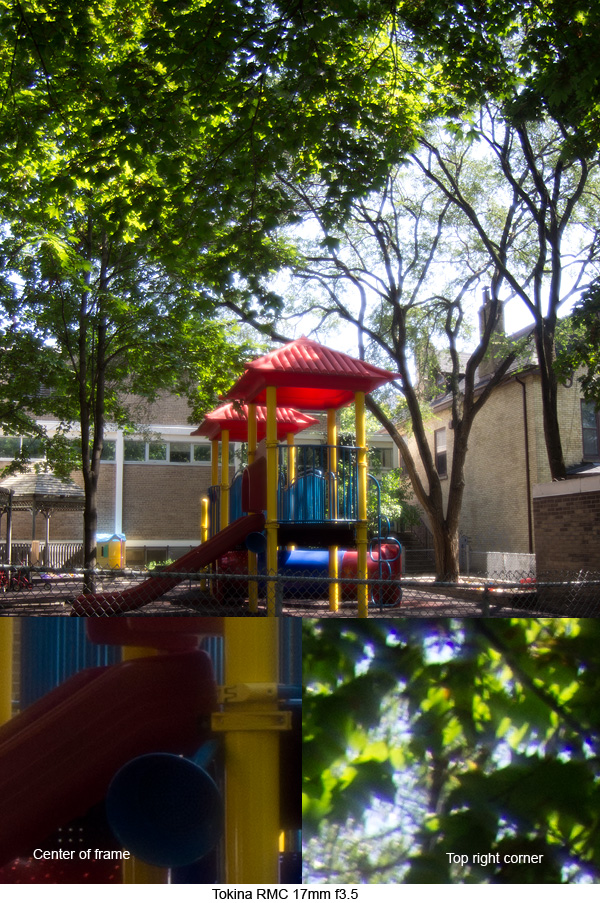
At the end, it's the image quality that matters.  Surprisingly, both lenses behave very similar optically, at least on the APS-C sensor.  The Tamron is slightly more contrasty (sharper) wide open, but the Tokina seems to show a bit more detail.  Interestingly, the Tamron appears to be wider than the Tokina.  I took the pictures below from the same spot without moving my feet.  Even from the small thumbnail, you can see the Tamron is more contrasty.  Also, the Tamron is a little better at suppressing color fringing than the Tokina.


Tokina on left, Tamron on right. Crops are NOT sharpened. Click each picture to see larger version 

At f8, both lenses are very sharp at the center of the frame. The Tamron does a bit better at the far corner.  Please note that the tree was not at the plane of focus, so on a flat surface, the corner might be better, but at f8, the depth of field should make up for it.  Note the colors are very similar.

I would imagine the Tamron will be a better performer on full frame at the corners.  The center of both lenses are very similar from about f5.6 on.


At f8 unsharpened. Tamron on left, Tokina on right. Click to see 100% crop.

Bokeh

For ultra wide angles, bokeh is usually not a real concern for most people.  They are normally used stopped down.  For interest's sake, I have provided one for your reference.


Flare Test

Both lenses flare badly when shooting at light source.  To be fair, most lenses, even the very expensive ones, probably wouldn't do much better than this.  The Tamron holds contrast much better than the Tokina in this situation.


Flare test.  click on each image to see a larger version.

The verdict

I paid exactly twice as much for the Tamron SP 17mm f3.5 (without mount) as the Tokina RMC 17mm f3.5.  I think the Tokina represents a great value for the money, putting up a good fight against the more expensive Tamron.  If used on M4/3 cameras, the differences is probably negligible once both lenses stop down one notch, but on full frame, and to a lesser degree, APS-C sized sensor, the Tamron hold an edge at the outer corners.

Monday, April 9, 2012

Adapting Manual Focus Lenses to Your Digital Camera - Part IV

Last time we talked about adapting lenses to the M4/3 and Sony E-Mount in Part III.  This time around I am going to share some of my experiences on how to start, where to get lenses, what to avoid when buying lenses and talk a bit about adapter, and finally, why bother with manual focus lenses.  This is a long article and I was debating whether to break it into two, but decided to just leave it as one.

I shot film from early 1980s to about 2001 with only two cameras, and not at the same time!  My first camera was a Pentax Program Plus with a 50mm f1.7, and I later added the 35-70mm f4, and a Sigma 70-210mm f4-5.6 cheap zoom.  Used this setup until 1995, when I got my first AF camera - the Canon Elan II with a EF 28-105mm f3.5-4.5, which lasted until I got my first digital camera, the Canon Powershot G1.  As you can see, I did not have gear acquisition issues back then and was quite happy with what I had.  From the film camera experience, it's kind of natural for me to use manual lenses on digital SLRs.  But, many people who start using DSLRs have never touched a film camera before, so how to you start?

Getting Started

My suggestion is to start simple.  Manual focus lenses are not for everyone.  Some people get very frustrated with getting unsharp pictures from manual lenses due to focus problems, and some just like auto focus lenses more.  If I had to start today, I would buy three lenses to start with: Vivitar 28mm f2.8, Takumar 55mm f1.8 (version doesn't really matter), and a Takumar 135mm f3.5, all in M42 mount.  All these lenses should cost about $100 plus $15 for the mount of your camera.  If you don't like them, you can sell them later at little or no lost of money.  I would spend a lot of time with the Takumar 55mm f1.8, since it's one of the best manual focus lenses and it was built like a tank, and focuses like a dream, not to mention optically excellent.  Use these lenses for at least a couple of months, and see if you start to grow on them.  For people who started out using manual focus lenses with film camera, this is natural, but if you don't find yourself enjoy using them, auto focus lenses are probably a better choice for you.

Megan from 2006 - Canon 10D & SMC Takumar 55mm f1.8

Where to Buy

If you like using manual focus lenses, chances are you will not be happy with what you have for long, and the next thing you do is looking for better and more exotic lenses.   This could be both a good and a bad thing.  The good thing is that you can get some really good fast lenses for a lot less than the auto focus equivalent, and the bad thing is that you could get hooked and addicted.  But, where to get lenses?

For most people, eBay is probably the best place where you can get all kinds of lenses, but unfortunately, it's also one of the most expensive place to buy lenses.  Personally, I never bought a lens from eBay.  Just don't like competing with other people on the price.  My usual sources of lenses is Craigslist, Camera shows, Pawnshops or second hand camera stores, and occasionally, camera stores.  Some of my favourite lenses were bought from my local Craigslist, such as the JML 25mm and 50mm f0.95, Kinoptik 210mm f2.8, and the Kilfitt Makro Kilar 90mm f2.8 at very reasonable prices.  Check your local community or flee market for used camera shows.  Here in Toronto, there are three to five of these shows every year so lots of opportunities to check out some lenses you want to buy.  I occasionally get some good deals on lenses from Pawnshops and second hand stores.  If you live in a small community, unfortunately, you only choice might be eBay.  Just remember, you don't have to buy all the lenses you want in one shot.  Finding one of the lenses you want after a long hunt is a thrill and that's part of the fun.  Make it fun, but don't get addicted.

What to look out for when buying manual focus lenses
First thing first - make sure it's functional.  Aperture clicks and stops down, focusing action is smooth without choppiness.  Aperture and focusing are two most important things to look for, because if these two things don't work, you either can't focus, or shoot wide open all the time, or both.

Other areas of concern is fungus.  Be sure to check carefully there is no fungal growth inside the lens.  Very minor ones, if the lens is cheap enough, can be tolerated, especially if the growth is at the corners.  The worse kind is the one growing in the rear elements.  Generally, avoid lenses with fungus as they will continue to grow and get worse.

Scratches on glass elements.  I am not as concern about this as other people.  I have had lenses which are very scratched up and they produce beautiful pictures.  Minor scratches do not affect the performance of the lens, but heavy and fine scratches all over the lens will soften the lens, and make it more prone to flare.  So, a few minor scratches are ok, and they tend to be cheaper.  Avoid heavy scratches at the rear elements, especially when they are in the middle.

Dust Specks/Haze.  It's unavoidable.  Old lenses are generally not very well sealed and thus dust will get inside more easily.  Again, don't panic when you see a few specks of dust inside. Practically ALL my lenses have some degree of dust problems.  However, haze is a big issue.  Basically it's a layer of very fine dust settled over a long time.  This haze will reduce contrast of the lens, and makes the lens flare easily.  Avoid lenses with haze.

Oil inside glass/Aperture blades.  In many preset type lenses, oil on blade is normal and should not be overly concerned about them.  Some of them have oil on purpose to lubricate the blades.  But for auto aperture type, oil in them is not normal.  Eventually, more will leak out and the aperture blades will stick together and you won't be able to stop down any more.  If you see oil on non-Preset type lenses, it's the first sign that the aperture may stick in the near future.

De-centering issues.  Many old lenses have this issue, especially those that were repaired or opened before.  Generally, the problem is that one side is sharp, but the other side is blurry.  This could also be caused by a cheap adapter, so be sure you know that the problem lies.

Adapters

Many asked what brand of adapters they should buy.  I really don't know.  Personally, I buy cheap Chinese made adapters and they have been working well for me.  Occasionally, I would buy a few good ones, like those from Fotodiox (pro-series), and Metabones.  High quality adapters can cost hundreds of dollars each.  If you  are just starting out, I suggest getting the cheap ones to try.  Unless you have some very expensive lenses, like a collection of Leica M-Mount lenses, it might make more sense to get a good adapter to share amount your lenses.  Even though I buy mostly cheap adapters, I have spent more than $2,000 on adapters so far, because I have so many different lens mounts.  They used to be very expensive, even for an M42-EOS adapter, until the Chinese started making and selling them.  Generally, common mounts like M42, Nikon, Olympus, etc, are very cheap, because demands are higher and they can sell at lower price but at greater quantities.  More obscure mounts like Alpa, DKL, etc, are far more expensive because there aren't that many lenses out there and therefore demand for them are much lower.

The major difference between cheap and expensive adapters are precision and accuracy.  Cheap adapters usually are not very accurate, and they tend to focus past infinity or not reaching infinity.  Cheap ones are also less precisely made where flatness of the adapter is not guaranteed, resulting in uneven sharpness in the pictures.  But, buying an expensive adapter does not guarantee it would work flawlessly with your lens.  I have one quite expensive and name brand Leica to EOS adapter which would not allow any of my Leica-R lenses to focus to infinity.  Be sure you can return the adapter if they don't perform as advertised.

Now that you have some knowledge of what lenses you can use, and what adapter to buy to get the lens to work on your digital camera.  The final question you might be pondering remains: Why bother with manual focus lenses?


Manual Focus Lenses - the good


Value for the money:
Most consumer lenses that come with the camera these days are not very good.  For one thing, they are slow, Often with a maximum aperture of f5.6 at the long end.  If you need to shoot at low light, you will have to folk out a few hundred dollars for a faster auto focus prime.  On the other hand, there are some great manual focus lenses costing under $40, such as the Takumar 55mm f1.8, which has better quality, in terms of build and optical, than the kit zoom you have.  Yes, it's not fair to compare a zoom to a prime, but if you want low light shooting lenses, there is no other choice.  If you have never used a large aperture lens before, you will be surprised to find how wonderful it is to be able to shoot shallow depth of field.


In Control:
I don't know about others, but I feel a sense of control when using manual focus lenses.  Let's face it, the cameras we have today basically does everything for us.  Auto exposure, auto focus, auto white balance, auto ISO, etc.  I sometimes feel that it's the camera doing all the decision for me.  With manual focus lenses, I control the aperture or shutter speed and focusing.  If you are using manual lenses for video, you will know the focusing on manual focus lenses are light years better than auto focus equivalent.

A satisfying experience:
The feeling after looking at a beautiful photograph taken with a cheap lens gives me immense satisfaction.  True, many manual focus lenses are not cheap, and can be more expensive than AF version, but majority of them are cheaper, especially the common ones.

Variety:
There are thousands of old lenses out there, most of them are cheap.  You can try many of them without breaking the bank, not to mention the different type of lenses like Cine lens, Lomo effect lenses (Lomo/Lensbabies), Telescopes, microscopes and much more.  All these the original manufacturers do not make. Different lenses give you distinctive looks to your pictures.

Manual Focus Lenses - the bad

No Automation:
With very few exceptions, adapting manual focus lenses on your digital camera means you will lose all the automated features.  There will be no auto focus, no auto aperture control, and in some cases, no metering (for some Nikon consumer DSLRs).

Quality of lenses not guaranteed:
Since most manual focus lenses are old, some are decades old. Even the best kept lenses might have minor issues after so many years of use. Most of them do not look like new (if that bothers you).  Some might have aperture issues, others have focusing problems, etc.  Read the section on "What to look out for when buying a manual focus lens".

Flare Easily:
Old lenses (even many new AF ones) flare easily, as the coating on them (some don't even have coatings) are not as effective as modern coatings.  This problem can be partially avoided by using lens hoods, or not shooting into the light source.

Exposure Variance:
This is only for the Canon DSLRs shooting through the view finder.  Live-view has no problem with this.  Basically, as you stop down the lens, the exposure tend to be less accurate.  My experience shows that some lenses need to be dialed -1 in exposure compensation for each f-stop you stop down.  EVIL camera shooters do not have this problem, as what you see in exposure is what you get.  You will learn to compensate in no time at all, so this is really not a problem.

A word about exotic lenses

Eventually, you will get tired of your garden variety of common lenses you have in your possession, and start looking at more exotic lenses.  Names that you may never have heard before, like Alpa, Dallmeyer, Kinoptik, Angenieux, Som Berthiot, Boyer, Cooke, Kern, Hugo Meyer, Astro Berlin etc, will start to enter your horizon.  These optical wonders are like drugs and can get very addictive and expensive.  Some of these lenses costs thousands of dollars.  Unless you have lots of disposable income, buying these kind of lenses will put a lot of pressure on your finances.  Sometimes it's hard not to think about them.  The first time I saw pictures from Kinoptik 50mm f2 and Dallmeyer Super-Six, I couldn't believe pictures can be rendered and look so beautifully! Make sure you understand that manual focus lenses is for fun and you don't need to spent thousands to enjoy them, unless you can.

This last installment will conclude our "Adapting Manual Focus Lenses on Your Digital Camera" series.  Thanks for reading.  If you have any questions, please e-mail or leave comments.

Sunday, April 8, 2012

Adapting Manual Focus Lenses on Your Digital Camera - Part III

After some initial mumble jumble, we talked about adapting manual focus lenses on the Canon EOS EF mount in Part II.  As you can see, there are lots of options for Canon shooters, but also a lot of limitations, due mostly to the reflex mirror clearance.  In Part III, we will talk about using manual focus lenses on the Micro 4/3 and Sony E-Mount, and to some extend, the Fuji X-Mount (not the AX mount on their old SLRs).

Without doubt, mirrorless cameras, except the Samsung NX series, with a flange focal distances of 25.50mm, are the most adaptable cameras to use on manual focus lenses.  The Samsung's 25.50mm thickness was just enough to shut out the use of adapting Leica-M lenses, which many have said as one of the biggest disappointments.  Leica M lenses are considered the pinnacle of 35mm lenses.  The build and optical quality is unequaled in the 35mm lens world.

So, what lenses can be used on Micro 4/3 and E-Mount cameras?

In a word, pretty much all lenses existed on the 35mm format, if anyone is willing to make the adapter for a particular lens mount.  The very short flange focal distance of the M4/3 (19.25mm), E-Mount (18mm), Fuji X (17.70mm) provide the opportunity to use a wide range of optical lenses, 35mm format, medium format, C-mount cine lenses, enlarging lenses, projection lenses, etc.  The possibilities are practically endless.  The only question is: is a mount adapter available?

The most popular lenses to use on M4/3 and E-Mount are Leica Thread Mount (LTM), Leica M mount and C-Mount.  The reason is that these lenses have very short flange focal distance and therefore adapters can be made very thin.  Adapted lenses would look very small, to complement the small M4/3 and NEX cameras.  The quality of lenses are also some of the best in these mounts (except c-mount, where there is a big variance).  To compare, the M mount adapter for NEX is roughly 10mm for the NEX, whereas the M42 to NEX adapter is almost 30mm thick.  Even a pancake Contax 45mm f2.8 lens will look like a 85mm SMC Takumar when mounted on the NEX.  Take a look at the comparison pictures below:

Voigtlander 40mm f1.4 & Contax 45mm f2.8 Pancake compared with and without adapter.
 
On adapters: C-Mount Switar 50mm f1.4, M-Mount Voigtlander 40mm f1.4, QBM 50mm f1.8

As you can see, the mount makes a big different on how large the lens will look when mounted on the camera.  Even a normal, small 50mm f1.8 QBM lens will look huge when mounted on the NEX, but the C-Mount and M Mount lenses look nice and small.

A note on c-mount lenses.  There are so many different lenses on this mount with different sizes.  Be very careful what you are looking for in c-mount lenses.  Some will not cover the image circle of the NEX or even M4/3 sensor, and some are too large to be used and be able to focus to infinity.  Even those that mount and focus to infinity with full image circle coverage, the image quality may not be what you are looking for.  The allure of c-mount lenses are their cinematic quality, or quirky characteristics, or weird bokeh or some combination of these or more.  Make sure you know what you want.  Some of these lenses costs thousands of dollars!

Another benefit of short flange focal distance of these mounts, is that the traditionally macro-only use of the enlarging lenses and projection lenses can be used like a normal lens; that is, be able to focus to infinity.  I have done quite a bit with both the enlarging and projection lenses.  If you do a search on my blog, you will see many examples.

In our next and final installment, Part IV, we will talk about buying manual focus lenses, what to look out for, why some lenses costs thousands and others almost nobody wants at give away prices, and the costs of different adapters.

Saturday, April 7, 2012

Adapting Manual Focus Lenses to Your Digital Camera - Part II

We talked some mumble jumble about adapting manual focus lenses to digital cameras in general in Part I.  Now let's get to the meat and potato.  Now the $64000 dollar question: What lenses will work on your digital camera?  The answer is: that depends mostly on the flange focal distance of your camera and the lens you want to use.  Generally, the shorter the flange focal distance, the easier it is to adapt and use manual focus lenses.  If you take a look at the nice wiki entry, you will find that Canon EF (EOS) has a distance of 44mm; shorter than most mounts that are still in use today.

Yes.  We Canon shooters are blessed with a shorter flange focal distance of the EF mount with 44mm, while the people in the Dark Side (Nikon) has a distance of 46.50mm. For this reason, very few lenses can be adapted and used on the Nikon with infinity focus, except Leica R lenses with a mount replacement.  We should toss a glass of sake to the Canon engineers who came up with the relatively short mount distance.  If you use Sigma SD cameras, good for you, because the Sigma SA mount is basically a Canon mount slightly rotated.  In fact, Sigma uses the same protocals as Canon.  You can actually modify the Sigma SD cameras and put on a Canon mount, and most Canon EF lenses will work (except IS).

So, which lens mount can be used with Canon EF?  These are the ones I know and have used:

Nikon (F) -- Almost all Nikon lenses can be used without restriction except the weird fisheye lens from the 60s that you had to lockup the mirror to use.  For G lenses, you need a special mount adapter that lets you set apertures.

M42/Universal -- Most lenses can be used on Canon without restrictions, but there are some exceptions.  The one I know of is the Takumar SMC 50mm f1.4 on full frame, Myer Optik Primoplan 58mm f1.9 (on 5D), and may be a few others.  The 5D (and possibly the 5D II and 5D III) are the most problematic.

Leica-R -- Most Leica-R lenses can be used on the Canon, but please refer to this great blog for the compatibility chart.  In general, it's the wide angles that have issues.

Yashica/Contax (CY) -- Most are compatible, but few Contax lenses will hit the mirror on infinity.  Again, Pebble Place has a great database with the compatibility chart.

Olympus OM -- As far as I know, there are no compatibility issues.  All lenses can be used on the Canon. But then again, I don't have many OM lenses.

T/T2 Mount -- These lenses require a Canon EF to T/T2 mounts to use.  I would say all are compatible with Canon.  All T/T2 lenses do not have aperture automation, and always come with pre-set aperture.

Tamron Adaptall -- All Tamron Adaptall lenses should have no issues on the Canon when used with the proper adapter.  Please note, as with the T/T2 mount lenses, there are mount adapters for most major cameras, including Canon EF.

DKL/Kodak Retina -- There aren't that many lenses with this mount and DKL lenses do not have aperture control on the lens, and no DKL lens is fater than f1.9.  The adapter comes with aperture control.  As far as I know, all DKL lenses work on the Canon. Voigtlander and Schneider are two major lens makers for the DKL mount.

Exakta (EXA) -- All the EXA lenses I have used can not focus to infinity because the adapters are not thin enough (can not be made too thin as there is only 1mm to work with).  Avoid using Exakta lenses on the Canon unless you can find a seller who will guarantee infinity focus.

Rollei QBM (Quick Bayonet Mount) --  Like the Exakta, these adapters have trouble making the lenses focus to infinity on Canon.  Avoid them unless you don't need infinity focus or the seller can guarantee it.

I think that's all the different mounts that I know of can be used with Canon.  If you know of any others that I have left out, please let me know and I will update the list.  Pretty much all medium/large format lenses can be adapted to Canon and other systems, but I have no experience with any of them so I won't talk about it.

Note that no range finder lens mounts are listed above.  Range finder camera do not use mirrors that therefore the lenses can be pushed further into the mount without worry about the mirror, and this also means the flange focal distance is a lot shorter than SLRs.

If you use manual focus lenses mainly for video, those lenses (Leica, Contax, etc) that hit the mirror at infinity can still be used if you put the camera on Live-View, as this will flip up the mirror.  Make sure you focus the lens to the closes focus distance before mounting it on the camera, or the mirror will hit the lens when you engage Live-View.  Some brave souls will go as far as shaving part of the reflect mirror off in order to use their favourite lenses.  I wouldn't do it, but other have done it.

Next time, we will have a look at the Micro 4/3 and Sony E-Mount in Part III.

An OM Mount lens on the Canon 1Ds that I used before.

Friday, April 6, 2012

Adapting Manual Focus Lenses to Your Digital Camera - Part I

Another reader, Mathew, has asked me to do a guide to adapting manual focus lens to digital cameras.  I actually have had this idea for a while, but unfortunately, even though I use a lot of manual focus lenses, I am not an expert on this topic.  But, I think I will put out something for what I know, as I am sure there are quite a few people out there who are confused by all the different adapters and lens mounts.  I will only be discussing adapters for Canon EF (EOS), Micro 4/3 and Sony E-Mount, as these are the only cameras I have more experience with.

So, how do you use your grandfather's old manual focus lenses from the 1950s on your brand new 2012 digital interchangeable lens camera?

There are at least two ways to do this.  One is to modify the old lenses to have the new mount of your camera.   This is usually done when adapter is not available, or the even possible.  The other, more common way, is through the use of lens mount adapters.

A small sample of my adapter collection

We won't be talking about the drastic lens modification option, since this is usually non-reversible and are expensive, not to mention finding the right person to do the job.  Common lens mounts that get modified is Canon FD to the new Canon EF (EOS) mount, or Minolta MD to EOS, since these two mounts generally are not adaptable unless you use an adapter with glass elements.  Lens mount modification is actually the best way to use old lenses on new cameras, because the converted lenses will behave like native lens on your DSLR, minus the auto focus/aperture function, unless you go the very best conversion with Contax N lenses for Canon EOS from the great Canadian company Conurus.  The conversion itself will cost hundreds of dollars, so unless you have some really nice Contax N lenses, this is probably not worth it.  Even the new mount that allows aperture settings on EF lenses for the Sony E-Mount costs hundreds of dollars, and it won't auto focus.

So, we will then be concentrating on the non-destructive adapters, but we won't be talking about the ones with glass elements, as these adapters basically act like a teleconverters which increases the focal length of the lens, as well as decreasing the maximum aperture, and at the same time degrade the optical quality of the lens.

Enough mumble jumble.  Let's get on with it.

How do I know which lens will work with my camera?

We will discuss this in Part II.

Wednesday, February 22, 2012

My Favourite Manual Focus Wide Primes - Part II

Yesterday I wrote about the wider lenses that I have used and like, and I forgot to mention that the Olympus 24mm f2.8, which is also an excellent lens worth considering. Today, we are going to talk about the 28mm and 35mm lenses.

28mm and 35mm are very common focal lengths in the olden days.  Partly because these are comfortable focal lengths for most people.  Anything wider and it becomes difficult to control.  Also, they are relatively easy and cheap to make, for most of them.

For the 28mm, my favourite is the Leica-R 28mm f2.8 Elmarit.  As with all Leica lenses, it's very well made.  The only concern I have with this lens, is that one version of it has the pins on the lens where the hood attaches to, and these two pins are easy to become loose and comes off with use.  I had one like that, and the hood can no longer be attached.  The do not remove the hood on the one I have now.  The lens is optically very good and I love the colours from this lens. The only complain about it is the pretty severe vignette wide open.  The other favourite 28mm is the Pentax original K-Mount 28mm f3.5, whose design was derived from the famous and popular Takumar 28mm f3.5.  Compact and sharp, and focuses so smoothly that in itself, is a joy.

The 35mm focal length is a bit tough, simply because I have so many of them and I also like many of them.  I wrote about them here before, and I will reuse the picture below:

Fast 35s

My favourite is still the Leica-R 35mm f2.  This is a lens that never fails me in giving me pictures that I like.  The colour and contrast of this lens is so pleasing to my eyes.  The other 35mm lenses I like a lot is the Minolta MC 35mm f1.8 and the Olympus 35mm f2, in that order.  I kind of regretted selling the MC 35mm f1.8.  Really should have kept it.  In the list above, I still have all of them except the Nikon 35mm f1.4. I got rid of it since I didn't like it much.  The first lens on the list is the Takumar SMC 35mm f2 which I traded for the OM 35mm f2 from Adam.  I like the OM better than the Tak, although the Takumar 35/2 is harder to find.

There are so many fine lenses in the 28mm and 35mm that are very good.  If you just started with manual focus lenses, I would suggest something cheap, like a Vivitar, Soligor, Minolta or even some less known third party marque like Makinon, which sells next to nothing, but many of them are surprisingly good.


Tuesday, February 21, 2012

My Favourite Manual Focus Wide Primes - Part I

A few of my readers have asked me to recommend lenses for their cameras, but unfortunately, lenses are like everything else: one man's junk lens is another's treasure, so it's kind of difficult to recommend lenses.  So, I have decided to write about my favourite manual focus lenses.  The ones that I commonly use, or not commonly use but I still like.  So, let's start with wide angle lenses.

The sad fact about cameras with crop sensors (1.5x, 1.6x, 2.0x, etc), is that equivalent wide angles are hard to find, or very expensive; often both hard to find AND expensive.  For Micro 4/3 system, a very wide 20mm lens on full frame becomes 40mm, which is not even considered wide angle any more.  The APS-C sensors fares slightly better.  The 20mm lens is equivalent to 30mm on 1.5x and 32mm on Canon APS-C cameras.  Still wide but no longer ultra wide.  Anyways, I will be talking about wide angles in full frame terms, or true focal lengths.  If you are looking for exotic lenses/focal lengths, sorry to disappoint you.  I don't have any, and can't afford anything like the Distagon 21mm f2.8 or the Olympus 21mm f2.0.  What you will see are readily available lenses that most of us can afford.

Tokina 17mm f3.5 -- I don't have any manual focus lenses wider than this, except the Takumar 17mm fish-eye. Truthfully, this is not a stellar lens, but is very cheap and more than good enough for everyday use.

Pentax-M 20mm f4 -- This lens is insanely sharp, but has some distortion.  Definitely not a good choice for architecture.  Under normal use, I don't find it objectionable.  This is the lens that I almost always use on my IR modified Canon 20D.

Vivitar/Kiron 24mm f2.0 -- Keep in mind that Vivitar has more than one version of this 24mm f2.  I used the 49mm filter size version before and found that wide open it has a lot of blooming and severely lack of contrast.  The Kiron (55mm filter size) is much better wide open, but still has a bit of blooming, which is gone by f2.8.  Very good optical performance, but do look out for sticky aperture blades.  My Kiron 24mm f2 is completely stuck open, and the Vivitar (made by Krion) 24mm f2 is starting to stick.  Also be sure to check de-centering.  My Vivitar seems to be slightly sharper on the left edge than the right edge.  These lenses have very good balance of value versus price.

Twin Brothers
Brothers -- Note the different coating. These two lenses could be made in different periods.

Twin Brothers
Twins -- Look identical except the mounts.  One is Olympus and the other is Nikon AI.

Next time will talk about my favourite 28mm and   35mm lenses.