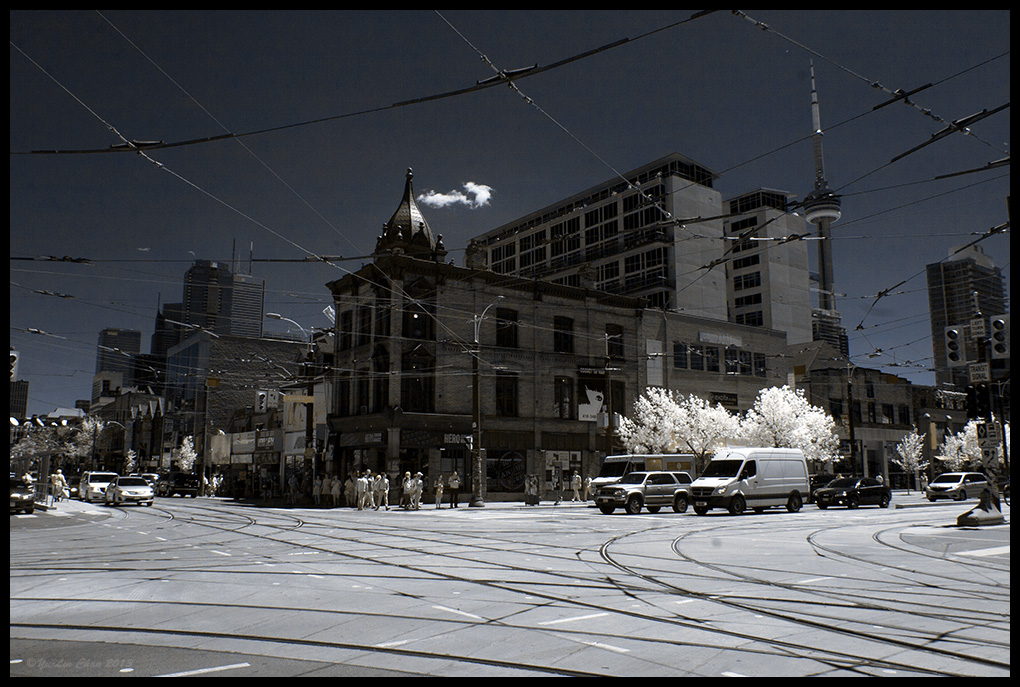
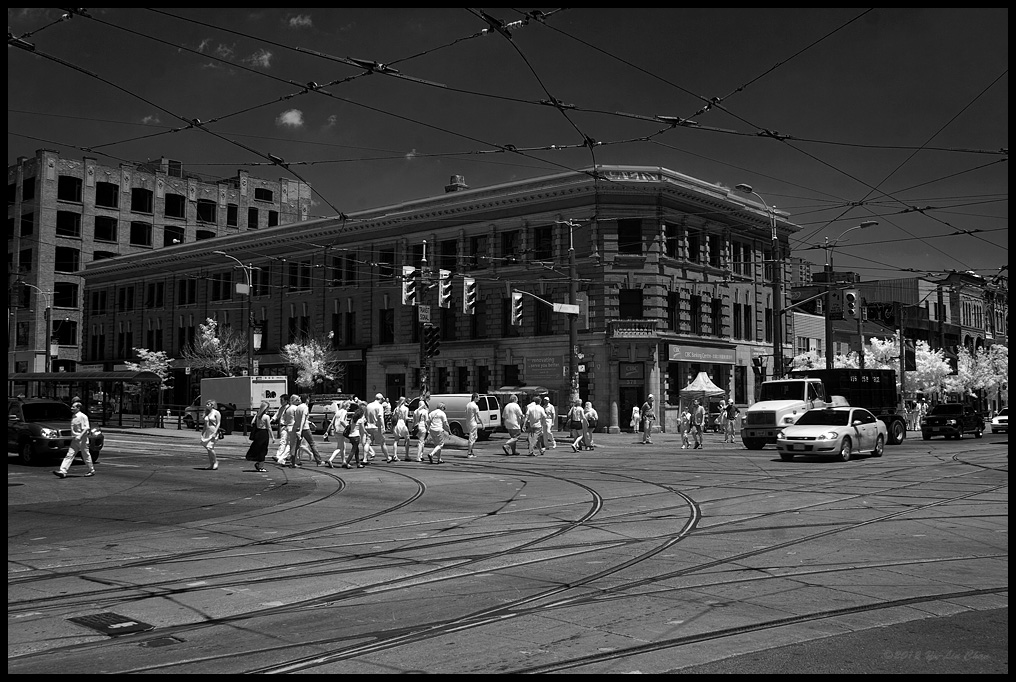
Showing posts with label Infrared Photography. Show all posts

Thursday, July 17, 2014

Another Infrared Picture Set

I wanted a different place to take pictures yesterday so I ventured out further west on my bike and stopped at Ontario Place. Ontario Place was a great amusement park when it opened some 40 years ago, but it has remained pretty much the same for four decades. Consequently, the number of visitors had been down each year and it was closed couple years ago. That's what happens when you become complacent. Not really sure what they are going to do; improve it? Get rid of it completely?

All pictures below were taken with the 20D & Pentax-M 20mm f4


Friday, June 13, 2014

Infrared Photo Set

Today was a beautiful day for Infrared pictures. I have been practicing taking close up pictures in Infrared. Due to focus shift, it's not as easy as one might think, if you don't have an infrared camera with live-view. This gets me thinking about getting a really cheap NEX or Micro 4/3 camera and convert it for infrared use. With live-view, I won't need to worry about getting the focus correctly. Unfortunately, the Infrared filter for the sensor is expensive, and even more so for the labour of conversion. The conversion could run into $500-$600. I guess I will just enjoy what I have, at least for the foreseeable future.

All pictures below taken with Infrared converted Canon 20D and Pentax-M 20mm f4.


Monday, May 12, 2014

Sugar Beach in Infrared with Pentax-M 28mm f2.8

I recently acquired a very cheap Pentax-M 28mm f2.8. There are many variations of this lens in the Pentax family, and I was especially interested in comparing it to the Pentax-K 28mm f3.5 which I have for a while, but hardly used.  But that has to come later.  I put this lens on the Infrared modified Canon 20D ran through a few dozen frames and like most Pentax primes, it's an excellent performer; I was not disappointed.  The Pentax-M 20mm f4, which I used pretty much exclusively on the 20D IR camera, is extremely sharp, but pictures coming out of the Pentax-M 28mm f2.8 is indistinguishable from the 20mm f4, except the angle of view of course.  Judging from memory, it's on par, if not better than the K28mm f3.5. Very nice lens indeed, and the best part is that this lens is reasonably cheap.

All pictures below were taken with Canon 20D IR and Pentax-M 28mm f2.8 at around f8-f11.


Thursday, September 12, 2013

For Paul

If you frequented the old Henry's Outlet Store on  Queen, you probably know Paul. Paul is one of those rare people who are genuinely nice, and always eager to help others. I have known Paul for many years, and he is the huge part of the reason I have so many old and sometimes weird lenses. As a matter of fact, without Paul, I probably would not have this blog to write about old lenses.

Paul - Photo by Prof. Robert Hudyma

Paul is a big Pentax fan, second only to his love of Zeiss glass. He shot various Spotmatics and Pentax lenses over the years; often with a wide angle, but sometimes with a Takumar 300mm f4. His last known camera was a Pentax MV with a 24mm lens. Paul loves film. He has a large collection of Kodak Chromes he shot back in his youth, and I had an opportunity to view some of them; they are marvelous. 1/125 f8, as he would like to say.

Pauls also likes infrared pictures, especially with the Pentax-M 20mm f4. He asked me to post more yesterday, so I shot some more today. For Paul. I hope he likes them.

All pictures below were shot with a Canon 20D IR modified, and the Pentax-M 20mm f4 at f8 and f11.

Misty morning

Entertainment in the park

A view to the lake

Picnic Table

Sail Boats


Thursday, August 29, 2013

Pentax-M 20mm f4 - Infrared Photo Set

Today is a perfect day for infrared photography.  As usual, my preferred lens for IR is the Pentax-M 20mm f4. This lens could be very bad with distortion if not careful, but I find it to be excellent on the APS-C cameras. The signature of this lens is its sharpness, especially on the low density sensors like the Canon 20D. The images captured by this lens has excellent definition. This is one of my favourite K-mount lenses.

All photos below were taken with the Canon 20D IR & Pentax-M 20mm f4.


Sunday, August 11, 2013

Zeiss Distagon 55mm f1.4 - The Best 55mm Lens in the World?

Since the introduction of the Zeiss Distagon 55mm f1.4 lens, the net is abuzz. Some love it, many question the purpose of such product, and yet others love it but hate the price.  For those who are negative toward the (seemingly) amazing lens, I question why.  If we only produce "good enough" products that most people can afford, the world will be filled with mediocre products. Without these best of the breed products, produced where money is no object, we would not know how far we can go. Sure, most of us will not be able to afford the new lens, but there is a chance that we could afford a used one later on.

The Canon EF 200mm f1.8L is one of the best lenses in the world. It was created to showcase Canon's technical prowess in lens design. Even by today's standards, it's still one of the best, certainly still the world's faster autofocus 200mm lens. I would not have been able to afford it when it was new, but I was able to buy one used. Canon never sold many of these lenses and I am not even sure it they made a profit from this lens, if you factor in the time it took to design and the tools needed to make it. But, I am glad they made it.

Still, many lambasted Zeiss for making such an expensive lens and it won't even autofocus. I am glad they made it a manual focus lens. Every time I think of the EF 200mm f1.8L lens sitting here, and cannot be fixed due to parts shortage, I wish the lens was a manual focus lens; manual focus lenses have a much longer service life. Some of my manual focus lenses are more than 50 years old and they still work wonderfully like the day they were made.

So Zeiss, bring us more lenses that are the best of the best.

Looking South of Yonge Street - Canon 20D IR & Pentax-M 20mm f4 @ f8

Saturday, July 13, 2013

More Infrared Pictures

I surprised myself this year by taking so many infrared pictures with the modified 20D. Last year I was contemplating selling it, as I was not using it much. I am liking it more when the pictures were converted into black and white. With some subjects that do not have planation in them, they look just like ordinary black and white pictures, but with trees and grass, etc, the pictures take on a whole different look and I really like that. Again, the Pentax-M 20mm f4 is still the best lens for IR on my 20D. Wide enough but not so much that makes composition difficult, and it's sharp as a tack.

Abandoned Railroad Tracks - Canon 20D IR & Pentax-M 20mm f4. Click for larger.

Tall Ship & Sailboat - Canon 20D IR & Pentax-M 20mm f4. Click for larger.

Sailboat  - Canon 20D IR & Pentax-M 20mm f4

Monday, June 3, 2013

Infrared Black & White Photo Set

I got tired of false colour infrared pictures, so I decided to do a series of pictures in black and white. The infrared filter used in my Canon 20D is not the deep black type, and it allows some false colour to go through. I normally like some false colours in IR but I think a change once in a while is good.          

Captain John's - Canon 20D IR & Pentax-M 20mm f4 @ f8. Click for larger.

Truck - Canon 20D IR & Pentax-M 20mm f4 @ f8. Click for larger.

Air Plane & Boat - Canon 20D IR & Pentax-M 20mm f4. Click for larger.

Shadows - Canon 20D IR & Pentax-M 20mm f4


Saturday, May 18, 2013

Tamron SP 17mm f3.5 - Infrared Photo Set

This is probably the last set of infrared pictures from the Spadina & Queen area, taken the day before my last day of work at lunch time.

I wanted to experiment with different wide angle lenses for IR photography other than the Pentax-M 20mm f4 lens I almost exclusively used before. Last time I tried the Flektogon 35mm f2.8 with good results, and I decided to try my widest manual focus lens - the Tamron SP 17mm f3.5. As it turned out, it wasn't bad at all. I was afraid I could not get infinity focus, but with aperture set at f8-f11, it was fine. What I really should have done, is try the Canon FD 20mm f4 against the Pentax-M 20mm f4, but there is always the next time.

The Tamron SP 17mm f3.5 is not as sharp the Pentax-M 20mm f4, especially at the edges, but it's a much wider angle therefore not a fair comparison.

The Hug Me Tree 2013 - Canon 20D IR & Tamron SP 17mm f3.5 Adaptall. Click for larger.

Spadina & Queen 2013 - Canon 20D IR & Tamron SP 17mm f3.5 Adaptall. Click for larger.

Grange Park - Canon 20D IR & Tamron SP 17mm f3.5 Adaptall. 

Tree outside Umbra building - Canon 20D IR & Tamron SP 17mm f3.5 Adaptall. 

Monday, May 6, 2013

Infrared Photography with Carl Zeiss Jena Flektogon 35mm f2.8

So far, most of my infrared photography was done with the Pentax-M 20mm f4 lens, and mostly at infinity. The reason is because with infrared photography, what you see focused in the viewfinder is not what is actually focused in the image, because the viewfinder is calibrated for visible light and focus point for infrared is not the same as visible light . This combo works perfectly when I set it to infinity focus.

But, it's time to try other lenses and different kinds of pictures. I picked the Flektogon 35mm f2.8, for no particular reason. Only because it was already there with the adapter on. I tried some pictures with close focus. Close focus is always a hit and miss with infrared, especially with large aperture settings. I use focus bracketing to at least get one or two pictures in focus; take a series of pictures with slightly different focus points. The results turned out quite satisfactory.

Kaiser's Crown - Canon 20D IR & Carl Zeiss Jena Flektogon 35mm f2.8 @ f2.8. Click for larger.

Leslie Groove Park - Canon 20D IR & Carl Zeiss Jena Flektogon 35mm f2.8. Click for larger.

Kaiser's Crown - Canon 20D IR & Carl Zeiss Jena Flektogon 35mm f2.8.

Reading in the park - Canon 20D IR & Carl Zeiss Jena Flektogon 35mm f2.8 

Tuesday, April 30, 2013

Infrared Photography - Restarted

I felt really guilty about the Infrared modified Canon 20D not being used much, so I intend to change that this year and take it out more often, perhaps even with different lenses. Currently, the Pentax-M 20mm f4 has been used on the 20D almost exclusively. I would like to try the Tamron SP 17mm f3.5 and other wide angle lenses on it and see if I can get different looks.

IR photography has fascinated me with its eerie, surreal quality, and false colours. I don't like the deep infrared pictures that do not show any false colours as much. The problem with IR pictures is that after you see them for a while, the pictures have the sameness to them. I am hoping I will learn alternative processing methods to make them look more unique.

All the pictures below were taken with the IR modified Canon 20D and the Pentax-M 20mm f4.


Wednesday, January 16, 2013

Current State of Lens Adapters

It has been almost eight years since I started using manual focus lenses on my digital SLRs; longer than most people.  Back then, adapters were expensive, even for a Canon EOS-M42, which cost around $50 to $60, and now can be had for under $5.  But I was happy to pay the price, because at least someone was willing to produce these adapters so that wonderful old lenses could have a second life.

With more companies getting into the lens adapter business, adapters are getting better and more sophisticated; they are getting smart too.  Old adapters were purely mechanical and there was no electronic linkage between adapter and camera, but that has changed.  First we had the EOS-NEX adapter by Metabones, that allows the NEX camera to control aperture of Canon EF lenses from the NEX camera.  Since then, various Chinese adapter makers introduced their own, with image stabilization and AF support.  They are also readying the Contax-G rangefinder to NEX adapter that allows auto focus.

The latest, and the best news, is the Metabones SpeedBooster adapters that makes full frame lenses behave the same on NEX or M4/3 cameras by angle reduction.  It behaves the opposite of lens extenders, with an added benefit of increasing the maximum aperture by one stop.  So, your EF 24mm f1.4 will have basically have the same angle of view on the NEX camera, but at f1.0 instead. The optical lens in the adapter was designed by the very well known Dr. Brian Caldwell.  So, all is well, right?  Yes and no.  The price is very steep.  Yup, $600 for the adapter.  Unlike mechanical adapters that can be copied/cloned, the optics in the adapter is pretty hard to copy without being sued.  So, don't expect the price of this great adapter to get cheaper any time soon.

Cherry Blossom in Infrared - Canon 20D IR & Pentax-M 20mm f4.

Thursday, June 21, 2012

Photo Essay: Around My Work Place in Infrared - Part II

This is the second part of a three part series on Infrared around my work place.  Today I headed west toward Bathurst on Queen street.  As always, this is a very busy section of the city, especially at lunch time in a nice day like today, when many people just wanted to go out for lunch and enjoy the weather.

I started from Spadina & Queen.  This intersection is one of the busiest in the area, partly because many people get on or off here from streetcars.

Spadina & Queen North East Corner -- Canon 20D IR & Penatx-M 20mm f4. Click for larger.

Hot Dog Stand -- Canon 20D IR & Pentax-M 20mm f4.

In the picture above, the same hot dog stand has been here for many years in this spot.  It opens 24 hours.  It almost becomes a fixture at the north east corner.  On the left of the picture, you can see my colleague Mark, with a camera on his right hand.  If you like street photography, you will love Mark's pictures on Flickr.  Mark is a collector and user of vintage cameras/lenses.

Trees -- Canon 20D IR & Pentax-M 20mm f4. Click for larger.

Even with a very ordinary and boring street scene, infrared makes it look different and interesting, and the false colours adds some weirdness to it.

St. Stanislau R. C. Church -- Canon 20D IR & Pentax-M 20mm f4.