Friday, April 27, 2012

Helicoid with Aperture Setting

Blossoms -- Schneider-Kreuznach Procolar 60mm Projection Lens

I have a Pentax-M 50mm f2 lens which has defective optics.  I mean it was probably repaired and got the glasses in the wrong order and it produced some weird looking images.  So, it's as good as useless.  I decided to make it into a helicoid by removing the glass elements from the lens.

It was quite easy to remove the elements, but the mount turned out to be much harder.  For some reason, the screws are really tight and I couldn't unscrew any of them without stripping the head.  My original plan was to replaced the Pentax K mount with a Sony E-Mount by using a 52mm reversing ring (E-Mount).  For the time being, it will have to be a K-Mount until I can get those screws off.

There are at least two projection lenses that can benefit from this helicoid: the Schneider-Kreuznach Procolar 60mm and the Leitz Hektor 120mm f2.5.  Tried them both and the results are fantastic, especially the Hektor; it's much sharper stopped down a bit.  Will post some pictures of the helicoid once I get the Sony E-Mount on it.


Thursday, April 26, 2012

Tessar Battle: Industar 50mm f3.5 vs Carl Zeiss Jena Tessar 5cm f3.5

These two lenses are very small, but the Industar 50mm f3.5 is even smaller than the CZJ 5cm f3.5.  It's tiny!  Both lenses are based on the same optical design and have same maximum aperture of f3.5 and both have circular aperture.  The Russian lens is in M42 mount while the German lens is Exakta.  I used both only a couple of times so I really don't have much experience with them yet, but I like the pictures from them.

I believe these lenses were first designed as rangefinder lenses and later added other mounts, but that doesn't matter.  Let's look at how they perform against each other.  Please note that this is a very UNSCIENTIFIC test.  No tripod, no cable release.  All pictures were shot handheld with the optional viewfinder on the NEX-5N.  So, take everything with a pinch of salt.

Industar 50mm f3.5 on the left, CZJ Tessar 5cm f3.5 on the right.


Getting Close Wide Open

The Industar 50mm f3.5 has a minimum focus distance of 0.65m, while the CZJ 5cm f3.5 has 0.7m.  So close we can ignore the difference.  Not a lens for close-ups for sure.

The pictures below are processed identically, and shown at 100% crop. You can see the colour is slightly warmer and more intense on the Industar.  I think it's a tiny bit sharper too.


Bokeh - Who has the the prettier picture?

Before the test, I assume the bokeh would be similar to both lenses, since they share the same design and have circular apertures.  I think they are pretty close, but you be the judge.

CZJ 5cm f3.5 @ f3.5

Industar 50mm f3.5 @ f3.5


Sharpness - Who Wins?

Most people's main criteria when looking for a lens, but there is more to a lens than just sharpness.  In any case, the Industar seems like the sharper one at the same aperture, just by a hair, but noticeable.

Carl Zeiss Jena 5cm f3.5 @ f8. Click for 100% crop.

Industar 50mm f3.5 @ f8. Click for 100% crop.

No doubt the Carl Zeiss Jena is better build and feels nicer in the hand and is focuses smoother.  But, both lenses are so close image quality.

Wednesday, April 25, 2012

Vivitar 35mm f2.8 - First Look

Vivitar made a lot of great lenses at its peak, with high prices to match, but they also made a lot of affordable ones, like this 35mm f2.8 (OM Mount).  This particular version was manufactured by Tokina (serial code starts with 37) with a 52mm filter size.

The copy I have is not in great condition.  You can see the separation is starting at the edges with bubble like, small white dots.  It should not effect the pictures though.  The lens is cosmetically very clean and looks like it was not abused at all.

Metrocentre -- NEX-5N & Vivitar 35mm f2.8 [OM] @ f8

At around f8, the far edges still show some softness, but center sharpness is very good.  It lacks the microcontrast of the very good/expensive lenses, but it's optically quite competent. Wide open you can also see some softness, which is quite normal for inexpensive consumer lenses, but the centre is still quite good.

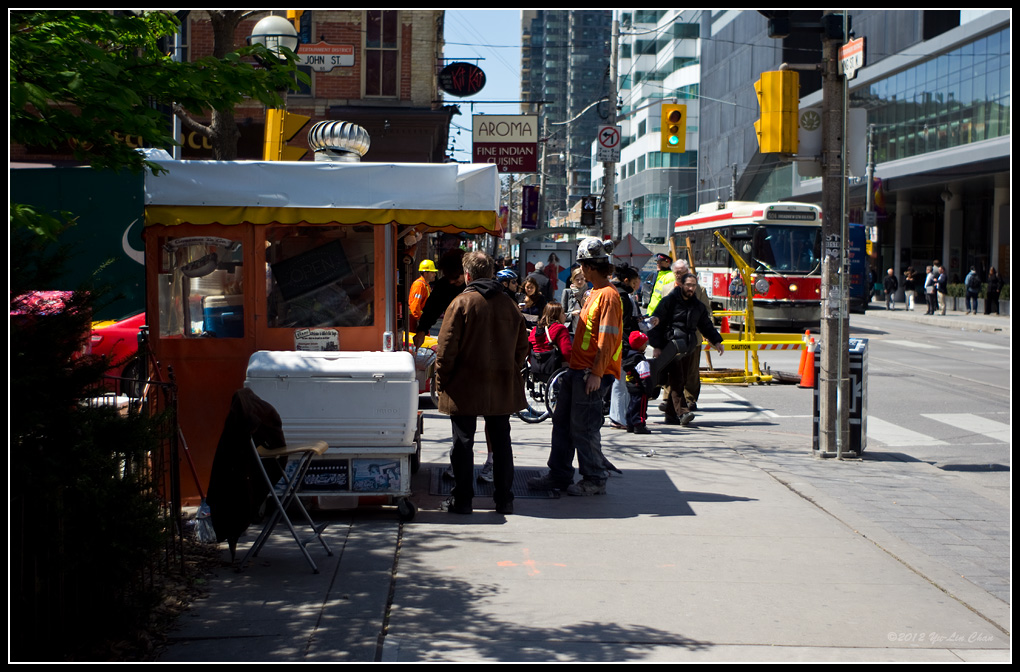
Hot Dog Vendor -- NEX-5N & Vivitar 35mm f2.8 [OM] @ f2.8

For a cheap lens, the build quality is excellent.  It focuses very smoothly and the focusing ring is well damped and very enjoyable to use.  The 8-blade aperture is a nice touch that no doubt helps with a  nicer looking bokeh, which i find not objectionable at all.  Surely not the best looking bokeh either.

Yellow Tulips -- NEX-5N & Vivitar 35mm f2.8 [OM]

I think this is a nice lens to have.  For sure, there are better 35mm lenses out there, and many are faster, but at what cost?  This lens should be quite cheap and therefore good value for the money.

Tuesday, April 24, 2012

Sony Customer Service

Seeing Purple -- NEX-5N & Voigtlander Skopar 8.3cm f4.5 (from a folding camera)

I received the EVF from Sony today.  About a week ago I dropped off the defective one at the Sony Services.  A big surprise when I opened the package: a brand new FDA-EV1S viewfinder!  I guess they either couldn't fix the bad one, or not worth their while to do so.  In any case, I am very happy.  Tried it on the NEX-5N and it looks so beautiful, without the mind altering distortion of the defective one.  The week that I was without the EVF, I really missed it.  Without it, focusing is just not as accurate.

I am extremely happy with the Sony service, as with the Panasonic service.  I used the Sony service twice and in both counts I was treated nicely and the service was done very promptly.  Can't say the same for Canon, unfortunately.  I have been a decade long Canon user, but I have never been completely satisfied with their service.  Companies that provide excellent service deserve our business.

I will write up a post on the EVF at the end of the week, with my experience.

By the way, I have completely solved the flare/white out issue with the Voigtlander 8.3cm f4.5 lens.  No longer do I have to worry about which way I need to shoot to avoid the flare and it's a great feeling.  I will create a separate post on how to get the most out of the old lenses.

Toronto Chinese Baptist Church -- NEX-5N & Voigtlander Skopar 8.3cm f4.5.


Monday, April 23, 2012

Eeewww! That's Ugly!

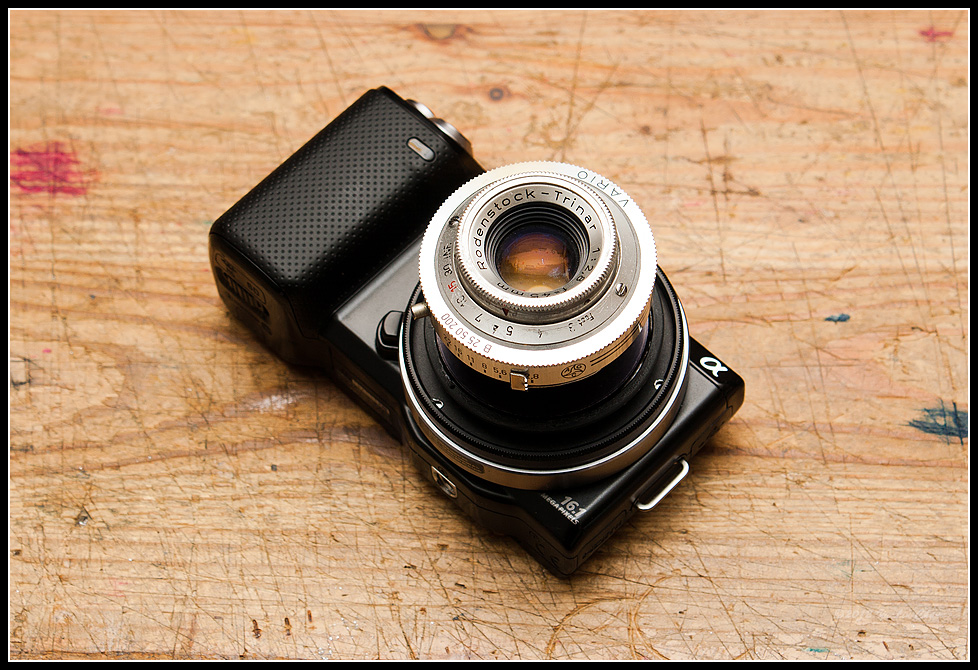
I have been pulling my hair, trying to get this Rodenstock Trinar 45mm f2.8 Rangefinder lens to work on the NEX-5N, but I just couldn't find the right parts to do it, until yesterday when I found a weird part with a Henry's Outlet Store sticker on it!  Another FrankenLens was born.

A real beaut, eh?

This is the first rangefinder lens that I have adapted to NEX.  I was hoping the lens would have a very short flange focal distance, but alas, it's just not be!  The lens is almost like an SLR lens in terms of flange distance.  Anyway, it's a good experience, and the lens is very tiny, though it looks very ugly when mounted on the NEX-5N.  The lens itself is quite nice.  Very sharp at f2.8.  Too bad this afternoon it was raining and I only managed to snapped a few pictures.  I little hood I put on was not long enough, as you can see some hazy spots near the building and tree of the image below.

Black Bull -- NEX-5N & Rodenstock Trinar 45mm f2.8 @ f2.8

The focus travel is rather limited and the minimum focus distance is a very long three feet, common with rangefinder lenses but makes any kind of close up impossible without aids.  Hopefully I will have more chance to use it later on.

Tulip -- NEX-5N & Rodenstock Trinar 45mm f2.8 @ f2.8

Sunday, April 22, 2012

Can't Resist Those Colours

You must forgive me for the many recent flower pictures.  You see, after the blahs and gray colours of winter, one can't help but get excited by the beautiful colours of flowers that are flourishing right now.

Yellow Daisies -- NEX-5N & Steihnheil Culminar 85mm f2.8. Click for larger size.

I noticed that I have been using a lot of Exakta mount lenses, thanks to the NEX-5N.  I tried them on the Canon bodies, but they just couldn't be focused to infinity, due to the imprecise adapters.  So, they were mostly retired to boxes somewhere in the house.  But, they are slowly finding a new photographic life on the NEX system.

Unknown (to me) plant -- NEX-5N & Steinheil Culminar 85mm f2.8. Click for larger size.

Saturday, April 21, 2012

Converting the JML 50mm f0.95 C-Mount Lens to NEX E-Mount

I received a few inquiries regarding the conversion of the JML 50mm f0.95 lens to Sony E-Mount or M4/3 Mount.  I wrote a post about it here, but I guess it was not very clear.  So this time, I will do a second attempt, and hopefully it will be better than the last post.

This JML 50mm f0.95 is an OEM lens, or a very generic design, which means there are other companies selling this lens with their own names on it, or make it with the same design.  The Canon 50mm f0.95 TV lens is probably the same design too.  I think Navitar 50mm f0.95 is closer to the JML in design.  This lens is frequently used in machine vision as well as a very low light TV lens.  Mine was used as a machine vision lens, according to its previous owner.

As the way it is, this lens will not focus to infinity on either M4/3 or NEX through the c-mount adapter.  The reason is that the lens barrel is too large to go into the recess area of the c-mount adapter.  As we know, the c-mount flange lens distance is even shorter than the NEX, at 17.52mm.  And the reason most c-mount lenses work on M4/3 and NEX is because the rear element of the c-mount lens actually goes deep inside the mount and very close to the sensor.  It works because there is no mirror gets in the way. Now, if the lens has a large barrel, you can not screw the c-mount lens all the way in, because the lens barrel would be blocked by the outer rim of the c-mount adapter.  Unmodified, the JML 50mm f0.95 would focus to about 2 meters on the NEX, so I decided to modify the lens mount and convert it to a native E-Mount.

Fortunately, the JML (and possibly the Navitar) 50mm f0.95 has removable mount.  A retention ring presses on the flat area of the c-mount and keeps in place. The picture below shows the three parts.  Please note that the second part where it is supposed to be just a ring, already has the c-mount adapter glued to it.  I don't have a picture of the naked ring.  Sorry.

The c-mount removed from the lens.  

It is quite easy to convert the lens to either a M4/3 or NEX mount.  I did it for M4/3 but changed it to NEX mount, because I use it more on the NEX.  However, care must be taken to ensure the conversion does not affect the image quality.  


The idea is to glue the c-mount to NEX or M4/3 adapter onto the retention ring.

What you will need:

A c-mount to NEX or c-mount to M4/3
Very strong glue
A large area file
Fine grit sand paper

Depending on what kind of c-mount adapter you use, the thickness of the rim might be different.  Most of them would be probably too thick and if you just glue it on, you won't be able to focus to infinity.  Try it on first and see how much you need to file the adapter to make it thinner.  The picture below shows the c-mount adapter I used for the M4/3:

Filed c-mount to M4/3 adapter.

I didn't have to file too much on the adapter rim.  The critical thing is that the surface of the mount must be very flat, or you will get uneven sharpness in your pictures.  I first file the adapter with a large file, and then sand it by moving it around a large fine grit sand paper with the force on the center of the mount for even sanding, until it's thickness is enough to attend infinity focus.  Once it's thin enough, just glue it on, like below:

Adapter glued on the retention ring.

A word about the glue.  I used Gorilla glue, instead of something more permanent like JB Weld or JB Kwik, because I want to be able to revert to its original mount if I need it later.  Although the Gorilla glue is very strong, it can be forced apart with a very sharp blade (I tried boiling water but that didn't do anything).  You could also try heating it up, but that may damage the retention ring.  It is strong enough to hold everything together without worrying it will snap in two.  So far, mine is holding up very well and I am not worried when using the lens.  Keep in mind that if you do use Gorilla glue, it expands as it sets.  After applying the glue, put something VERY heavy on to keep it from moving the adapter/retention ring.

If you want to permanently convert it, I would suggest using JB Weld or JB Kwik.  These compounds will harden into something as strong as steel.  Once cured, you can not easily separate the retention ring and the c-mount adapter without filing.  So be sure you know what  you want to do.

Completed conversion 

I hope this version is more clear and easier to understand the last one.  If you have any questions, please do ask.  Don't be afraid to experiment.  I am not particularly good at this kind of thing, but it worked out OK for me.  Sometimes, we are forced to do this ourselves, because there is nobody else do to it for us.

Friday, April 20, 2012

The Fascination with Old Lenses

Daffodil - NEX-5N & Meyer-Optik Gorlitz Primoplan 58mm f1.9. Very interesting bokeh.

Sometimes I am amazed at my persistence with old lenses after so many years.  I thought I would be bored after a little while, but the opposite is true.  I am MORE into old lenses than I ever was.  Not really sure if this is a good thing or not, but at least something to keep me occupied.

What is it that so fascinates me with old lenses?  I tried to answer that, but not with satisfying answers, and I don't even bother with it any more.  I just know that old lenses bring me joy and that's enough for me.

Thursday, April 19, 2012

Kodak Enlarging Ektar 100mm f4.5 Sample Pictures


Red & Yellow - NEX-5N & Kodak Enlarging Ektar 100mm f4.5. Click for larger.

I have not used enlarging lenses to take pictures for a little while, so I took out the little used Kodak 100mm f4.5 Enlarging Ektar lens and mounted it on the Vivitar 2X Macro Focusing Teleconverter modified helicoid, and gave it a go on my lunch break.  Most older enlarging lenses have circular aperture, which gives a very nice round shape at any given aperture setting and this lens has it too.

Used this last time and I didn't have a good experience, but than I learned that nearly all enlarging lenses need to be properly shielded when used outside, sunny or not, or the pictures will come out all washed out/foggy with no contrast.  You can make an easy lens shade by using black craft paper rolled to the size required, and tape it.  Easy and effective. I used a piece of tubing from one of the lenses I took a part as a hood and it works very well.  The hood was secured by the trusty electrical tape.

This lens is not very contrasty wide open, but is quite sharp, once proper shielding is used.  Stop down a little and it improves quite a bit.  I find that it creates very nice bokeh too.  Very enjoyable lens to use.

As a side note, I  found a little 50mm f4 enlarging lens with 4 aperture blades that gives a square aperture!  I think it's a Schneider, but could be a Rodenstock.  It's too small and won't fit the normal L39 thread.  Need to find a way to mount it on the helicoid.  I think it would be interesting to see what the bokeh would look like.

Magnolia -- NEX-5N & Kodak Enlarging Ektar 100mm f4.5. 

Wednesday, April 18, 2012

A Cheap Wide Angle Lens - Sicor 23mm f3.5 [MD]

Back in the old days, there are more of everything.  More computer companies that make different and incompatible computers, and more lens brands.  You could have five or six different labels on the same lens.  Case in point, Sicor 23mm f3.5, which also sold by Soligor, Prinz, Hanimex, Elicar, and possibly others, with their own names on it.  I only used this Sicor 23mm f3.5 once, here, and I didn't much like the results from the G1, though it was passable as a no name lens.  23mm seems like an odd focal length for a lens, but then we also have 25mm, 29mm, 31mm, so it's not rare.  I am sure, if anyone cares to measure it, this 23mm lens is probably close to 24mm.

Kaiser's Clown -- NEX-5N & Sicor 23mm f3.5. Click for larger size.

So I decided to take it out and try it on the NEX-5N.  It seem like some lenses work better on different cameras.  Indeed, this is true for this lens.  On the NEX-5N, pictures seem to come out better, sharper, though the edges are still lackluster, but as you can see the picture above, which was shot at f3.5 wide open, it's quite OK in the center of the image.  Stopping down to around f11 improves the edges, but still not as sharp as the center.  Bokeh is kind of funky and not to my liking, but your mileage may vary.

The Georgin House -- NEX-5N & Sicor 23mm f3.5. Click for larger size.

I think if you print the pictures at 8x10, you probably won't be too critical of the edges, as the low resolution of the print would mask unsharpness, and you should be quite happy about it.  I mean, this lens usually sells for $20 to $40, so no one should expect top performance from it.  In truth, I think the kit lens will do better, except the distortion, but it's a very nicely built lens.  It has an usually large 62mm filter size.

Building -- NEX-5N & Sicor 23mm f3.5. Click for larger size.
  
My take?  I won't spend too much for it.  There are far better wide angle lenses at 24mm for not too much money.  For example, Tokina RMC 24mm f2.8, Vivitar 24mm f2.8 are good choices.  Unless, of course, you can get one for the cost of a cheap lunch, by all means buy one, if only for the somewhat usual focal length of 23mm.